
US deploys 3rd aircraft carrier to West Asia after laundry room fire
 3 Min Read
The US deploys the USS George H.W. Bush to West Asia amid the continued war on Iran, while the USS Gerald R. Ford docks for further repairs in Europe.
-
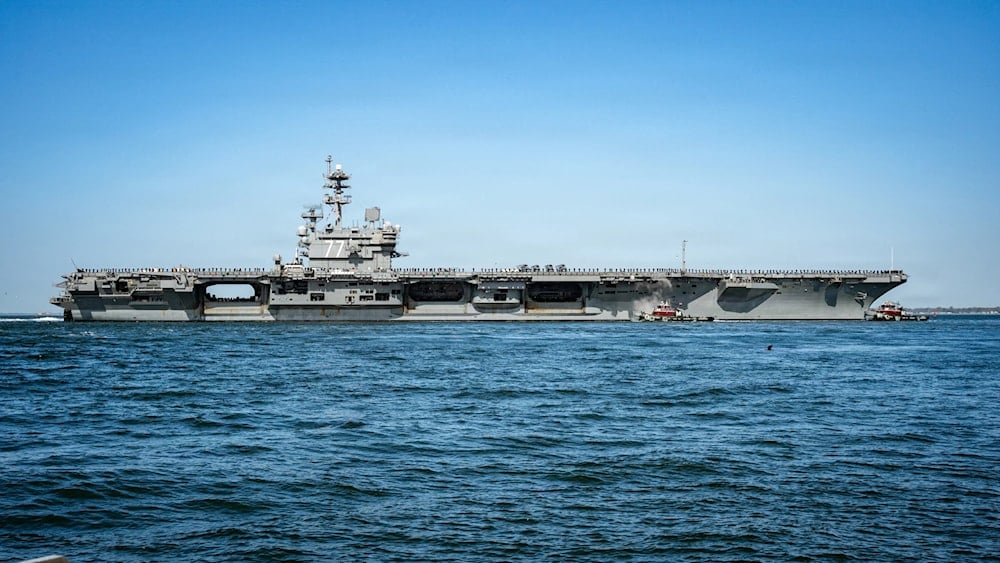
The USS George H.W. Bush departs Naval Station Norfolk, Virginia, to begin operations in support of its scheduled deployment, on March 31, 2026 (US Navy)
The United States is deploying additional military assets in West Asia, with a third aircraft carrier set to join its floundering naval force as Washington weighs further escalation against Iran.
According to US officials, the USS George H.W. Bush carrier strike group has departed Naval Station Norfolk and is en route to the region, where it will join the USS Abraham Lincoln and the USS Gerald R. Ford. The move could leave the US operating three aircraft carriers simultaneously in West Asia for an extended period.
The Pentagon has not disclosed details about future operations, but the deployment comes as US President Donald Trump considers expanded aggression against Iran, alongside a broader influx of American troops into the region. A Marine expeditionary unit aboard amphibious warships has already entered Middle Eastern waters in recent days.
Ford carrier fire raise questions
The reinforcement effort coincides with mounting scrutiny over the operational readiness of the USS Gerald R. Ford, the newest and largest US aircraft carrier.
On March 28, the vessel docked in Split, Croatia, for maintenance following months of deployment in what US officials describe as operations linked to confrontation with Iran. Prior to arriving in Croatia, the carrier had been operating in the Red Sea as part of a joint US-Israeli aggression on Iran. US officials attributed the ship’s withdrawal to a fire that broke out on March 12 in a laundry facility, reportedly injuring three sailors and exposing nearly 200 others to smoke inhalation. Around 100 sleeping berths were also destroyed, forcing the ship to dock.
However, Iran’s Islamic Revolution Guard Corps (IRGC) publicly challenged the US account, dismissing it as implausible and framing the withdrawal as evidence of deeper structural weaknesses. The IRGC described the incident as a “humiliating” retreat, arguing that Washington is masking operational setbacks under the guise of technical malfunctions.
Technical strain and extended deployment
The Ford’s stop in Croatia follows an earlier visit to Souda Bay in Crete, as the US naval command attempts to address both the reported fire damage and a series of persistent technical issues, including plumbing failures that have affected onboard systems.
The carrier has been deployed for approximately nine months, one of the longest recent deployments for a US warship, raising further questions about sustainability and readiness during prolonged operations.
Read more: Iran has 'no air defense whatsoever' but scored world's first F-35 hit


