
US disguised warplane as 'civilian' in deadly Caribbean strike: NYT
 6 Min Read
A covert Pentagon operation that killed 11 people using a warplane disguised as civilian has prompted legal experts to warn that the Trump administration’s drug war tactics may violate the laws of war.
-
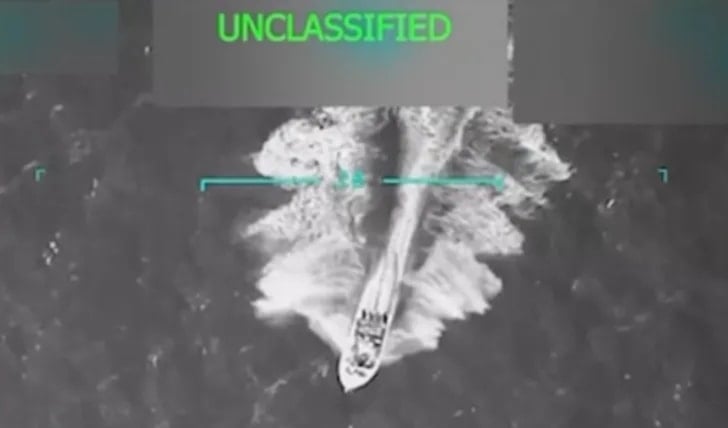
A screenshot from a video posted by the US President on social media showing a motor boat speeding across choppy water before it bursts into flames, September 2025. (@Donald Trump/Truth Social)
The Pentagon carried out its first lethal strike on an alleged drug-smuggling boat using a classified aircraft designed to resemble a civilian plane, killing 11 people last September, The New York Times reported, citing officials familiar with the operation.
The aircraft was painted to appear non-military and concealed its weapons inside the fuselage, rather than mounting them visibly under its wings.
Legal experts say the aircraft’s civilian appearance is critical because the administration has justified the boat strikes as "lawful acts of war" after President Donald Trump declared the US to be in "an armed conflict with drug cartels."
Under the laws of armed conflict, however, combatants are prohibited from disguising themselves as civilians in order to deceive adversaries into lowering their guard before launching an attack. Such conduct constitutes perfidy, a recognized war crime.
Former military lawyers warn of potential war crime
Retired Maj. Gen. Steven J. Lepper, a former deputy judge advocate general of the US Air Force, said that if the aircraft was deliberately painted to conceal its military identity and approached close enough for those aboard the boat to see it, the strike could meet the legal threshold for perfidy.
“Shielding your identity is an element of perfidy,” Lepper stressed.
“If the aircraft flying above is not identifiable as a combatant aircraft, it should not be engaged in combatant activity,” he added.
Surveillance footage raises further questions
According to officials briefed on surveillance video, the aircraft descended low enough to be visible to the people on the boat. After spotting the plane, the vessel turned back toward Venezuela before the initial missile strike.
Two survivors later climbed onto an overturned section of the wreckage and were seen waving at the aircraft, officials said, before being killed in a second strike that sank the remains of the boat. It remains unclear whether they understood that the explosion had been caused by a missile.
Military later changed tactics
Following the September operation, the military reportedly switched to using clearly identifiable military aircraft, including MQ-9 Reaper drones, for subsequent boat strikes. It is unclear whether those aircraft were visible to the targets.
In an October strike, two survivors swam away from the wreckage after the initial blast and avoided a follow-up attack. US forces later detained the men and returned them to Colombia and Ecuador.
US military doctrine addresses perfidy in detail. Manuals define it as a situation in which a combatant feigns civilian status, causing an adversary to “neglect to take precautions which are otherwise necessary.”
A US Navy handbook emphasizes that lawful naval operations must occur “within the bounds of military honor, particularly without resort to perfidy” and stresses a commander’s duty to clearly distinguish military forces from civilians.
Congress briefed privately, aircraft remains classified
Concerns about perfidy have been raised during closed-door congressional briefings, according to people familiar with the discussions. The issue has not been debated publicly because the aircraft remains classified.
Public attention has instead focused on the legality of the second strike, which killed the shipwrecked survivors, despite international prohibitions on targeting people who are no longer actively participating in hostilities.
The press office of US Special Operations Command, which oversaw the operation under Adm. Frank M. Bradley, declined to comment on the aircraft used, as per the report.
In a statement, the Pentagon said all weapons platforms undergo legal vetting.
“The US military utilizes a wide array of standard and nonstandard aircraft depending on mission requirements,” said Kingsley Wilson, the Pentagon’s press secretary.
“Prior to the fielding and employment of each aircraft, they go through a rigorous procurement process to ensure compliance with domestic law, department policies and regulations, and applicable international standards, including the law of armed conflict,” Wilson added.
Speculation over aircraft identity
Officials declined to identify the aircraft, confirming only that it lacked military markings and was not painted in standard military gray.
Plane-spotting enthusiasts posted images on Reddit in early September showing what appeared to be a modified Boeing 737, painted white with a blue stripe and no visible military insignia, at St. Croix airport in the US Virgin Islands.
While the aircraft’s transponder broadcast a military tail number, experts said that would not resolve concerns, as those on the boat would have had no way to detect the signal.
Among those dismissing the transponder argument was Todd Huntley, a retired Navy captain and former JAG who served with Joint Special Operations Command.
Huntley said such aircraft could be lawfully used in other contexts, such as hostage rescue missions where weapons might be carried for self-defense. But he said using them to conduct offensive strikes raises serious legal problems.
Legal oversight reportedly sidelined
The planning of the boat-strike campaign was kept tightly restricted, excluding many military lawyers and operational specialists who would typically review such missions.
Defense Secretary Pete Hegseth has also sought to limit the influence of military lawyers, including by removing senior JAG officials earlier this year.
The US military has killed at least 123 people in 35 boat attacks, including the September strike.
Numerous experts in the law governing the use of force argue that the operations are illegal, saying civilians suspected of crimes cannot be targeted absent an imminent threat.
The administration claims the killings are lawful because Trump designated the situation "a non-international armed conflict against 24 criminal gangs and drug cartels deemed terrorists."
That claim is widely contested, but it has intensified scrutiny of whether specific attacks violated the laws of war.
Perfidy applies even outside declared wars
Geoffrey Corn, a retired Army JAG officer and now a law professor at Texas Tech University, said he does not believe the September attack occurred within an armed conflict. Still, he noted that perfidy is prosecutable even in non-international conflicts.
Corn said the key legal question is intent.
“The critical question is whether there is a credible alternative reason for using an unmarked aircraft to conduct the attack other than exploiting apparent civilian status to gain some tactical advantage,” he stressed.
Read next: Trump to big oil: '$100bln for Venezuela, dealing with US' only


