
US-Israeli war on Iran aimed to derail Iran-Arab normalization: Lavrov
 4 Min Read
Russia’s Lavrov says the US-Israeli war on Iran was aimed at preventing Arab normalization and hints at BRICS disputes.
-
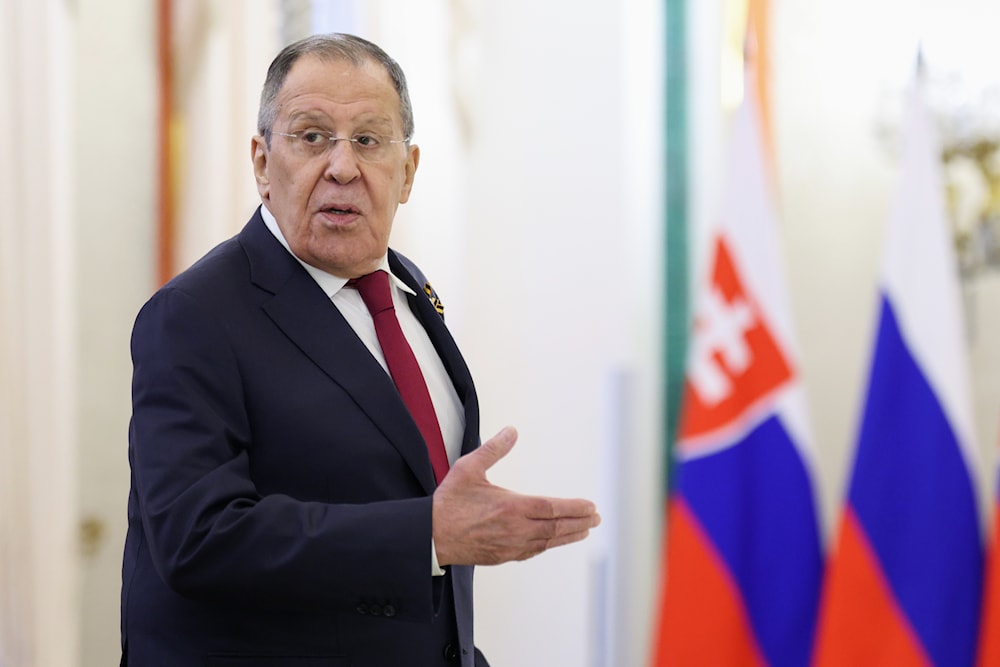
Russian Foreign Minister Sergey Lavrov attends a meeting between Russian President Vladimir Putin and Slovak Prime Minister Robert Fico at the Grand Kremlin Palace in Moscow, Saturday, May 9, 2026 (AP)
The US-Israeli war on Iran was aimed in part at preventing the normalization of Tehran’s relations with Arab states, Russian Foreign Minister Sergey Lavrov said Tuesday.
In an interview for RT India, Lavrov stated, “I have no doubt that when these plans of unleashing aggression against Iran were being hatched, one of the goals was to prevent the normalization of relations between Iran and Arabs."
This mirrors earlier pushes by Russia for Arab-Iran normalization. Russian Foreign Minister Sergey Lavrov said on May 8 during a phone call with Saudi Foreign Minister Prince Faisal bin Farhan Al Saud that efforts to normalize relations between Iran and Arab states should continue, according to a statement from the Russian Foreign Ministry.
During the call, both sides discussed the situation in the Middle East and stressed the importance of diplomatic engagement aimed at reducing tensions in the region. The talks also covered broader regional security concerns, including developments around the Gulf.
The Russian Foreign Ministry said the two ministers “expressed their position on the inadmissibility of a return to escalation” and supported continued political and diplomatic efforts involving regional stakeholders.
The statement also noted that both sides “emphasized the advisability of resuming efforts to comprehensively normalize relations between Iran and the Arab monarchies for the long term.”
Russia proposed BRICS statement on Hormuz
He also revealed that Russia had proposed a BRICS statement on the situation in the Strait of Hormuz, but that it was not adopted due to disagreements involving Iran and the UAE.
Russia proposed drafting a BRICS statement on the situation surrounding the Strait of Hormuz, but this did not happen due to irreconcilable differences between Iran and the UAE during negotiations, the top Russian diplomat said.
Moscow would likely have supported the proposal if India had suggested discussing this issue in substance at the meeting of the BRICS foreign ministers in New Delhi on May 14-15, he added.
Enormous damage to global energy if war expands to Bab al-Mandab
The Russian foreign minister further warned that if a conflict breaks out in the Bab al-Mandab Strait, which separates the Red Sea from the Arabian Sea, the global energy sector will suffer immeasurable damage.
"There is already talk that the Bab el-Mandeb Strait could become a theater of confrontation. In that case, the damage this would inflict on the global energy sector would be immeasurable," Lavrov told RT India.
Without the creation of Palestinian State, hotbet of tensions to prevail
When it comes to the Palestinian issue, the risk persists that it will smolder for decades if the "two-state solution" is not implemented, Lavrov added.
"I have no doubt that without the creation of the Palestinian State, we will keep a hotbed of extremism for many years to come. For decades, it will be a hotbed of tension that would bring suffering to everyone: to Israel, to its Arab neighbors, because Israel responds to extremism and terrorist actions, disproportionately it will be a perpetual mobile, a constant driver, an irritant that will foster the critical situation in its hot phase for many decades," he said.
Eurasia still has role in stabilizing global situation
In the same interview, Lavrov highlighted the geopolitical importance of Eurasia, saying: “I think it [the Eurasian continent] is unique in the fact that it is not only the largest and the richest continent, but it is also the continent of several great civilizations, Indian, Chinese, Persian, Ottoman, and Russian. Of course, this continent, well, I am taking a long path towards answering the question, this continent is to play a great role in the stabilization of the international situation."
He added that Russia, India, and China could play a role in fostering what he described as an inter-civilizational dialogue across the region.


