
US military presence in Gulf source of instability, not security: Iran
 4 Min Read
Iranian military officials say the US cannot guarantee regional security, urging Gulf states to rely on Iran and calling for the withdrawal of American forces.
-
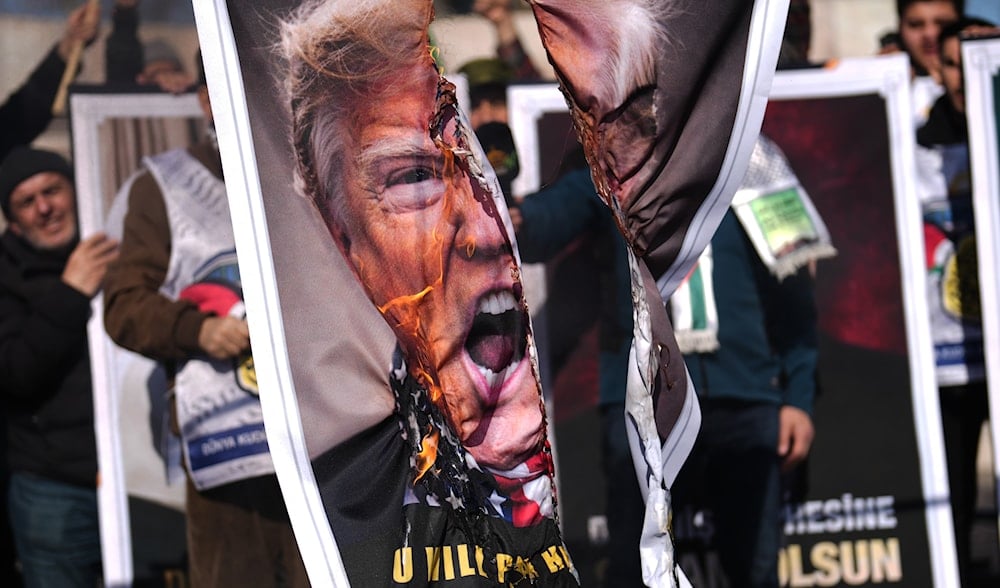
People burn a photograph of US President Donald Trump during a protest against "Israel" and the US, in Istanbul, Friday, March 13, 2026 (AP)
Iranian military officials have dismissed the United States’ ability to provide security in the region, calling its power "illusory" and urging regional countries to trust Iran instead.
The spokesperson for the Iranian Armed Forces, Brig. Gen. Abolfazl Shekarchi, asserted that the United States "cannot provide security for the countries of the region," urging regional states not to trust "the illusory American power."
Addressing countries in the region, Shekarchi said, "The United States cannot even defend its shaky army and will not be able to provide security for the countries of the region," calling instead for trust in Iran and its people and for efforts toward the unity of the Islamic world "against disbelief, polytheism, and hypocrisy spearheaded by the United States and the Israeli entity."
He added that Iran had successfully driven the largest US aircraft carrier, USS Abraham Lincoln, out of the region, after the United States "used to spread fear and plunder the region’s wealth in its name." Shekarchi continued, "The American carrier was put out of service by the power of the Iranian state and was forced to flee in a historic defeat."
Operations will continue until threats are eliminated: Brig. Gen. Talaei
In a related statement, the spokesperson for the Iranian Ministry of Defense, Brig. Gen. Reza Talaei affirmed that the Iranian Armed Forces would continue their operations "until the threats are eliminated, the enemy is severely punished, and compensation is obtained from it."
Speaking during the funeral ceremony of Martyr Nasirzadeh, Talaei said the enemy "is heading toward a dead end and is suffering a dilemma and a heavy defeat."
He emphasized that the Iranian Armed Forces will continue their operations "with strength and decisiveness," supported by the people and the leadership of the new Commander of the Armed Forces.
War will only end when 3 demands are achieved: Rezaei
Mohsen Rezaei, a member of Iran’s Expediency Discernment Council, said that the war on Iran would only truly end once Iran secures its demands from Washington. "The war is over when we first obtain all our compensations from the United States and second when we obtain a full guarantee for our future," he said, adding that such guarantees would be impossible "without the exit of the United States from the Gulf."
Rezaei further asserted that Iran currently holds the upper hand in the war, stating that "until this moment, Iran is the victor in the war and has broken the hegemony of the United States." He concluded by asserting that Iran’s regional standing will grow stronger after the war, saying that "Iran after the war will not be the same as before, and its standing in the region will be greater."
The top military official also stated that the Strait of Hormuz "will not be opened" and that "no American ship has the right to enter the Gulf." He argued that the American military presence in the region has been the primary cause of instability over the past five decades, stressing that "the American presence in the Gulf is the main reason for instability during the past fifty years."
He added that lasting regional security cannot be achieved while US forces remain in the Gulf, saying, "Security cannot be achieved except with the exit of the United States from the Gulf and the control of the Strait of Hormuz by the countries of the region." He also asserted that the course of the war remains in Iran’s hands, declaring that "the end of the war is in our hands."


