
US Navy jets, drones circle Cuba in sustained surveillance campaign
 4 Min Read
US Navy P-8A Poseidon aircraft and MQ-4C Triton drones have been conducting sustained surveillance missions near Cuba since 11 May, as Washington deploys the USS Nimitz.
-
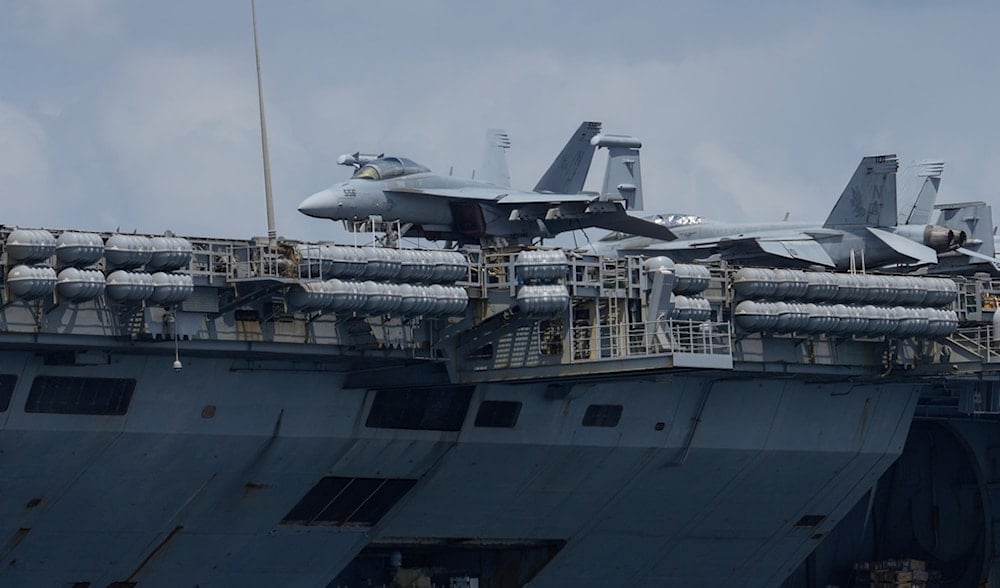
The US Navy aircraft carrier USS Nimitz docks in the Gulf of Panama, Monday, March 30, 2026. (AP Photo/Matias Delacroix)
The United States military has significantly stepped up surveillance operations near Cuba, deploying multiple P-8A Poseidon reconnaissance aircraft and MQ-4C Triton drones in what analysts say is a deliberate show of force as Washington intensifies its pressure campaign against Havana.
Flight-tracking data from Flightradar24 shows at least five US Navy P-8A Poseidon aircraft and three MQ-4C Triton drones conducting sustained espionage operations over the Caribbean Sea.
Some flights came within 50 miles of the island, with one Poseidon approaching southern Cuba on May 11 before returning to its base in Jacksonville, Florida. The following day, the same aircraft was tracked flying north of Havana.
By May 15, two MQ-4C Triton drones were operating off Cuba's southern coast, retracing routes previously flown by the Poseidons.
Nimitz deployment timed with Castro indictment
The surveillance surge coincides with a series of coordinated US moves to further strangle Cuba.
On Wednesday, the US military announced the arrival of the aircraft carrier USS Nimitz and its strike group in the Caribbean. On the same day, the Department of Justice unsealed a federal murder indictment against former Cuban President Raul Castro, 94, over the 1996 shootdown of aircraft operated by a Miami-based exile group. Ironically, the indictment was announced on Cuban Independence Day.
US President Donald Trump, when asked by reporters whether the carrier's presence was intended to intimidate Cuba, dismissed the suggestion. "No, not at all," Trump said, attributing the Nimitz deployment to the Southern Seas 2026 multilateral exercise, which includes scheduled stops in Brazil, Chile, Panama, and Jamaica.
Trump nonetheless signalled Washington's broader ambitions, stating that previous US presidents had attempted to "do something" about Cuba for decades and that "it looks like I'll be the one to do it."
US Secretary of State Marco Rubio, who is of Cuban descent and has long called for political change in Cuba, addressed the Cuban people directly in a Spanish-language video message on 20 May, laying responsibility for the island's dire economic and energy conditions on its leadership rather than the US blockade. Rubio separately described Cuba as a serious national security threat due to its ties with China and Russia, and declined to discuss how Washington might act on the Castro indictment.
The Castro charges have drawn comparisons to the US approach toward Venezuela, where a federal drug trafficking indictment against President Nicolas Maduro preceded a January 2026 US military aggression in which Maduro was abducted. Cuban-born US Congressman Carlos Gimenez said publicly that the Castro indictment gives the United States "the legal basis to go and remove" him from Cuba.
Havana rejects charges as pretext for aggression
Cuban President Miguel Diaz-Canel condemned the indictment as a political maneuver aimed solely at "justify[ing] the folly of a military aggression against Cuba," arguing that Washington was reviving a decades-old incident to provide cover for its escalating political and military pressure on Havana.
The Cuban government rejected the charges on the merits as well, maintaining that the Brothers to the Rescue aircraft had repeatedly violated Cuban airspace prior to the 1996 incident.
Cuba has been under a US energy blockade since early 2026, with Washington intercepting at least seven oil tankers bound for the island and enacting an executive order in May expanding restrictions across Cuba's energy, defense, mining, and financial sectors.
The measures have reduced Cuban energy imports by an estimated 80 to 90 percent, resulting in power outages lasting between 12 and 18 hours daily across more than half the island's territory.


