
US Navy’s Iran deployment exposes an empire stretched to the limit
 9 Min Read
Washington’s naval buildup against Iran highlights growing concerns over fleet readiness, overstretched forces, and the limits of sustaining prolonged wars.
-
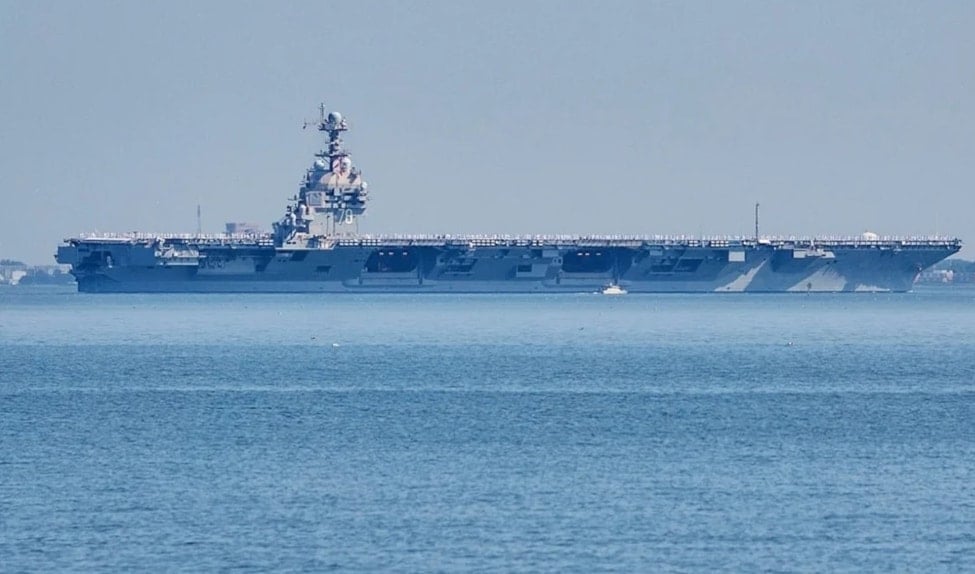
The USS Gerald R. Ford aircraft carrier leaves Naval Station Norfolk, June 23, 2025, in Va. (AP)
A large US naval force has been positioned across waters stretching from the Mediterranean Sea to the Indian Ocean as Washington continues its aggression against Iran. The deployment includes two aircraft carriers, six amphibious assault ships, and 19 cruisers and destroyers, forming one of the largest concentrations of American naval power in the region in recent years.
The buildup follows President Donald Trump’s announcement that Washington would reimpose a blockade on Iranian ports, while US aggression on coastal and island targets continues. But the growing naval presence has raised a broader question: how long can the US Navy sustain such a force in a prolonged confrontation with Iran?
The question itself reflects deeper concerns about the state of American sea power. Once the dominant global naval force, the US Navy operated more than 6,000 ships in 1945 and maintained a worldwide presence. Today, decades of fleet reductions have fueled doubts over whether Washington still has the capacity to sustain extended operations in multiple theaters.
A renewed blockade, even one enforced at a distance in the Arabian Sea, would place significant demands on ships, crews, and maintenance systems. Several vessels that have remained deployed in the region since February, including some serving rotations of 10 months or longer, would eventually require replacement.
Maintaining such a large concentration of warships in the US Central Command area of responsibility would also force the Navy to prioritize one region over others, limiting its ability to project power globally.
In an analysis published by Responsible Statecraft, military historian Michael Vlahos examines the challenges confronting the US Navy, arguing that its ability to sustain operations near Iran is constrained by three major problems: a shrinking fleet, overstretched deployments, and growing strain on sailors and maintenance systems.
Shrinking and unbalanced fleet
In Vlahos' view, the first factor is the loss of ships. The US Navy counted 6,768 vessels in 1945, giving it enough capacity to sustain operations for decades. Even during the Vietnam War, the fleet still exceeded 900 ships. By the late 1970s, however, that number had fallen to roughly 450.
During the Reagan administration, the fleet expanded again, reaching nearly 600 ships. But after the end of the Cold War, a prolonged period of reductions began.
Today, the Navy’s effective combat fleet consists of roughly 180 major vessels, including aircraft carriers, large-deck amphibious ships, attack submarines, and guided-missile destroyers.
China’s Navy now operates more battle force ships than US Navy
A major challenge for Washington is that China’s People’s Liberation Army Navy now operates more battle force ships than the US Navy.
Although American warships remain larger and more technologically advanced, they are not sufficiently supported by vessels needed for secondary but essential missions, including patrol, escort, and mine-clearing operations.
The Littoral Combat Ship (LCS) program was designed to address these gaps, with 35 ships built over the past two decades. However, those vessels are now being retired, including some relatively new ships.
Former House Armed Services Committee Chairman Rep. Adam Smith (D-Wash.) criticized the program in 2022, saying, “We can’t use them, number one, because they’re not ready to do anything. Number two, when they are, they still break down.”
As a result, the author argues, the US Navy no longer operates as a balanced fleet.
Too few ships, too many deployments
The second challenge, as per Vlahos, is that a smaller fleet leaves fewer ships available for sustained overseas missions.
A common naval planning principle holds that three ships are required to keep one vessel deployed abroad. During periods of crisis, ships are often kept at sea for extended periods to maintain military pressure, reassure allies, and demonstrate deterrence.
The USS Abraham Lincoln, for example, deployed in November 2025 and remained in the Arabian Sea for more than 210 days without a port visit, a record for the Navy.
Insufficient repair capacity
The consequence is that valuable ships experience greater wear and tear before being sent into additional missions until failures occur.
When damaged or exhausted vessels finally return home, the Navy faces another problem: insufficient repair capacity.
Maintenance facilities are limited, with some submarine overhauls taking up to eight years. One nuclear-powered submarine, the USS Boise, was eventually scrapped after a decade of repairs, despite $800 million being spent while only 25% of the work was completed.
The situation has become so severe that 40% of the Navy’s submarine fleet is unavailable for deployment because of maintenance delays and contractor problems. Submarines receive the highest priority, meaning surface ships face even greater difficulties.
A weak repair system effectively reduces the size of an already limited fleet, as per the analysis.
Sailor fatigue threatens the Navy’s future
Vlahos pointed out that the third factor affecting naval readiness is less visible but potentially more damaging: the exhaustion and declining morale of sailors.
Repeated long deployments, especially those extended beyond their planned schedules, place significant pressure on both service members and their families.
Vice Admiral Phil Wisecup (ret.) experienced this challenge firsthand. While serving as a Navy Scheduler in the 1990s, he co-authored a study recommending that deployments be limited to six months, except in urgent circumstances.
The Navy adopted that standard, but it was abandoned following the heightened military demands after the September 11 attacks.
For the past 25 years, the US Navy has operated under wartime conditions in terms of deployment demands. The article compares the situation to World War II, when ships crossed the Pacific and did not return home until the war ended, and the Vietnam War, when aircraft carriers remained in the Gulf of Tonkin for extended periods before returning briefly for rest.
However, those periods of intense operations lasted only several years. Maintaining similar pressures for a quarter-century risks pushing sailors beyond their limits.
Today, 10-month deployments have become routine for destroyers and amphibious ships operating in missions such as blockade patrols in the Arabian Sea.
USS Gerald Ford becomes symbol of strain
The USS Gerald Ford, America’s newest and most advanced nuclear-powered aircraft carrier, has become a prominent example of crew exhaustion and morale problems.
The $3 billion carrier, the first ship of a new class, introduced numerous advanced systems, including electromagnetic catapults, arresting gear, new radar systems, weapons elevators, and a vacuum waste-disposal system.
However, incorporating so many new technologies created multiple potential points of failure. Critics have described the ship as “a monument to everything wrong with the US Navy.”
After the vessel’s toilets failed, the crew’s difficulties intensified. A major fire broke out in the ship’s laundry on March 12 of this year, an incident many believe was deliberately caused, bringing its deployment to an end.
After spending months in the Red Sea, the carrier traveled to Crete for repairs before returning home.
Expanding the fleet remains a decades-long challenge
The analysis argues that simply increasing spending will not quickly solve the Navy’s problems.
A 2017 estimate suggested that building and maintaining a 355-ship fleet would cost more than $3 trillion, a figure that would be considerably higher today.
The Navy’s ambitious “Golden Fleet” modernization initiative, which seeks to expand the fleet to 450 ships, requires at least $267 billion just to begin, according to figures released by the Navy in May.
However, analysts have pointed out that “despite a doubling of the shipbuilding budget over two decades, fleet size has not meaningfully increased.”
The 2026 Shipbuilding Plan emphasizes “changing how we do business” and “delivering accountability", but supporters face decades of entrenched practices and limited oversight.
The country’s political divisions also make sustained and extremely expensive fleet expansion more difficult, as per the author.
The likely outcome, the analysis suggests, is that the Navy will continue operating with an aging and overstretched fleet while attempting to prevent further reductions in ship numbers.
Over time, modernization of shipyards could improve maintenance and repair timelines, but the Navy will eventually have to confront the limits of American naval power.
A powerful fleet, but no longer a global force
So can the US Navy sustain operations near Iran? Vlahos questions.
The answer is yes, but with significant limitations.
The Navy remains capable of deploying a powerful group of advanced warships anywhere in the world and maintaining that force through rotations for as long as political leaders require.
However, this represents the new maximum capacity of the service.
Like the Navy of the 1920s and 1930s, the author argues, today’s fleet has effectively become a single-mission force: capable of moving to one location and conducting operations there, but no longer the globally dominant naval power it was during World War II and the Cold War.
Even the current force in the Central Command region has limitations. The 27 major warships deployed there cannot easily enter situations where they risk serious losses because the Navy lacks enough replacement vessels and does not have sufficient repair capacity to quickly restore damaged ships.
"The iron reality of limited American Seapower is stark. It can put a modest armada off a foreign shore, and keep it there. It just cannot afford to get into a real fight," Vlahos concluded.


