
US Patriot stocks in Europe hit 'critical' low over war on Iran: AP
 5 Min Read
65% of US Patriot inventory has been burned through fighting Iran, officials tell AP, leaving the alliance dangerously exposed to Russia.
-
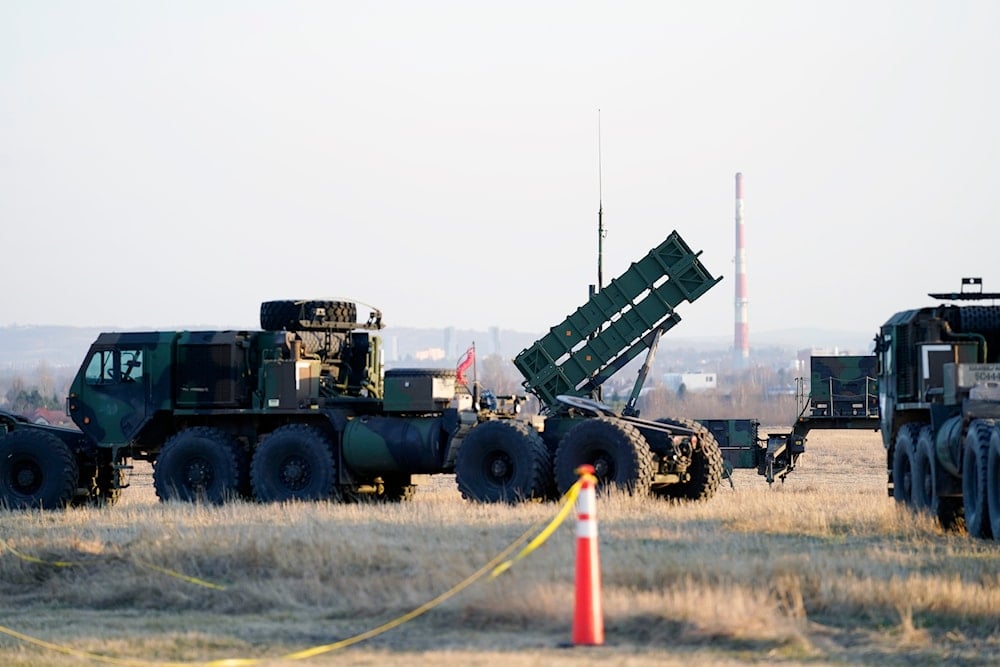
Patriot missiles are seen at the Rzeszow-Jasionka Airport, March 25, 2022, in Jasionka, Poland. (AP)
Europe's supply of Patriot missile interceptors has fallen to a "beyond critical" level, with the six-month-old US war on Iran identified as the primary driver behind the shortfall, a US defense official in Europe and a NATO official told the Associated Press.
Both officials, who spoke on condition of anonymity given the sensitivity of the matter, said the depletion has left US and NATO forces in Europe without adequate means to intercept the kind of high-speed ballistic missiles Russia possesses, raising questions about the alliance's ability to defend itself should tensions with Moscow escalate.
Interceptors diverted from Europe to the war on Iran
According to the report, the shortage stems largely from the redirection of US missile stockpiles from Europe to West Asia, where US and Gulf allies have expended a significant number of interceptors, including Patriots, to counter Iranian drone and missile fire.
Mark Cancian, a retired Marine colonel and senior adviser at the Center for Strategic and International Studies, told the AP that the war on Iran alone has consumed 65 percent of total US Patriot inventory, or roughly 1,500 of the country's 2,330 interceptors. This dwarfs the drawdown from years of transfers to Ukraine, which had taken around 600 Patriots since 2022 under the Biden administration.
Ed Arnold, a senior associate fellow at the Royal United Services Institute in London, noted that unlike the Ukraine transfers, which were "planned for and reasonably measured," the depletion tied to the war on Iran happened rapidly and without warning, exposing gaps in the US supply chain that officials had not anticipated.
What this means for Europe's defenses
The US official told the AP that US forces in Europe "definitely" lack sufficient Patriots to withstand a sustained ballistic missile assault, and would have only "very limited" ability to respond even to a single strike, or a Russian missile that strays off course.
In the event of a Russian ballistic missile attack on a target such as a military headquarters or power plant, the official warned NATO could find itself in a position resembling Patriot-starved Ukraine, forced "to take punch after punch in the mouth." A single Patriot battery can only defend a limited area, such as one military installation, not an entire city.
The stakes are heightened by the fact that some European states, including Germany, have already purchased Patriot systems but currently have little to no ammunition to operate them, a situation Arnold called "ridiculous." Germany's defense ministry declined to comment on its stockpile levels when asked by the AP.
NATO says a Patriot production facility set to open in Germany this September could start deliveries as early as next year, though these would first go to nations with existing orders, among them Germany, the Netherlands, Romania and Spain. A broader production target of 2,000 Patriots annually has been set for 2030, the same year European and NATO officials estimate Russia could be capable of moving against the alliance.
Ukraine still waiting on more Patriots
The shortage has direct consequences for Kiev as well, which has long argued that Patriots are the only system capable of intercepting Russia's more advanced ballistic missiles.
Ukrainian officials continue to press Washington and European allies for additional interceptors as Russian strikes increasingly penetrate the country's air defenses, including in an overnight barrage reported Thursday.
Officials on record dispute the severity
US and NATO officials speaking on record pushed back against the AP's reporting.
NATO military spokesperson Col Martin O'Donnell rejected the characterization that Patriot stocks in Europe were "beyond critical," saying the alliance retains sufficient munitions to defend itself and continue supporting Ukraine.
Pentagon spokesman Sean Parnell similarly dismissed claims of a shortage as false, stating the US maintains "a deep, ready arsenal" and has carried out operations across multiple commands without depleting its capabilities.
A narrow window before 2030
CIA Director John Ratcliffe reportedly traveled to Moscow this week to warn Russian officials against any attack on NATO members, according to the Wall Street Journal. Asked whether the message had been delivered to President Vladimir Putin, Trump gave an indirect answer, saying only that Russia was "not going to attack."
Analysts caution, however, that Russia's own military constraints, namely its ongoing war in Ukraine and exposed air defense vulnerabilities exploited by recent Ukrainian strikes, may currently serve as more of a deterrent than NATO's depleted stockpiles.
As Arnold put it, "the uncomfortable truth is possibly the best air defense that we have is Russian constraints."


