
US pressure intensifies as Cuba becomes next regime change target
 6 Min Read
As Cuba's fuel reserves dwindle and blackouts intensify, the island faces its worst crisis since the collapse of the Soviet Union.
-
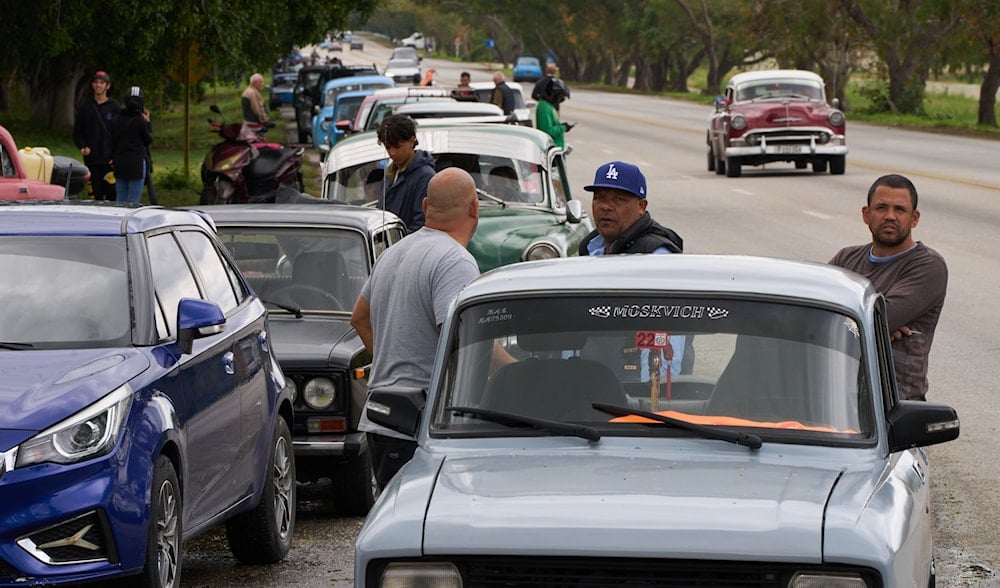
Drivers wait in a long line to enter a gas station in Bacuranao near Havana, Cuba, Friday, Jan 30, 2026. (AP)
Following the US aggression on Venezuela and violent abduction of its president Nicolás Maduro in early January, Cuba has become Washington's next target as part of a decades-long campaign of regime change across Latin America.
The blueprint for economic strangulation dates back to 1960, when US Undersecretary of State Lester Mallory advocated for measures to "bring about hunger, desperation and overthrow of government."
Six decades later, that strategy has reached its most intense phase under the Trump administration, which has openly declared its intention to topple Cuba's communist government by year's end.
Oil cutoff further strangles Cuba
The US has effectively blocked all fuel shipments to the island through a combination of direct pressure and tariff threats. Only one oil delivery has arrived this year, 84,900 barrels from Mexico, and data consultancy Kpler estimates Cuba will exhaust its reserves within three weeks if no additional tankers arrive, the Financial Times reported.
The energy crisis follows a predictable pattern: after carrying out regime change in Venezuela, Washington immediately severed Cuba's primary oil lifeline. Venezuela had been supplying roughly one-third of Cuba's fuel needs. When Mexico attempted to fill the gap with approximately 20,000 barrels per day, President Trump signed an executive order threatening tariffs on any country selling oil to Havana.
'There is going to be a real blockade'
At a January party celebrating US independence at the US embassy in Havana, US chargé d'affaires Mike Hammer delivered a chilling message to assembled diplomats. "The Cubans have complained for years about 'the blockade," he said of the six-decade embargo. "But now there is going to be a real blockade."
CNN reported that Hammer advised embassy staff internally: "If you don't have your bag packed yet, then pack your bag," though the embassy maintains it has no evacuation plans.
The statement reflected Washington's escalating pressure campaign. Trump has publicly declared there will be "NO MORE OIL OR MONEY" flowing to Cuba and urged leadership to "make a deal BEFORE IT IS TOO LATE."
Meanwhile, Secretary of State Marco Rubio, when asked by senators to rule out regime change, responded bluntly, "Oh no. I think we would like to see the regime there change."
Washington's playbook for regime change
According to senior Trump administration officials cited by The Wall Street Journal, the US is "actively seeking Cuban government insiders who could facilitate an agreement to oust the Communist regime" by the end of 2026, mirroring the approach used against Venezuela.
The intensified assault combines multiple mechanisms refined over decades. Cuba's 2021 redesignation as a "State Sponsor of Terrorism" dramatically expanded financial isolation, with banks worldwide refusing Cuban transactions to avoid US penalties.
Congressional Republicans Carlos Giménez and Mario Díaz-Balart have called for ending all flights and remittances to Cuba, with Giménez declaring the government "a cancer" requiring a "painful cure".
Economic collapse, isolation
The humanitarian toll is mounting rapidly. Jorge Piñón, an energy expert at the University of Texas, told The Guardian that diesel shortages would prove "catastrophic" as the fuel powers transportation, railways, agriculture, industry, water distribution, and electricity generation. Many parts of Cuba already endure 12-hour blackouts daily.
Cuba's economy contracted by 11% between 2019 and 2024, with another 5% decline through September 2025, according to government figures. Hyperinflation has decimated those dependent on state wages or pensions. Eddy Marrero, a trained doctor now working as a motorcycle taxi driver, explained to The Guardian, "Doing this, I make in one day what I'd make in a month as a doctor."
Abandoned
Help appears unlikely. Mexico cancelled a scheduled oil shipment in a not-so-sovereign "sovereign decision" according to President Claudia Sheinbaum, though clearly influenced by US tariff threats targeting the USMCA trade agreement.
Venezuela has provided no supplies since Maduro's abduction. Russia and Algeria, other traditional suppliers, sent their last shipments in October and February, respectively, according to Kpler data.
China expressed "deep concern and opposition" to US actions while promising "support and assistance," but has historically purchased oil from Cuba rather than supplying it.
Pope Leo urges 'sincere' Cuba-US dialogue
Meanwhile, Pope Leo has expressed profound concern over the escalating tensions between the United States and Cuba, urging for "sincere and effective dialogue" to avert violence and further hardship for the Cuban populace.
Speaking after his weekly Angelus prayer, Pope Leo confirmed he had received reports "with great concern" regarding the rising tensions.
He echoed Cuban bishops in "urging those responsible to promote sincere and effective dialogue to avoid violence and further suffering for the Cuban people."
Pope Leo prayed that the Blessed Virgin Mary may watch over all Cubans.
“May Our Lady of Charity of El Cobre assist and protect all the children of that beloved land!”
Cuba signals defiance despite threats
Cuban President Miguel Díaz-Canel has responded forcefully to Trump's threats, accusing the US president of attempting to "suffocate the Cuban economy by imposing tariffs on countries that sovereignly trade oil with Cuba" under false pretenses. Carlos Fernández de Cossio, who leads the US desk at Cuba's Foreign Ministry, called a potential blockade "a brutal assault against a nation that doesn't threaten the US."
Mexico's President Sheinbaum warned on Friday that Trump's tariffs "could trigger a far-reaching humanitarian crisis, directly affecting hospitals, food supplies, and other basic services for the Cuban people."
Yet Trump dismissed humanitarian concerns, telling reporters that Cuba could avoid a crisis by accepting his undefined "deal", terms that appear to require nothing less than the Communist Party's dissolution in exchange for sanctions relief.
As Cuba's fuel reserves dwindle and blackouts intensify, the island faces its worst crisis since the Soviet collapse, this time orchestrated by US policy designed to produce exactly the desperation Lester Mallory prescribed 66 years ago.


