
US war on Iran fuels Vance-Hegseth rift after GOP election defeat: TWT
 7 Min Read
A growing rift between JD Vance and Pete Hegseth is exposing divisions within the Trump administration over the war on Iran, the Pentagon's leadership, and responsibility for Republican election losses, as both figures face growing political scrutiny ahead of 2028.
-
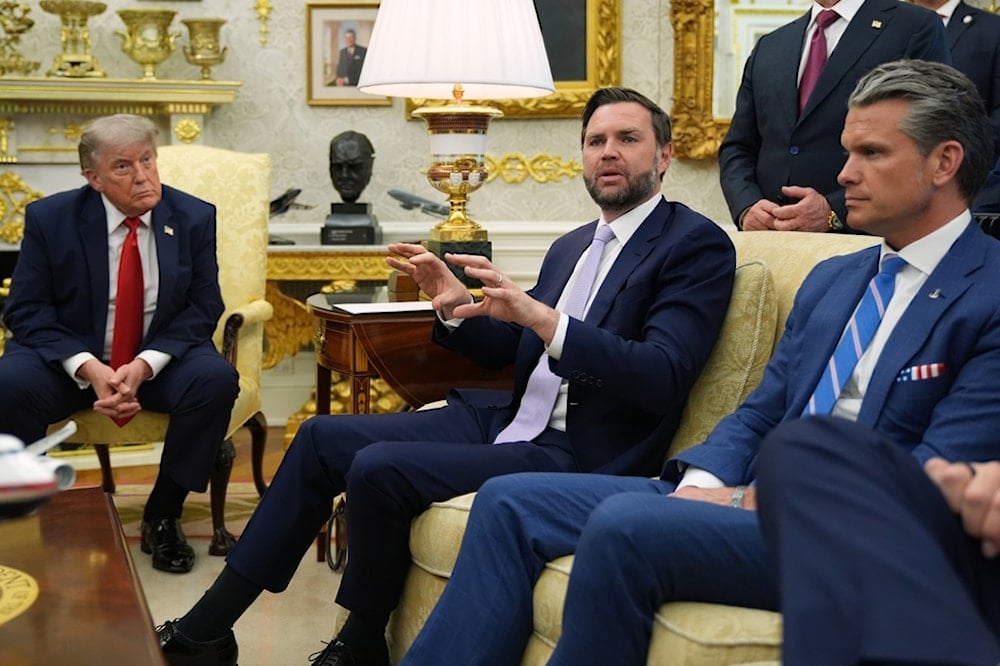
Vice President JD Vance speaks as War Secretary Pete Hegseth and President Donald Trump listen during meeting with NATO Secretary General Mark Rutte in the Oval Office at the White House, June 24, 2026, in Washington (AP/Jacquelyn Martin)
A growing rivalry between US Vice President JD Vance and Defense Secretary Pete Hegseth is coming to a head as the Republican Party grapples with the political fallout of the war on Iran and its sweeping losses in last week's midterm elections, The Washington Times reported in a report on Wednesday.
The behind-the-scenes tensions, which sources say have been brewing since the early days of President Donald Trump's administration, are increasingly exposing divisions within the Republican Party over the war and who should bear responsibility for its political consequences.
The election results have placed Vance and Hegseth on opposing sides of a Republican establishment increasingly divided over the war, which is expected to become a central issue in the 2028 presidential race. Vance is widely expected to seek the Republican nomination, while Hegseth has also been mentioned as a potential contender, although he has denied any intention of running for the White House, according to the report.
Republicans could increasingly portray Hegseth as the architect of an unpopular war that cost the party control of both the House and Senate, while undermining its focus on domestic concerns, including energy prices and affordability.
Publicly, however, both officials have sought to downplay any friction. According to The Washington Times, Vance backed Hegseth ahead of a House effort on Tuesday to impeach the war secretary, which was ultimately tabled in a 211-204 vote.
Asked about his relationship with the vice president this week, Hegseth said "politics is not really my thing" and described Vance as a "crucial member of the team" involved in military decision-making. Vance has also repeatedly defended Hegseth, dating back to his January 2025 tie-breaking Senate vote to confirm him as war secretary.
However, Pentagon insiders, former senior military officers, and officials familiar with the matter told The Washington Times that the relationship is more complicated, with tensions partly rooted in Vance's close ties to former Army Secretary Daniel P. Driscoll, a fellow Yale Law School alumnus.
Hegseth angered by Vance's ties to Driscoll
Driscoll resigned in September following deep disagreements between Hegseth's office and Army leadership. Several months earlier, Hegseth had dismissed Army Chief of Staff Randy George, further deepening tensions within the military establishment.
According to a former senior military officer cited by The Washington Times, Driscoll had direct discussions with Vance early in the Trump administration about Army modernization and restructuring initiatives. Those conversations reportedly angered Hegseth, who viewed Driscoll's direct access to the vice president as an attempt to bypass his authority and exclude him from key discussions.
"That did not land well at all," one source told the newspaper.
Two Pentagon officials familiar with the matter said Vance and Driscoll also discussed issues extending beyond Army affairs, despite military service secretaries typically concentrating on their respective branches, while operational matters are handled by regional military combatant commanders.
The tensions between Driscoll and Hegseth intensified in November 2025, when Driscoll was dispatched to represent the US at Russia-Ukraine peace talks in Abu Dhabi. The assignment was unusual, given that such meetings would typically involve the war secretary rather than a military service secretary.
Sources told The Washington Times that Hegseth and members of his inner circle believed Driscoll's relationship with Vance had afforded him influence extending well beyond his official position.
In a statement to the newspaper, chief Pentagon spokesman Sean Parnell sought to dismiss reports of friction between the two senior officials.
"Secretary Hegseth is grateful for the vice president’s leadership as a key member of the administration’s national security team. They are completely aligned in executing President Trump’s ’peace through strength’ vision for our military," he said.
A senior administration official also dismissed Driscoll's role in the Pentagon's restructuring efforts, saying, "Since Day 1, Secretary Hegseth has been the chief architect of modernization at the Department of War. Dan Driscoll is a total nonfactor when it comes to these reforms," the official said.
Iran war exposes diverging political positions ahead of 2028
The rivalry is unfolding as Republicans seek to assign responsibility for the party's midterm losses and the political consequences of the war on Iran.
A senior Republican on the Senate Armed Services Committee argued that Hegseth could not be held solely responsible for the war, given that Trump, as commander in chief, retains final authority over military decisions.
"It’s hard to push the secretary of defense in front of the bus when the commander in chief is his boss and makes all the final calls," the senior Republican told The Washington Times.
"I just don’t think you can separate Pete’s role from the president’s in terms of the final decision-making," the official added.
Vance, meanwhile, has sought to defend Hegseth against the impeachment effort while distancing himself politically from the war. Ahead of Tuesday's House vote, the vice president dismissed the allegations against the war secretary.
"Has Pete Hegseth committed impeachable crimes? The question is absurd, and the answer is: obviously not," Vance said.
He also argued that the impeachment push stemmed from Hegseth's confrontation with the Pentagon establishment rather than the Iran war.
"The irony is that legislators are most angry at Pete on the issues where he’s most correct: repositioning forces away from Europe/Ukraine and reorganizing the general officer corps," he said, referring to Hegseth's efforts to reduce the number of generals and admirals in the US military and shift some American troops away from Europe.
"This isn’t about Iran; this is about the fact that Pete took on the bureaucracy at the Pentagon," Vance added.
The vice president adopted a different position when addressing the Republican election defeat, explicitly identifying the war as the reason for the party's poor performance.
"The reason we lost is the war," Vance wrote in a social media post on November 4.
Although he avoided directly criticizing Trump or Hegseth, his remarks were widely interpreted as an early attempt to distance himself from the conflict ahead of a potential 2028 presidential campaign.
Hegseth, by contrast, has remained publicly committed to defending the war, presenting it as a major strategic achievement.
"Regardless of how people feel about the war, I believe it is a courageous and historic effort that will ensure Iran never gets a nuclear weapon," he said in a defiant speech at the Pentagon last week.
The diverging positions could become increasingly significant as the Republican Party approaches the next presidential election. Vance would also face a historical challenge if he seeks the presidency, as the last sitting vice president elected to the White House before George H.W. Bush in 1988 was Martin Van Buren in 1836.
A sitting vice president seeking the presidency must balance defending the administration's record with presenting himself as capable of delivering better results, without appearing disloyal to the president. Conservative leaders have warned that the war, its duration, and its impact on consumer prices have strained the coalition that brought Trump and Vance to power.
Heritage Foundation President Kevin Roberts told The Daily Signal last week that the Republican coalition had been built around several central commitments, particularly avoiding new wars and reducing prices.
"The Trump-Vance coalition was put together on a lot of issues, but two of the most central ones were that there would be no new wars and that prices would go down," Roberts said.
He argued that the resulting electoral defeat should have been foreseeable, describing it as "just Politics 101 in any representative government."


