
US warns ships to avoid Iran waters amid Strait of Hormuz tensions
 4 Min Read
The US advises its commercial vessels to steer clear of Iran’s territorial waters in the Strait of Hormuz as tensions escalate with Tehran.
-
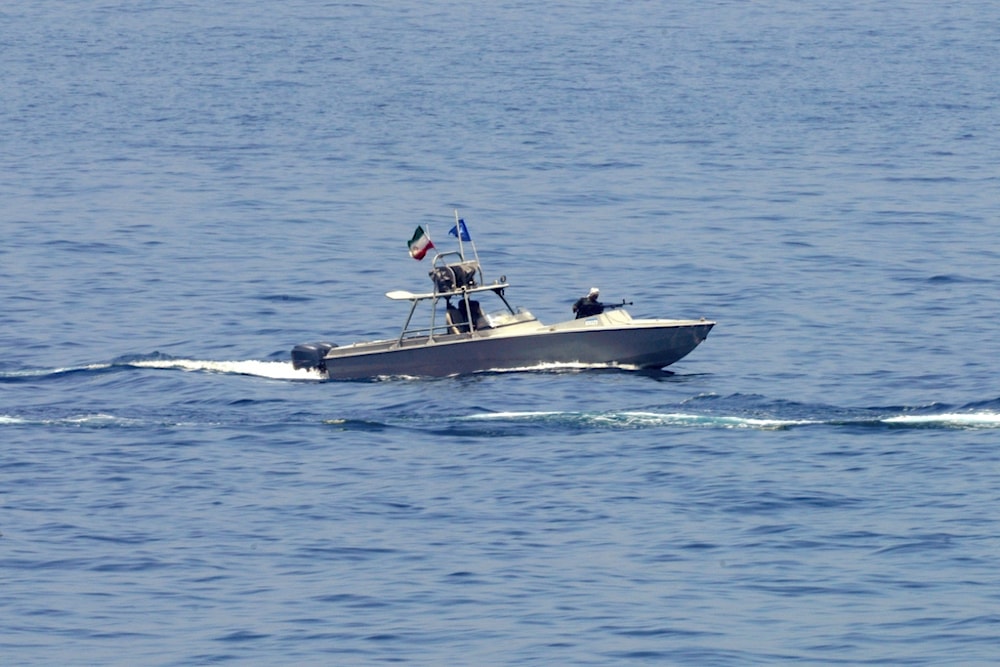
An Iranian Revolutionary Guard vessel watches an American warship in the Strait of Hormuz, May 19, 2023 (AP)
Amid heightened tensions between the US and Iran, the US Department of Transportation (DOT) has issued a maritime advisory urging all US-flagged commercial vessels to maintain maximum possible distance from Iran’s territorial waters while transiting the Strait of Hormuz.
The advisory, issued by DOT's Maritime Administration, comes in response to growing concerns over maritime security in one of the world’s most strategic waterways.
DOT recommends distance from Iran’s territorial waters
"It is recommended that U.S.-flagged commercial vessels transiting these waters remain as far as possible from Iran’s territorial sea without compromising navigational safety," the guidance stated.
The Strait of Hormuz, a vital chokepoint for global oil and trade, has been a flashpoint in recent years due to geopolitical tensions involving Iran and Western powers, particularly the US.
Guidance on Iranian boarding protocol
The DOT advisory also outlines procedures for US commercial vessels in the event of an encounter with Iranian forces.
Should Iranian forces seek to board a US-flagged vessel, captains are instructed to decline permission, in accordance with international law, but only if doing so does not endanger the vessel or crew.
"If Iranian forces board a U.S.-flagged commercial vessel, the crew should not forcibly resist the boarding party. Refraining from forcible resistance does not imply consent or agreement to that boarding," the guidance added.
IRGC: Strait of Hormuz security is Iran’s decision
The DOT’s announcement follows earlier remarks by senior officials in the Islamic Revolution Guard Corps (IRGC), who asserted that the security of the Strait of Hormuz is fundamentally tied to decisions made by Tehran.
Mohammad Akbarzadeh, political deputy of the IRGC naval forces, stated that while Iran views its neighbors as friends, any use of their land, airspace, or waters against Iran would be regarded as hostile.
"Tehran possesses capabilities that will be revealed at the appropriate time," Akbarzadeh warned, underscoring Iran’s readiness to respond to regional threats.
Iranian Intelligence Minister Esmaeil Khatib, in a separate statement, affirmed that efforts to undermine national unity have failed, stressing that “no threat can shake the unity of the Iranian people.”
Rising tensions and US military deployment
The advisory and IRGC statements coincide with growing regional friction, particularly after US President Donald Trump confirmed a significant military build-up near Iranian waters.
In an interview published by Axios, Trump claimed that a “big armada” had been deployed to the region, including the USS Abraham Lincoln aircraft carrier group, fighter jets, and air defense systems.
“We have a big armada next to Iran. Bigger than Venezuela,” Trump said, while also claiming Tehran “wants a deal,” though no confirmation has been made by Iranian officials.
The escalation reflects Washington’s aggressive posture, with analysts warning of increased risks to maritime navigation and the potential for miscalculation in the Strait of Hormuz.
Iranian authorities warn against destabilization attempts
Meanwhile, Iranian security services have announced a wave of arrests targeting what they describe as externally-backed rioters.
Iran’s General Directorate of Intelligence in Semnan reported detaining 80 individuals and seizing over 100 firearms.
Authorities in Gilan and Yazd provinces also detained over 300 people allegedly linked to destabilization efforts tied to foreign intelligence, including "Israel’s" Mossad and the US.
Read More: IRGC Navy: Security of Hormuz Strait contingent on Tehran decisions


