
Vance and Rubio show differing tones on Iran and 'Israel' policy
 4 Min Read
Divergent remarks by JD Vance and Marco Rubio highlight internal tensions over Iran diplomacy and regional developments, despite White House claims of full alignment.
-
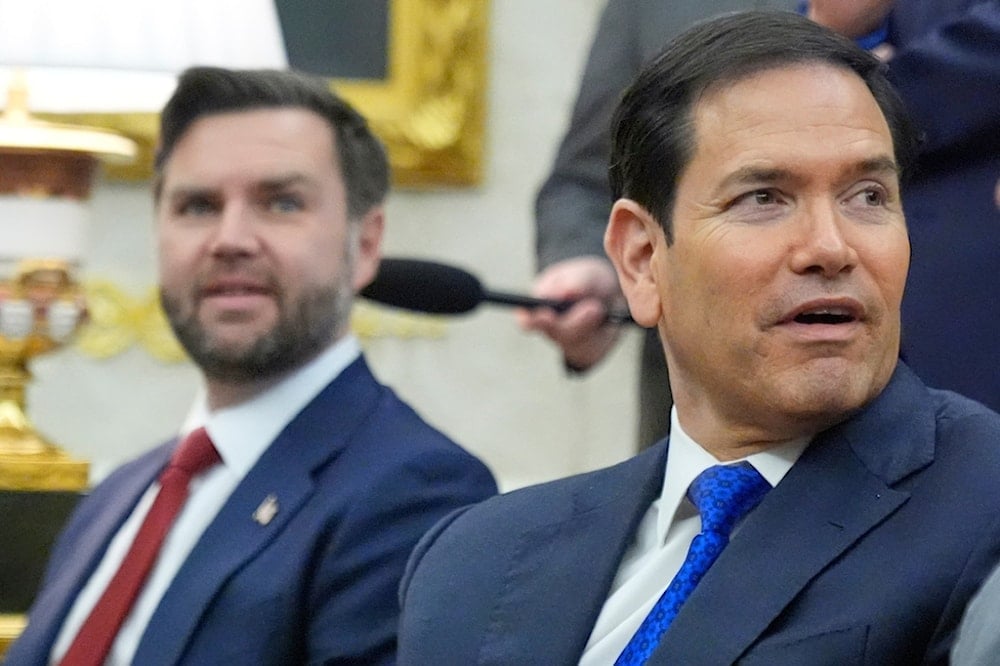
Vice President JD Vance and Secretary of State Marco Rubio attend a meeting in the Oval Office at the White House on March 3, 2026, in Washington. (AP Photo/Mark Schiefelbein)
Subtle differences in tone have emerged between US Vice President JD Vance and Secretary of State Marco Rubio over Iran negotiations and developments regarding a ceasefire attempt between Lebanon and "Israel", even as the White House insists that the administration remains fully unified.
The variations in messaging come as the Trump administration continues efforts to consolidate support around a preliminary agreement with Tehran, while simultaneously managing escalating regional tensions and competing priorities among US allies.
Vance adopted a critical tone toward Israeli military actions during remarks at the White House last week, arguing that strikes on civilian infrastructure in Beirut risk undermining US-led diplomatic efforts with Iran. He also pushed back against Israeli critics of the emerging US-Iran framework, suggesting that continued escalation in Lebanon would complicate broader regional negotiations.
"Israel" is known for continuously breaking ceasefire deals and sabotaging negotiation efforts, breaking multiple deals with Gaza, and breaking Washington's stated promises of the cessation of attacks on Lebanon. His comments reflected a more restrained approach to regional escalation, particularly at a moment when Washington is attempting to maintain momentum in talks with Tehran.
Read more: Israeli MK threatens: 'US could find itself in conflict with Israel'
Rubio defends 'Israel’s' Lebanon operations during Gulf tour
By contrast, Rubio, during a regional tour of the Gulf, defended Israeli attacks on Lebanon.
Pressed on Vance’s remarks, Rubio declined to directly engage the criticism, instead reiterating accounts of recent retaliatory strikes by Hezbollah in response to Israeli aggression as the reason for IOF attacks.
Rubio’s messaging emphasized deterrence and alliance reassurance during meetings with officials in the United Arab Emirates, Kuwait, and Bahrain, where concerns have been raised over the implications of the interim US-Iran understanding.
He stated that any agreement with Tehran must be firmly structured around US and allied interests, adding, "While we want a deal, we don’t want a deal at any price".
Competing messaging on Iran deal implementation
Both officials were dispatched abroad to support the implementation of the preliminary US-Iran understanding signed on 17 June, though they advanced different emphases in their respective engagements.
Vance expressed optimism over diplomatic channels with Tehran, including the possibility of expanded regional cooperation and reconstruction frameworks involving Gulf states. Rubio, however, suggested that reconstruction discussions remain premature and contingent on broader security guarantees.
Despite these differences in tone, both officials reiterated support for the administration’s overall diplomatic framework.
Read more: Hezbollah says it's monitoring Israeli violations of Lebanon ceasefire
White House rejects claims of internal divisions
The White House dismissed suggestions of policy divergence, insisting that the administration remains unified behind US President Donald Trump’s approach to Iran.
Officials described reports of disagreement as inaccurate, arguing that both Vance and Rubio are aligned with the administration’s strategic objectives.
State Department representatives also rejected claims of internal splits, stating that US policy is coordinated and consistent across agencies.
Analysts point to ideological split within Republican foreign policy
Outside observers, however, have pointed to longstanding ideological divisions within the Republican Party over foreign policy direction.
Analysts describe an emerging contrast between interventionist approaches traditionally associated with establishment conservatives and a more restrained current skepticism of overseas military engagement.
These tensions are reflected in broader public opinion, with polling suggesting a divided Republican electorate over the outcomes of the US military's failures in its war on Iran. Both Vance and Rubio are widely viewed as potential future contenders for leadership within the party, reflecting competing constituencies shaping Republican foreign policy direction.


