
Venezuela dares US to show if drug use dropped after Caribbean strikes
 5 Min Read
Venezuelan Parliament President Jorge Rodríguez denounces the alleged US anti-narcotics operation in the Caribbean, calling it a "sham" amid rising US opioid use.
-
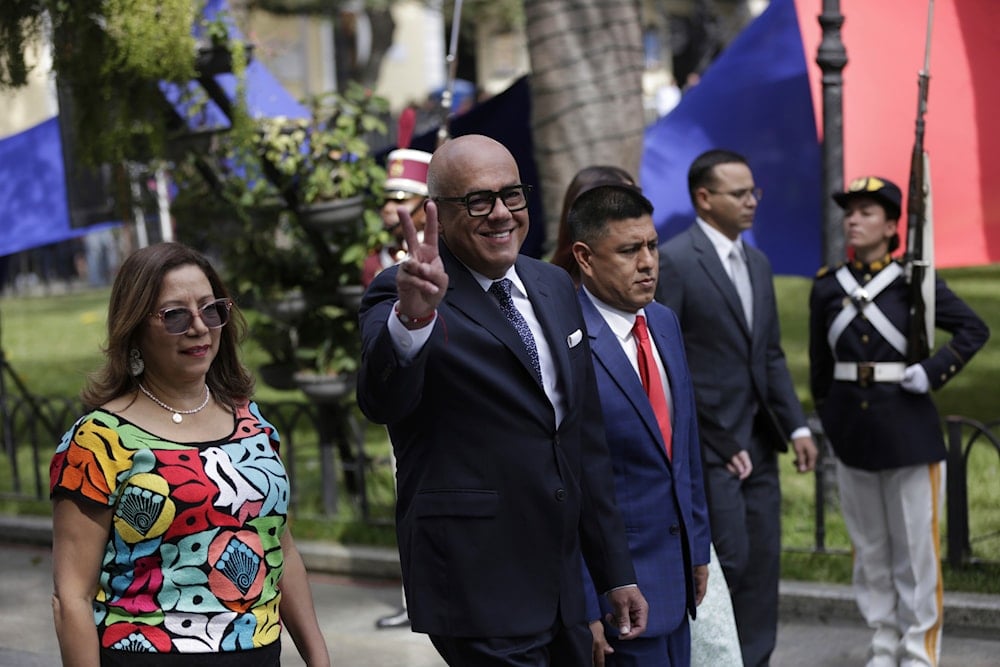
National Assembly President Jorge Rodriguez waves as he walks to congress before the ceremony to open the legislative year in Caracas, Venezuela, Sunday, Jan. 5, 2025 (AP)
The President of Venezuela's Parliament, Jorge Rodríguez, questioned the effectiveness of the US campaign in the Caribbean, rejecting any connection between Caracas and the opioid epidemic ravaging US cities.
In a speech on Sunday, Rodriguez raised doubts about the actual impact of the mission, arguing that instead of curbing illicit drug trafficking, the strategy might serve as a “sham” aimed at targeting Venezuela and facilitating regime change.
In a pointed statement, Jorge Rodríguez questioned the effectiveness of the US "anti-narcotics operation" in Caribbean waters, asking, “Is anyone measuring the prevalence of illicit drug use in the United States right now?” and whether trafficking, including micro-trafficking of fentanyl, cocaine, and marijuana, has actually decreased in the country at this time.
Rodríguez forecasted that when the official figures are released at the end of 2025, they will show that “the consumption of illicit substances in the United States has only increased,” arguing that if consumption has risen, it directly reflects the expanded supply.
He added that this demonstrates that “the trafficking of illicit substances to the United States continues,” despite the US military presence in the Caribbean, with this reasoning undermining the claimed success of the operation.
US pharmaceutical companies behind fentanyl epidemic
The president of the Venezuelan Parliament firmly rejected any link between Venezuela and the current opioid epidemic in the United States, emphasizing that the country is not involved in the trafficking of these substances. Rodríguez noted that the main driver is fentanyl, an opium derivative that “enters the United States of America through the routes you know; Venezuela has absolutely nothing to do with it.”
Rodríguez asserted that the source of the opioid epidemic in the United States is not the Caribbean or Venezuela, but the American “big pharmaceutical companies” themselves, specifically naming firms like Purdue Pharma, which he held accountable for the ongoing crisis.
He explained that fentanyl is a result of the codeine sold indiscriminately in the 1990s, following misleading reports claiming it was not addictive, and stated, “That’s where the opioid epidemic caused by fentanyl that we are currently experiencing in the United States of America comes from."
Furthermore, lawsuits in the United States against opioid manufacturers have emphasized the role of deceptive communication campaigns that promoted the use of these products over the past 25 years, coinciding with a dramatic increase in the consumption of these substances.
Inconsistent accusations expose US 'farce'
Rodríguez condemned the lack of consistency in the accusations against Venezuela, noting that the claims “can’t even agree on whether it’s the Cartel of the Suns or the Tren de Aragua” and arguing that this inconsistency underscores his point that the operation and its allegations are “a big farce, a big slander against Venezuela.” He reiterated that his country will carry out a rigorous and thorough investigation of the events to present the truth to all relevant multilateral organizations.
He also criticized the so-called “war on drugs” strategy, highlighting its failure to effectively target the lowest-level participants in the drug trade, expressing surprise at an anti-drug effort that “fails to capture the small-time smuggler,” even though the boats intercepted are usually shallow-draft.
Rodríguez further argued that the logic of the anti-drug campaign should involve apprehending these smaller smugglers first in order to “work one way up and go after those who are truly responsible for the drug business,” and he suggested that this approach is not being applied, implying that other interests may be driving the operation.
Pentagon investigated for war crimes in the Caribbean
This comes as Republican-led congressional committees initiate extensive investigations into the Pentagon after a report by The Washington Post reported that War Secretary Pete Hegseth ordered the killing of all crew members aboard a suspected drug-smuggling vessel in the Caribbean Sea earlier this year.
The report indicated that on September 2, a missile strike targeted a vessel in the Caribbean, with drone footage capturing two survivors from the original crew of 11 clinging to the wreckage. Sources familiar with the operation stated that a second strike was subsequently ordered by a Special Operations commander to carry out Hegseth’s verbal directive, resulting in the deaths of the two remaining survivors.
Several officials, speaking on condition of anonymity due to the sensitivity of the matter, corroborated the sequence of events, prompting serious questions about the legality of the operation and its adherence to international law.
Human rights experts and former military attorneys have warned that the operation may constitute a war crime, with a group of ex-US military lawyers stating that targeting survivors of a sinking vessel violates international law, and emphasizing that survivors should be protected and, if applicable, treated as prisoners of war, noting that “violations of these obligations are war crimes, murder, or both. There are no other options.”
The War Department, however, maintains that the strikes are lawful under US and international law, citing a classified Justice Department memo shielding personnel from prosecution, and framing the campaign as part of a “non-international armed conflict” with terrorist-affiliated traffickers. Meanwhile, critics argue the traffickers posed no imminent threat and that the operation, which has killed 80 people so far, exceeds legal limits


