
War fuels Americans’ distrust in government, historian argues
 5 Min Read
A Foreign Policy column by historian Julian E. Zelizer argues that US wars have been the primary driver behind the long-term erosion of Americans’ trust in their government.
-
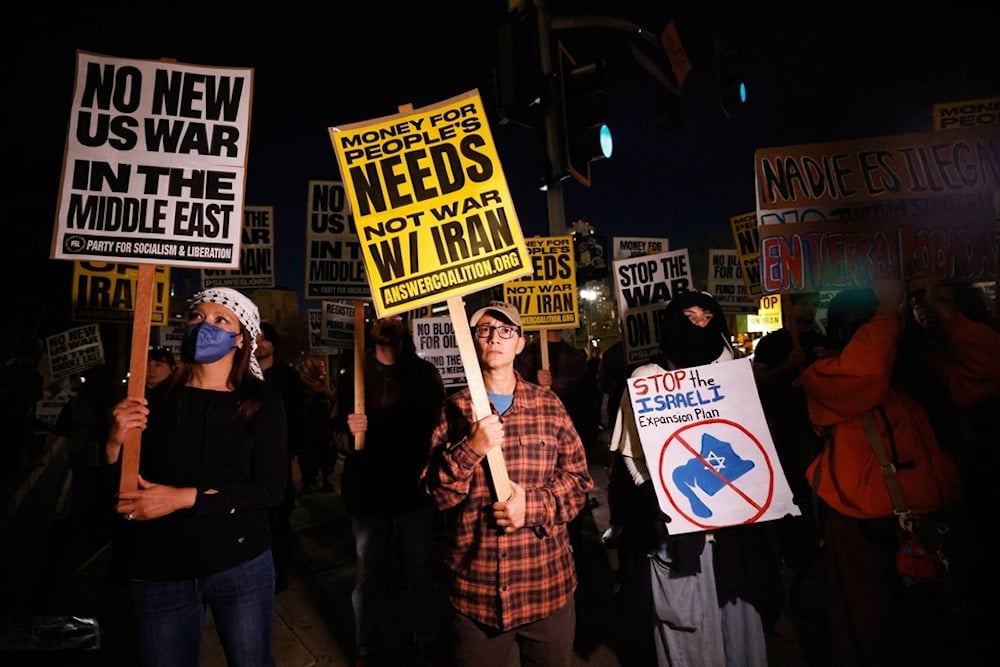
Protesters hold signs during a demonstration against the United States-led war on Iran, in Los Angeles, California, on March 2, 2026. (AP)
A major United States aggression on Iran ordered by US President Donald Trump, conducted alongside the Israeli regime, risks further eroding public trust in the federal government, according to historian Julian E. Zelizer in a column published by Foreign Policy.
Zelizer, a professor of history and public affairs at Princeton University, argues that the decision to launch the attack without a clear public rationale or a formal case to the US Congress could deepen long-standing skepticism toward Washington’s leadership.
In the column, Zelizer contends that while political scandals and polarization are often cited as causes of public distrust, war has historically been the most powerful driver of declining confidence in government.
Vietnam and the collapse of postwar confidence
Zelizer writes that Americans once held relatively high confidence in the federal government during the mid-20th century, particularly following the economic recovery programs of Franklin D. Roosevelt’s New Deal and the US role in defeating fascism during World War II. That confidence began to erode during the escalation of the Vietnam War under Lyndon B. Johnson, when growing evidence contradicted official claims that the war was progressing successfully.
According to Zelizer, journalists and anti-war activists increasingly exposed the gap between official statements and conditions on the battlefield. The turning point came during the Tet Offensive in 1968, when prominent news anchor Walter Cronkite publicly questioned the war’s trajectory.
Later revelations intensified the damage to public confidence. The leak of the Pentagon Papers in 1971, made public by whistleblower Daniel Ellsberg, revealed years of misrepresentations and deception surrounding US policy in Vietnam.
Read more: Trump wants world to pay hefty price of his war on Iran 'blunder'
Decades of conflict deepen skepticism
The historian argues that subsequent political scandals and controversial military actions further entrenched public distrust.
Among them was the Watergate scandal, which led to the resignation of Richard Nixon, as well as the so-called Iran–Contra affair during the presidency of Ronald Reagan, when US officials secretly transferred weapons to Iran and diverted proceeds to Nicaraguan rebels despite a congressional ban.
Even military successes, Zelizer notes, were accompanied by controversial claims. In the run-up to the Gulf War of 1991 under George H. W. Bush, US officials promoted allegations that Iraqi soldiers had removed babies from hospital incubators in Kuwait, which turned out to be disinformation promoted by the Kuwaiti ruling family.
The historian argues that the most damaging episode since Vietnam came with the invasion of Iraq launched in 2003 by George W. Bush, justified by claims that Saddam Hussein possessed weapons of mass destruction and maintained links to al-Qaeda, which were again false claims to justify the costly war.
According to Zelizer, decades of such conflicts and controversies have left many Americans skeptical of government statements, creating a political culture in which trust in Washington remains fragile.
Iran war could deepen this distrust
In his analysis for FP, Zelizer argues that the latest war involving Iran could exacerbate the trend.
He writes that the absence of congressional authorization and shifting explanations from administration officials have left Americans uncertain about the reasons behind the attack. Zelizer also notes that claims suggesting Iran possessed missiles capable of striking the United States were quickly disputed, adding to doubts about the administration’s justification for military action.
According to Zelizer, presidents seeking to restore public trust must prioritize transparency when making decisions about war. While leaders may feel pressure to justify military operations through persuasive messaging, he warns that misleading narratives eventually come to light.
“Presidents cannot ignore the long-term costs that result from dismissing the truth in pursuit of national security,” Zelizer argues in the column, warning that the consequences ultimately damage both military missions and the credibility of the government itself.
On February 28, the United States and the Israeli regime launched a joint aggression against Iran that has killed hundreds of Iranians, including more than 200 children, while severely damaging civilian infrastructure and destroying hospitals, schools, and residential areas. The Trump administration’s main justification for the attack, however tenuous, was that Washington had to join the ongoing Israeli assault or risk Iranian retaliation against US forces stationed across the region. In doing so, the administration once again chose military escalation over ongoing diplomatic negotiations.
More than two weeks later, the US–Israeli aggression has produced not only regional repercussions but also global consequences, particularly for energy markets. Disruptions in shipping through the Strait of Hormuz, one of the world’s most critical energy chokepoints, have already begun affecting supply flows, with the full extent of the economic fallout still uncertain.


