
West Bank pushed toward financial collapse under Israeli restrictions
 7 Min Read
The West Bank economic crisis is deepening as "Israel" imposes labor, banking and tax restrictions, straining the Palestinian Authority and public services.
-
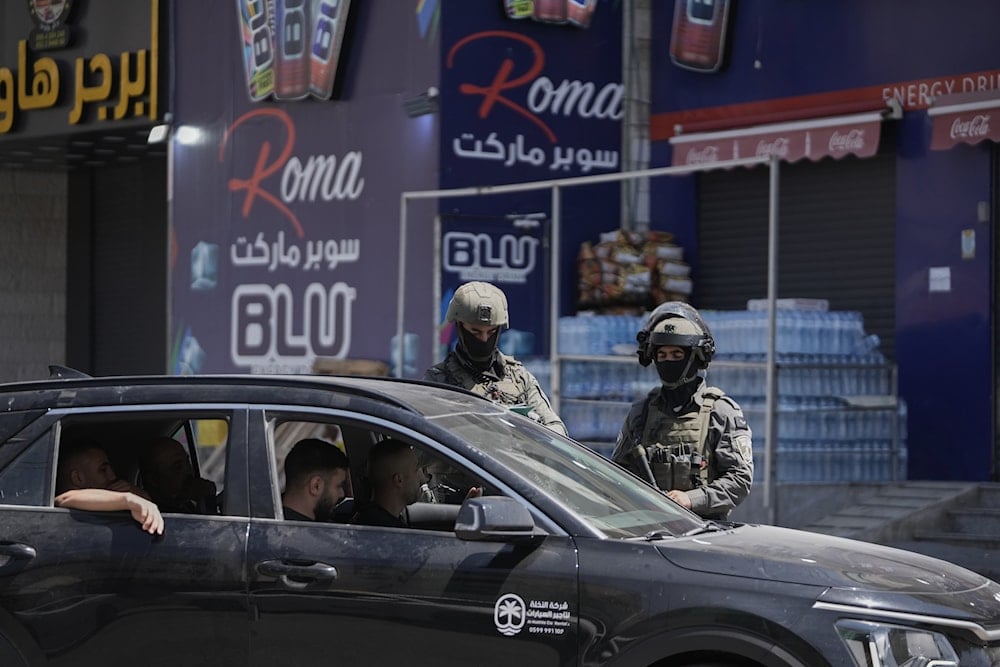
Israeli border police officers check the identification cards of Palestinian passengers riding in a vehicle during an army operation in the West Bank refugee camp of Qalandiya, Thursday, Aug. 6, 2026 (AP)
Severe restrictions imposed by the Israeli regime on the occupied West Bank have sent the territory to the brink of financial collapse, as measures have touched every part of daily life and caused a widespread economic crisis, according to Palestinian officials and residents interviewed by The New York Times.
Since October 7, 2023, Prime Minister Benjamin Netanyahu's government has stopped thousands of Palestinians from working in "Israel", withheld billions of dollars of tax revenues and enforced banking restrictions that have harmed business. The Palestinian Authority, which administers parts of the West Bank, has been forced to cut spending on salaries and public services because of the sharp fall in revenues.
The reductions have been felt acutely in sectors such as health care, with pharmacies routinely running out of medicines as the government allocates less money to buy them. The budget cuts have also forced clinics to open only a few days a week and hospitals to operate with fewer doctors and nurses.
Health Care System Strains Under Budget Cuts
NYT reported on the story of Ibtisam Hammad, 54, who was diagnosed with breast cancer three months ago, and who made her way to a pharmacy in Ramallah to collect her medications following a hospital appointment. Only three of her six prescriptions were in stock.
Her trouble getting medicines was indicative of wider economic problems, according to officials. The Palestinian Authority has often warned of a financial collapse that never materialized, but there are growing concerns about how long it can remain solvent.
As an occupied territory, the West Bank is inescapably economically dependent on Israel, which controls who and what enters and leaves that territory and the Gaza Strip, including the money that flows in and out.
The Oslo Accords in the 1990s reinforced that dependency, making the Israeli shekel the main currency in both territories and establishing links between Israeli and Palestinian banks, effectively giving "Israel" control of a financial spigot that it can turn off.
Israel Imposes New Economic and Labor Restrictions
After October 7, "Israel" started a devastating war on Gaza and also opened a new era of economic warfare in the West Bank, according to Palestinian officials. "Israel" quickly canceled permits for tens of thousands of Palestinian laborers to reach their workplaces in the occupied territories, many of whom worked in construction and agriculture and brought billions of dollars into the Palestinian economy every year.
Since the start of the war on Gaza, unemployment in the West Bank has skyrocketed to 28%, more than double the rate before the war, according to the Palestinian Central Bureau of Statistics. In May 2025, "Israel" started confiscating hundreds of millions of dollars per month in import taxes that it collects on the Palestinian Authority's behalf.
This revenue stream accounts for about two-thirds of the West Bank government's 2026 budget of about $6 billion, according to Palestinian officials. That deficit has forced the Palestinian Authority to lower the salaries of 140,000 civil servants and security officers, shorten school weeks to three days, and accumulate billions of dollars in debt.
Salary Cuts and Movement Restrictions Hit Daily Life
Maj. Arafat Halabi, a traffic police officer in Nablus, said that his monthly salary of about $1,500 had been halved. "Israel" has also erected new roadblocks across the West Bank, stifling the movement of goods within the territory.
In al-Khalil, the most populous city, the Israeli military has closed five of seven entrances and exits, according to Mayor Yousef Jaabari and residents. The military said that only two were regularly open and a third was "intermittently" open based on operational and security considerations.
Doron Spielman, a spokesman for the Israeli prime minister's office, accused the Palestinian Authority of "attempting to divert attention from its support for terrorism and its failure to reform by blaming Israel."
Palestinian Authority Defends Reform Efforts
The Palestinian Authority says it has taken some steps to address Israeli concerns. In February 2025, Mahmoud Abbas, the authority's president, issued a decree to end the practice of paying stipends to the families of Palestinians held in Israeli prisons, a long-held demand of Israeli officials.
US and Israeli officials have dismissed Abbas's efforts, while Palestinian officials say the new law is being enforced. The Palestinian Authority has often warned of a financial collapse that never materialized, but there are growing concerns about how long it can remain solvent.
The reductions in public spending have continued to affect daily life across the territory, with school weeks shortened and health care services operating at reduced capacity, according to local officials and residents.
Banks Hobbled by Transfer Restrictions
"Israel" has also limited the amount of shekels that Palestinian banks are allowed to send to Israeli banks, a crucial process that helps enable Palestinian merchants to buy goods from Israel and the rest of the world. The Israeli regime under Netanyahu permits quarterly transfers of about $1.5 billion from Palestinian to Israeli banks, far less than previous administrations allowed.
The restrictions have resulted in about $5.7 billion languishing in bank vaults in the West Bank, according to Palestinian government and banking officials. "They're preventing us from meeting the demand in our markets," said Bashar Yasin, general manager of the Association of Banks in Palestine, a trade group.
Thaer Abahri, a wholesale importer of flour, sugar, rice, and chocolate, said that he was only able to import half of what he used to buy. In recent weeks, Palestinian banking executives have expressed concerns that their institutions could be cut off entirely from Israeli banks.
Israeli Banks Threaten to Sever Ties
Israel Discount Bank and Bank Hapoalim, the only Israeli banks that work with Palestinian ones, have said that they are worried that those ties could expose them to lawsuits over money laundering or terrorist financing, and they have threatened to end the relationships. The Israeli banks have expressed frustration that the Israeli government has not done more to protect them from the risk of litigation.
Yahya Shunnar, governor of the Palestinian Monetary Authority, warned diplomats in July that the Palestinian economy was nearing a "full crisis" because of "Israel's" economic restrictions, according to a recording of his remarks obtained by The New York Times.
Businesses and individuals have reported feeling the strain of the economic restrictions. In Majd, a village near al-Khalil, Montaser Amro, 32, a supermarket owner, has allowed customers to take groceries and pay for them later.
Businesses Struggle as Debt Mounts
Amro's customers owe him around $155,000, he said, and he is struggling to pay suppliers on time, prompting some to refuse to deliver goods unless he pays upfront. "How am I supposed to run my business this way?" he said. "It's not sustainable at all."
Mustafa, the Palestinian Authority prime minister, has few tools to improve the situation. His government has imposed a hiring freeze except for the health sector, stopped allocating money to development projects and is operating on an emergency budget, he said.
He has asked for the international community to send more aid, but those requests have largely gone unanswered. The only hope, Palestinian analysts and officials said, is that Netanyahu's right-wing coalition will be replaced by a less hard-line government in elections in October. A new Israeli government that is less determined to inflict pain on Palestinians could loosen the economic chokehold, they say.


