
West is after Iran's science, not its weapons, nuclear chief says
 3 Min Read
Iran's nuclear chief Mohammad Eslami said Western pressure on Tehran is driven by opposition to Iran’s scientific and technological advancement rather than concerns over nuclear weapons.
-
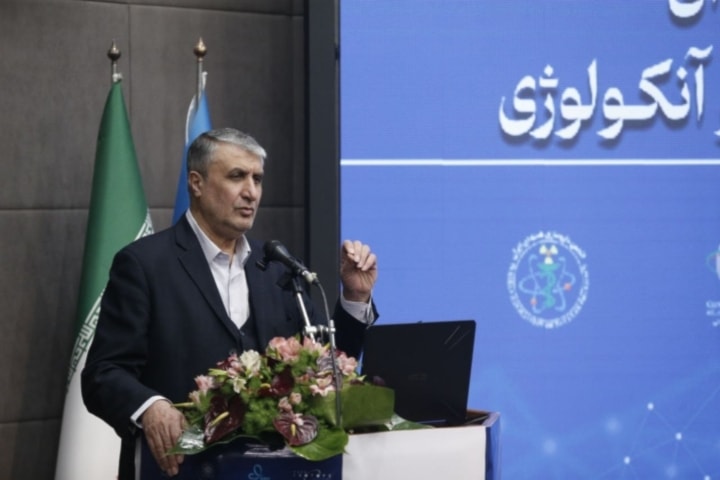
Mohammad Eslami, head of the Atomic Energy Organization of Iran (AEOI), speaks at a joint meeting of Iran’s nuclear medicine, radio-oncology, hematology and oncology associations on Dec. 25, 2025. (IRNA)
Iran’s nuclear program has become a focal point of geopolitical confrontation not because of weapons ambitions but because of Tehran’s scientific and technological progress, the country’s nuclear chief said this week.
Speaking at a joint meeting of Iran’s nuclear medicine, radio-oncology, hematology and oncology associations, Mohammad Eslami, head of the Atomic Energy Organization of Iran, said nuclear science remains a foundation of national progress and public welfare.
"Nuclear science is a driver of progress and power," Eslami said, adding that Iran is "duty-bound to move at the frontiers of knowledge."
He described nuclear sciences and technologies as "progress-driving, superiority-creating and power-enhancing" fields that have long been monopolized by major powers, arguing that Iran’s success in entering this arena lies at the heart of Western hostility.
"The real problem they have with us is our presence at this level and in this arena," he said.
West Targets Iran’s Progress
Eslami’s remarks come amid renewed diplomatic tensions at the UN Security Council, where the UK, France and Germany have intensified pressure on Iran and revived threats of reinstating UN sanctions, despite Tehran’s insistence on its rights under international law. Iranian officials say such moves reflect an effort to halt Iran’s technological rise rather than address genuine proliferation concerns.
Eslami said Iran’s scientific gains were achieved "regardless of their dictates and monopolies," crediting the country’s young scientists and the guidance of Leader of the Islamic Revolution Sayyed Ali Khamenei.
"Administrations come and go with different policies, but this goal-setting remains constant," he said, underscoring the continuity of Iran’s long-term scientific strategy.
Referring to recent military developments, Eslami argued that accusations against Iran’s nuclear sector have been exposed as politically motivated, particularly following Israeli attacks on Iranian territory.
"If one pays attention to the recent UN Security Council meeting and the remarks by officials of the three European countries, it becomes clear that the main objective is to stop Iran’s progress," he said.
He cited Israeli missile strikes on Isfahan, saying the first site targeted was a facility producing radiopharmaceutical fuel used in cancer treatment and other medical applications. The attack, he argued, demonstrated hostility not toward weapons but toward technologies that directly serve civilian needs.
Science for Society
Without nuclear medicine and access to domestically produced nuclear materials, Iran’s healthcare system would face severe shortages, Eslami warned, noting that such materials would otherwise be denied to the country under sanctions.
He also pointed to what he described as a recently released US national security document identifying artificial intelligence, quantum technology and nuclear science as pillars of national advancement.
"If these are necessary for the US, they must be for other countries as well," he said, arguing that Iran should not be excluded from scientific fields deemed essential for progress by Western powers themselves.
Eslami expressed hope that closer coordination among medical and scientific specialists would reduce public suffering and accelerate advances in healthcare, reinforcing Iran’s position that its nuclear program is rooted in development, sovereignty and service to society rather than militarization.
Read more: Iranian device detects residual breast cancer cells during surgery


