
Who is Sayyed Mojtaba Khamenei, Iran's next leader?
 8 Min Read
Iran’s Assembly of Experts elects Sayyed Mojtaba Khamenei as the new Leader of the Islamic Republic, marking a historic leadership transition. Here's all you need to know about Iran's new leader.
-
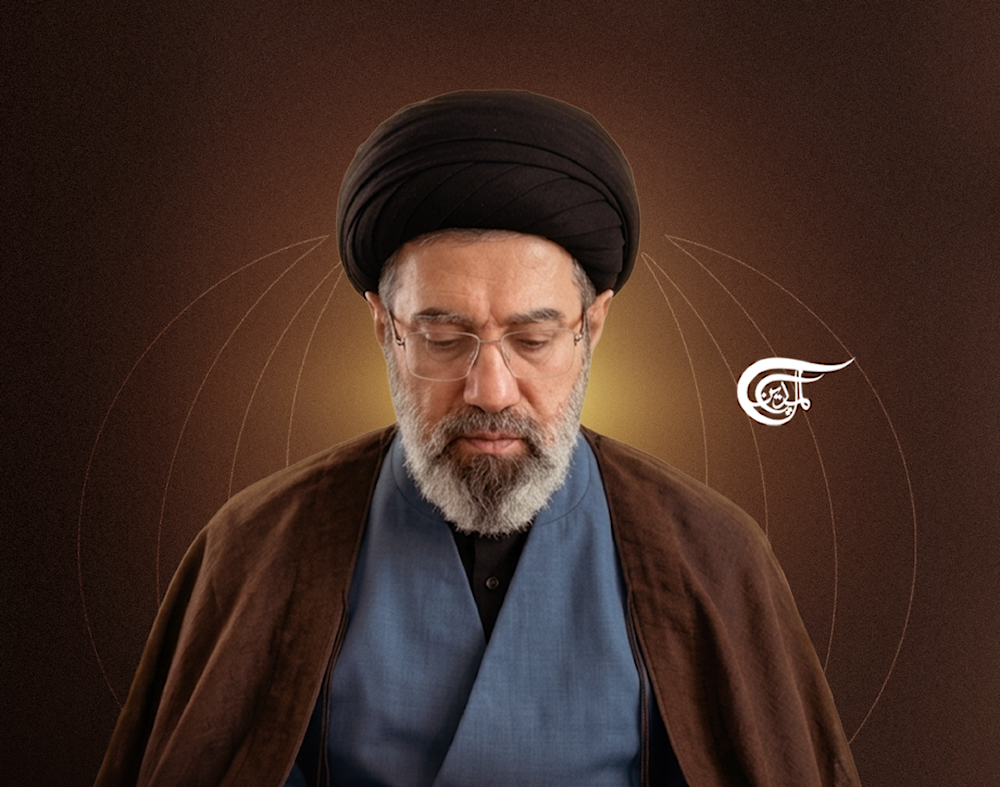
An illustrated photo shows Iran's new leader Sayyed Mojtaba Khamenei. (Illustrated by Mahdi Rtail for Al Mayadeen English)
In a pivotal moment for the Islamic Republic, Iran's Assembly of Experts has elected Sayyed Mojtaba Khamenei as the country's new Leader, succeeding his father martyr Sayyed Ali Khamenei, who was killed in the initial strikes of the US-Israeli aggression on Iran on February 28.
The decision marks a historic transition for Iran's leadership at a moment of unprecedented global uncertainty, resulting from the American-Israeli decision to launch an existential war on the Islamic Republic of Iran.
The 56-year-old Khamenei was born in 1969 in the holy city of Mashhad and has spent his entire life immersed in revolutionary politics and religious scholarship. Unlike many political successors who come to prominence through formal government positions, Mojtaba Khamenei ascended through informal channels, building an extensive network of relationships across Iran's security apparatus, religious institutions, and political circles.
A life shaped by revolution
Mojtaba's childhood unfolded during the most formative period of the Islamic Republic. Born just months before the 1979 Islamic Revolution that transformed Iran, he grew up in a deeply religious and political household at the heart of revolutionary institutions. His early exposure to state-building, decision-making processes, and governance gave him an insider's understanding of Iran's political machinery that few contemporaries possess.
In his formative years, he chose to pursue advanced religious education at Qom's seminaries, the premier theological center for Shia Islam. There, he devoted himself to studying Islamic jurisprudence and the principles of Islamic law, reaching the highest stages of seminary education, which precedes the rank of marja (source of emulation). This scholarly foundation distinguished him from many Iranian political figures and provided him with the religious credentials necessary for the leadership of the Islamic Republic.
The crucible of war
The trajectory of Sayyed Mojtaba's political influence was shaped significantly by the Iran-Iraq War that dominated the 1980s. During these formative years, he became affiliated with the Islamic Revolution Guard Corps (IRGC), serving in military units alongside fighters who would later become prominent commanders in Iran's security establishment. These wartime bonds have proven decisive, as he now commands the full trust of the security and military leadership to guide Iran through the current war on the country.
The shared experience of the "Sacred Defense" against Iraq created a cohort of leaders bound by mutual respect, shared ideology, and battle scars.
Power without portfolio
What distinguished Sayyed Mojtaba's rise was his accumulation of influence without holding prominent formal positions. For decades, he remained largely out of the public eye, yet his name became increasingly central to analyses of Iran's power dynamics. He reportedly played key roles in coordinating policy initiatives, building communication channels between various state institutions, and serving as a liaison between the office of the Leader and other branches of government.
His influence became particularly visible during the political upheavals of 2009, when Iran faced its most serious internal crisis. From that moment forward, his name was consistently mentioned in discussions regarding power balances and the future direction of the Islamic Republic.
Beyond his political networks, Sayyed Mojtaba developed genuine religious credentials. He spent more than 17 years teaching advanced seminary courses in Islamic jurisprudence and principles of Islamic law. His scholarly contributions were recognized by prominent clerics, and he gained respect within theological circles for his rigorous approach to Islamic sciences. This dual foundation, both religious scholarship and political-military connections, positioned him uniquely for the leadership role.
Read more: Sayyed Ali Khamenei: The man who refused to bow to global arrogance
A challenge to US imperialism
The Assembly of Experts' decision to elect Sayyed Mojtaba represents continuity and significant change, as well as a direct challenge to US President Donald Trump.
The Iranian system has traditionally resisted hereditary succession, and some observers noted that the martyr Sayyed Ali Khamenei had reportedly expressed reservations about his son assuming the position. However, the current context of succession is different.
Sayyed Ali Khamenei was assassinated in joint US-Israeli airstrikes, in what Israeli officials characterize as a "decapitation strike" intended to paralyze Iranian decision-making and foster a leadership transition more favorable to Western interests. Meanwhile, Trump has intervened in the succession debate, publicly dismissing the late leader’s son, Mojtaba Khamenei, as an "unacceptable lightweight". Trump signaled a desire for a hand-picked successor who would align with US regional goals, warning that a continuation of anti-West policies would lead to further aggression.
In this light, the succession transcends a mere transfer of familial power. It has emerged as a unified defiance by Iran’s clerical establishment, military apparatus, and political factions against a US attempt to subvert national sovereignty and impose external will on the Iranian people.
In accepting his election, Sayyed Mojtaba pledges to continue the revolutionary path established by Ayatollah Ruhollah Khomeini and maintained through his father's 34-year tenure. Officials have emphasized that the transition represents continuity with established principles, as well as a contemporary touch to move the Islamic Republic forward.
Broad support across political and regional lines
The election has garnered support from Iran's political establishment and allied movements across the region. President Masoud Pezeshkian said that the council's selection will mark a new stage for self-sufficiency and prosperity for the Iranian people.
First Vice President Reza Aref declared his backing for Sayyed Mojtaba, testifying that he is "a sincere and capable person for leadership, knowledgeable about the issues and affairs of the system and the state."
Reformist-intellectual Atta'allah Mohajerani also announced his support for the selection, signaling that backing for the transition extends across Iran's traditional political spectrum. The Iranian judiciary affirmed the legitimacy of the process, with the head of the judicial branch noting that the Assembly of Experts selected Sayyed Khamenei by an "overwhelming majority" and praising the assembly's demonstration of its "decisive role in preserving the country's stability and cohesion".
Iran's armed forces, through the Khatam al-Anbiya command headquarters, declared their readiness for "complete obedience" to their new leader and renewed their allegiance to the principles of the Islamic Revolution's founding figures.
Regional allies voice confidence
The election has also received backing from Iran's regional allies. Sanaa's Supreme Political Council Chairman Mahdi al-Mashat characterized the selection as "an indicator of Iran's strength and cohesion", while the Yemeni Ansar Allah movement's political office expressed confidence that Iran will "advance toward achieving a great victory that shapes the characteristics of dignity and honor for the nation in confronting global arrogance."
Iraq's Kata'ib Hezbollah, speaking through Secretary General Abu Hussein al-Hamidawi, called the appointment evidence of "the deep insight and foresight" of the Assembly of Experts in selecting a leader capable of carrying the banner of resistance movements amid the "destabilizing challenges" facing the region.
Resilience amid adversity
Supreme National Security Council of Iran (SNSC) Secretary Ali Larijani underscored the significance of the transition, noting that despite the enemies' calculations that the assassination would leave the country at an impasse, the election of Sayyed Mojtaba Khamenei demonstrated Iran's institutional resilience. Larijani predicted that Sayyed Khamenei's presence "will be a source of prosperity and blessing for the future of the Islamic Revolution."
International observers have noted the election's broader significance. The New York Times and the Financial Times suggested the choice signals Iran's determination to continue on its course regardless of pressure from "Israel" and the United States, demonstrating continuity during crisis.
As Iran enters this new chapter under Sayyed Mojtaba Khamenei's leadership, the breadth of institutional support and regional backing suggests the transition, while unprecedented in circumstances, may provide the new leader with considerable political capital to navigate the extraordinary challenges ahead.
His decisions in the coming months on military strategy, the nuclear file, negotiations, and the direction of the revolution will shape not only Iran's future but regional stability more broadly.
Read more: Iran judiciary chief backs Sayyed Mojtaba Khamenei as Leader


