
Xi urges 'immediate, comprehensive ceasefire', opening Hormuz Strait
 4 Min Read
China’s Xi Jinping calls for keeping the Strait of Hormuz open and urges an immediate ceasefire as global oil supplies' disruption continues.
-
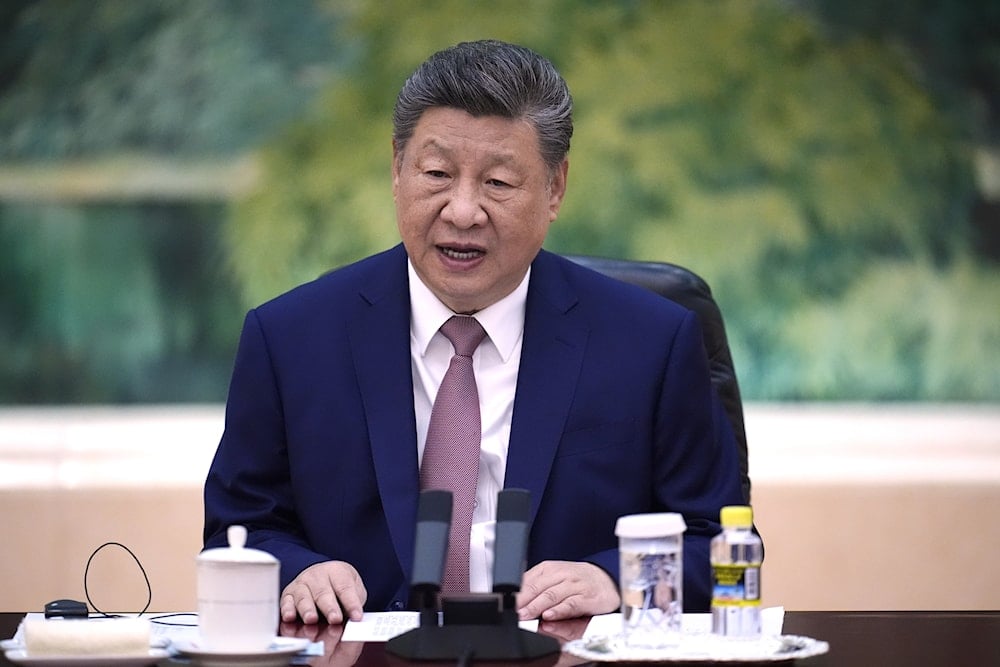
China's President Xi Jinping holds a talk with Russia's Foreign Minister Sergey Lavrov, at the Great Hall of the People in Beijing, China, April 15, 2026 (AP)
Chinese President Xi Jinping has called for the Strait of Hormuz to remain open to navigation, marking his first direct appeal for restoring access to the strategic waterway amid ongoing regional tensions.
According to China’s state broadcaster CCTV, Xi made the remarks during a phone call on Monday with Saudi Crown Prince Mohammad bin Salman. The Strait has been blockaded, then opened, then blockaded since US-Israeli strikes on Iran began on February 28, disrupting one of the world’s most critical maritime routes.
“The Strait of Hormuz should remain open for normal passage, which aligns with the common interest of countries in the region and the international community,” Xi said.
Xi calls for immediate, comprehensive ceasefire
The Chinese president also reiterated Beijing’s position on the broader war, calling for “an immediate and comprehensive ceasefire” and expressing support for efforts aimed at restoring peace. He stressed the need to resolve disputes through political and diplomatic means.
Xi further emphasized China’s backing for regional countries in fostering cooperation and stability, saying Beijing supports efforts to build “a shared home of neighbourliness, development, security and cooperation,” enabling nations to take greater control over their future.
The ongoing impasse in the Strait of Hormuz has significantly disrupted global oil supply chains, triggering volatility in energy markets and weighing on global economic growth.
Oil surges as US attacks, blockade derail ceasefire talks
Oil prices surged on April 20 after US forces opened fire on and seized an Iranian commercial vessel in the Gulf of Oman, an incident Tehran condemned as maritime piracy and a violation of the ceasefire agreement, sharply narrowing prospects for a diplomatic resolution to the US war on Iran.
Brent crude, the global benchmark, rose 6.3% to $96 a barrel, while West Texas Intermediate (WTI) climbed 7% to $88.3 a barrel.
The spike reversed Friday’s steep losses, when Brent had fallen more than 9% following Iran’s announcement that it would reopen the Strait of Hormuz. Tehran reinstated the closure a day later in response to what it described as a continued US blockade of Iranian ports.
The seizure of the TOUSKA sent shockwaves through global financial markets. European equities declined, with the pan-European STOXX 600 down 1.1% by the morning session, erasing gains recorded at the end of last week. France’s CAC 40 fell 1%, while Germany’s DAX dropped 1.6%.
Travel and leisure stocks led the downturn, falling 2.5% as rising fuel costs compounded geopolitical risks. Airline shares, including easyJet, Lufthansa, Ryanair, and IAG, dropped between 3.1% and 4%.
US futures also pointed lower, with Dow Jones Industrial Average futures down 258 points, or 0.5%, S&P 500 futures slipping 0.5%, and Nasdaq-100 futures declining 0.4%.
European markets continued to underperform their US counterparts, weighed by the region’s higher exposure to energy price volatility.
Rapid developments
Shipping activity in the Strait of Hormuz remained severely disrupted, with no tankers transiting the waterway on Sunday, one of the quietest days in months.
US President Donald Trump confirmed the incident involving the nearly 900-foot Iranian-flagged cargo vessel TOUSKA in a post on Truth Social on Sunday. He said the USS Spruance intercepted the ship in the Gulf of Oman and struck its engine room after the crew refused to stop, before US Marines boarded and took control.
Iran’s Khatam al-Anbiya Central Headquarters described the attack as unprovoked aggression against a commercial vessel in international waters, adding that US forces disabled the ship’s navigation systems prior to boarding.
The escalation has pushed ceasefire talks to the brink of collapse. Iran’s Foreign Ministry said on April 20 that no decision had been made regarding a new round of negotiations, despite Washington’s expectation that talks would resume before the ceasefire expires on Tuesday.


