Sayyed Ali Khamenei: Architect of the Axis of Resistance
-
 Hanna Eid
- 5 Jul 2026 13:07
 6 Min Read
In this tribute, I wish to focus on the martyred Sayyed's role as both an architect of the Axis of Resistance and a spiritual and political leader whose vision helped shape an entire generation of struggle and renewal.
-
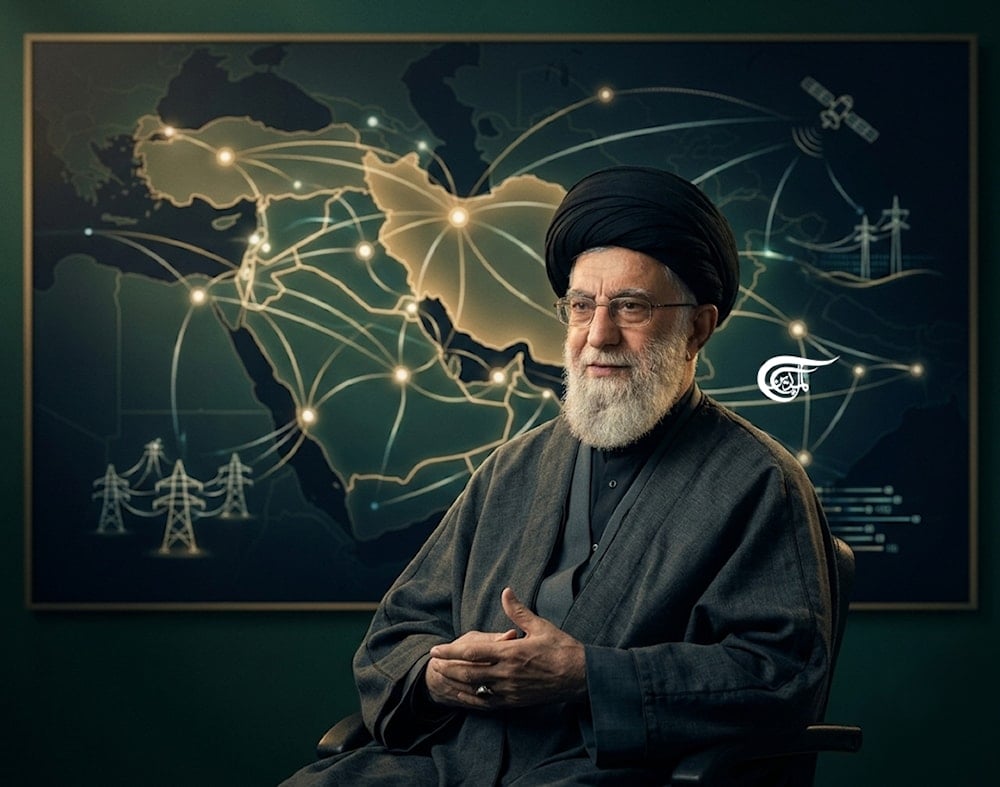
Just as the architect finishes his phase of the project, it is now the time of the builders–all of us–to pick up the blueprint and finish the project he started (Illustrated by Fatima Attieh for Al Mayadeen English)
When architects die, do the structures they designed collapse with them? Or do those edifices endure, standing as evidence of their vision, and as a hujjah (proof) of their life’s work?
Similarly, when a spiritual and political leader is martyred on the very path he trod fearlessly throughout his life, does the spirit of the nation perish with him? Does the body politic pass away in his absence? Or is it instead strengthened, nourished, and renewed by the example of his sacrifice? I would argue that the latter is true.
The task handed to me—to eulogize a leader such as Rahbar Ali Khamenei—is a difficult one. Despite my education and my thirst for knowledge, I never grew up in a civilization that still maintains a grasp on the “firm chord” of faith, tradition, and civilization (Quran 3: 103). Where I live, there is no moral elite and little leadership worthy of the name. Yet from afar, I have come to recognize the significance of Ayatollah Ali Khamenei’s legacy. It is a legacy that will endure beyond his lifetime, illuminating the path toward decolonization and sovereignty for generations to come.
His influence cannot be measured solely by the offices he held or the policies he advanced, but by the institutions he helped build, the ideas he cultivated, and the people he inspired.
In this tribute, I wish to focus on the martyred Sayyed's role as both an architect of the Axis of Resistance and a spiritual and political leader whose vision helped shape an entire generation of struggle and renewal.
In a lecture given by Shaheed (martyr) Sayyed Khamenei, he spoke of the patience of Imam Hussain, knowing his fate already as he trekked to Karbala. This patience was translated into state policy by Sayyed Khamenei; Iran’s reality of sanctions, economic strangulation, and political isolation was the terrain where this strategic patience was tested and demonstrated. Inheriting a weak and corrupt army left by the Shah, the Iranian revolution government was then forced into a prolonged war with Western-backed Iraq. In this crucible, the Pasdaran (IRGC) was formed and turned into a real fighting force. Given the Islamic Revolution’s need to build relationships and bolster its ideology of self-sufficiency, it only made sense that the IRGC would also be tasked with aiding the anti-colonial and revolutionary forces of the region. These relationships were made possible through the guidance of Sayyed Khamenei.
Sayyed Khamenei was an integral part of this transformation of the regional strategic depth and confrontation with the Zionist colony. Although the Iranian state has passed through various phases of confrontation and conciliation with the West, Sayyed Khamenei’s leadership was the stable force that kept the country adherent to its constitutional responsibilities, to aid in the liberation of Palestine and the region from Zionism, colonialism, and imperialism. In his short book written about Palestine, Sayyed Khamenei states very clearly:
“Our position on the issue of Palestine is a clear position. We support the Palestinian nation. We support the liberation of Palestine. We support the idea of putting an end to the transgression of the aggressors to the Palestinian lands. We say that the people of Palestine do not have security in their own homes. Islam is against such conditions, and so are we, even if other countries sit at the negotiation table and sell Palestine to the enemies. But they should know that Muslim people and the Palestinian nation will never sell Palestine to the enemy.”
In fact, Sayyed Khamenei’s leadership put Iran firmly within the anti-imperialist camp globally; I remember once seeing a photo of the martyred Sayyed alongside the Burkinabe revolutionary and martyr, Thomas Sankara, and thinking to myself ‘oh, to have been a fly on the wall in this great meeting of minds’… Such leadership is a rare gem which should be cherished.
Leaders of the Islamic revolution, such as Sayyed Khamenei, Beheshti, Bani Sadr, and Taleqani, were not just moral elites; they were also intellectual vanguards of an Islam that rejected quietism, subservience, and disengagement from action, rather serving the interests of palace dwellers.
They were the architects of a vitalist, praxis-oriented Islam that confronts oppression, uplifts humanity, fights the Taghut embodied in US and Zionist imperialism, and seeks to embody the message of the Prophet (saws) in lived reality. These leaders are the authors of books exploring Islam, socialism, anti-imperialism, religious edicts, and human history. They are indeed the foundation of a new social theory. For many years, Islam has been mischaracterized and maligned in the Western world, despite the fact that many of the foundations of modern civilization—from the numerals we use and the medicine we practice to the preservation of ancient philosophy and the development of historiography—owe a great deal to the contributions of Muslim scholars.
One day, when the censorship is over, and people have a chance to look at Iran and Muslims on their own merits, they will see the books of Sayyed Khamenei and the others as the foundational social theory born in the interregnum between the old and the new world.
Many in the West have a caricatured image of what an ‘Ayatollah’ is, because the whole Western civilization, from the so-called Renaissance onward, was based on the denial and rejection of traditional religious principles. The funeral ceremonies held for the martyred Sayyed underscored the profound gulf separating the two civilizations. In the Arab-Iranian sphere, leadership reflects the formula of ‘selection plus election’, whereby figures such as Sayyed Khamenei act not merely as heads of state, but also as spiritual guides and sources of emulation for millions of believers.
In Western civilization, leadership follows a criminal and Mafioso logic, where leadership is tied to materialist values and the ability to maintain control through violence and sadism, as evidenced by the genocidal violence against the people of Gaza, Lebanon, Yemen, Iraq, and Iran. Millions who filled the streets during the funeral ceremonies held for Khamenei were seen weeping and praying, a scene that testified to how the Sayyed’s martyrdom has reaffirmed and reinforced the lessons he taught during his life.
By re-centering Palestine as the lodestar of the region and religion, Sayyed Khamenei is remembered by many as a symbol of the Axis of Resistance. His fingerprints are all over every victory on the road to al-Quds. The wisdom he left for us is a reminder of the clarity needed on the path to liberation of the region. Sayyed Ali Khamenei now joins the ranks of martyrs, his brothers in creed and fellow leaders: Sayyed Hassan Nasrallah, Yahya Sinwar, Ismail Haniyeh, Ali Larjani, and Hajj Qassem Soleimani, to name only a few. The world is poorer for the loss of Sayyed Khamenei, yet just as the architect finishes his phase of the project, it is now the time of the builders–all of us–to pick up the blueprint and finish the project he started.