Gaza, Venezuela, and the price of sovereignty
-
 Hanna Eid
- 6 Jan 2026 14:36
 7 Min Read
Venezuela and Palestine are targets of US imperialism not only because they are rich in natural resources but because they represent a new social formation that challenges capital accumulation on a world scale.
-
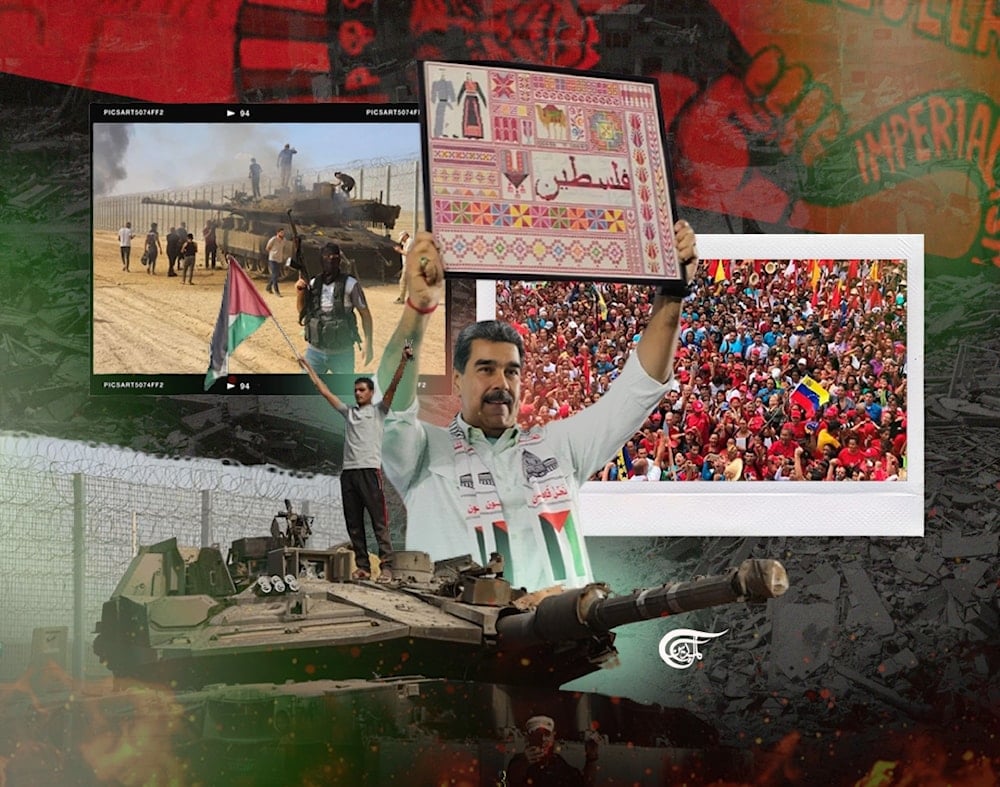
US assault on Venezuela isn’t about drugs; it’s about power, resources, and crushing resistance, using the same failed tactics seen in Gaza (Illustrated by Zeinab al-Hajj; Al Mayadeen English)
In the early morning of January 3, 2026, the United States military started bombing Venezuela. President Trump posted on Truth Social that the military ‘captured’ the president of the Bolivarian Republic, Nicolas Maduro. This aggression by the United States is reportedly about drug trafficking, with the involvement of numerous fictitious gangs–such as Tren de Aragua and Cartel de los Soles–invented by the US themselves operating across the Americas. Yet, Donald Trump has openly stated that the reason for the invasion and bombing is so that the United States can access Venezuela's oil and mineral wealth. Over the last few weeks, Gaza has returned to the headlines with the imperialist and Zionist forces calling for the resistance to disarm in the next two months. In a speech given by Colombian President Gustavo Petro regarding the genocide in Gaza, he insinuated that what is being done to Gaza is what will be done to all of the peoples of the South who dare raise the flag of revolution against imperialism.
Now that imperialism and Zionism have not only set their sights on Venezuela, but have pulled the trigger, how should we, as the free peoples of the world, respond? How should we analyze the attacks on Venezuela and the calls for the Palestinian resistance to disarm?
To understand how we got here, we can go back to October 7, 2023, when the myth of Zionist and imperialist military superiority was shattered by the brave fighters of the Palestinian Resistance. This was a watershed moment on the world scale, where not only the horrors of imperialism became more well known, but also its vulnerability. Venezuela has long stood in solidarity with the Palestinian people, and through its strong relationship with Iran, it has materially aided the Islamic Republic, which, in turn, materially aids the Palestinian Resistance. Venezuela is also no stranger to direct Zionist aggression, either. Winner of the Nobel Peace Prize, Maria Corrina Machado–a terrorist in her own right–-invited the Zionist military to invade Venezuela in 2018 to oust Maduro. Many years prior, in a speech given to Venezuelan oil workers, former president Hugo Chavez highlighted how Zionism finances the Venezuelan opposition, how Mossad operates all over the Caribbean, and how they even tried to assassinate him. Yet, on behalf of the imperialists, there is a fundamental misunderstanding of both Gaza and Venezuela, one that makes them arrogant and one that will lead to their eventual downfall.
The Israeli tactic of ‘decapitation’ has long been in their military doctrine. The idea is that leaders of the Resistance are killed or captured in the hopes that the rest of the Resistance networks will fold. Over the last 40 years, this has been an integral part of the Zionist military doctrine, and yet it has never produced the desired result for them. The assassinations of Sayyed Hassan Nasrallah, Abu Obeida, Qassem Soleimani, Ismail Haniyeh, Yahya Sinwar, Abu Ali Mustafa, and Muhammad Deif are all evidence of this Zionist strategy. The United States is now attempting this strategy in Venezuela by kidnapping President Nicolas Maduro.
What the Zionists and imperialists fail to understand is the depth of field, or what Palestinians call ‘the popular cradle’. The Bolivarian revolution and the Palestinian revolution both have and retain a strategic depth; this is not only allies internal and external, but the masses of working class peoples themselves. The people sustain the revolution because the revolution sustains them. It is a symbiotic relationship that is necessary for any movement that seeks independence, freedom, and sovereignty. The Bolivarian revolution is not isolated to a few bureaucrats and military generals in Caracas, as US and Zionist media outlets would have us believe. As a matter of fact, the Bolivarian revolution is a popular revolution sustained by the communes and the barrio assemblies, which form the backbone of Venezuelan society.

According to Angel Prado, the Venezuelan Minister of Communes: A commune is a grassroots organization within a specific territory, where self-government is established with a political structure that legislates, administers resources, and manages its own means of production… In a commune, there are many levels of popular organization. There is the communal parliament, the communal bank, and various committees, from economy to sports. At the base of the commune are the communal councils, which are the fundamental organizational cells.
Venezuela and Palestine are targets of US imperialism not only because they are rich in natural resources such as gold and oil in Venezuela, and natural gas and shipping lanes in Palestine, but in fact they are under imperialist bombardment because they represent a new social formation that challenges capital accumulation on a world scale. They challenge the imperialist model of accumulation, which lays waste to humanity and the natural world. Palestine represents the renaissance of the Arab and Islamic world, freed from Zionism and external control. Venezuela represents what Hugo Chavez and Jose Marti before him called nuestra America or Our America.
Prado continues: It’s clear what happens when progressive and anti-imperialist governments are overthrown—massacres, repression, and devastation. That is why unity is essential. There will always be internal debates.
However, in the mass movement, we are fighting to strengthen communes, to ensure that they become more organized, more robust, and a true expression of self-governance by the people.
Both the Venezuelan and Palestinian peoples have forged their national unity in the crucible of war, colonialism, imperialism, and external designs. In 2002, when a coup tried to dislodge Hugo Chavez and the Bolivarian revolution, it only lasted 47 hours because the people were already four years into their revolutionary process, and they understood that only they could be the masters of their own destiny, not a Western puppet from a Zionist-backed party. Similarly, although in the context of overt genocide and mass starvation, the Palestinian Resistance fought valiantly against not only the bloodthirsty IOF, but also against agents provocateur–such as Yasser Abu Shabbab and his gang hired by the Zionists to steal aid, kill Hamas leaders, and spy on the Resistance.
No matter what happens in Venezuela over the coming weeks and months, the US imperialists–in their arrogance–will have trouble carrying out their plans of stealing the patrimony of the Venezuelan people. Handing the oil over to US capitalists will not happen without a fight, as Maduro activated the state of emergency and all the regional popular militias prior to being kidnapped.
In their arraignment, Maduro and First Lady Cilia Flores pleaded not guilty to the four charges brought against them, which include "narco-terrorism". Maduro proclaimed to the court that he is a political prisoner and a prisoner of war. These are defining moments of our time, and how anti-imperialists respond is of critical importance. In Gaza, no matter how many times the imperialists insist the Resistance must disarm, their historical amnesia blocks them from understanding that October 7 changed the entire equation across the whole globe, and setbacks do not equal defeat for a people struggling for freedom.