
The gate to a global mosaic
-
 Nora Hoppe
- Today 14:48
- 4 Shares
 10 Min Read
Nearly three millennia have passed; many invasions, wars and plunderings have ravaged this great land… and yet this Gate still stands. Now more firmly than ever.
-
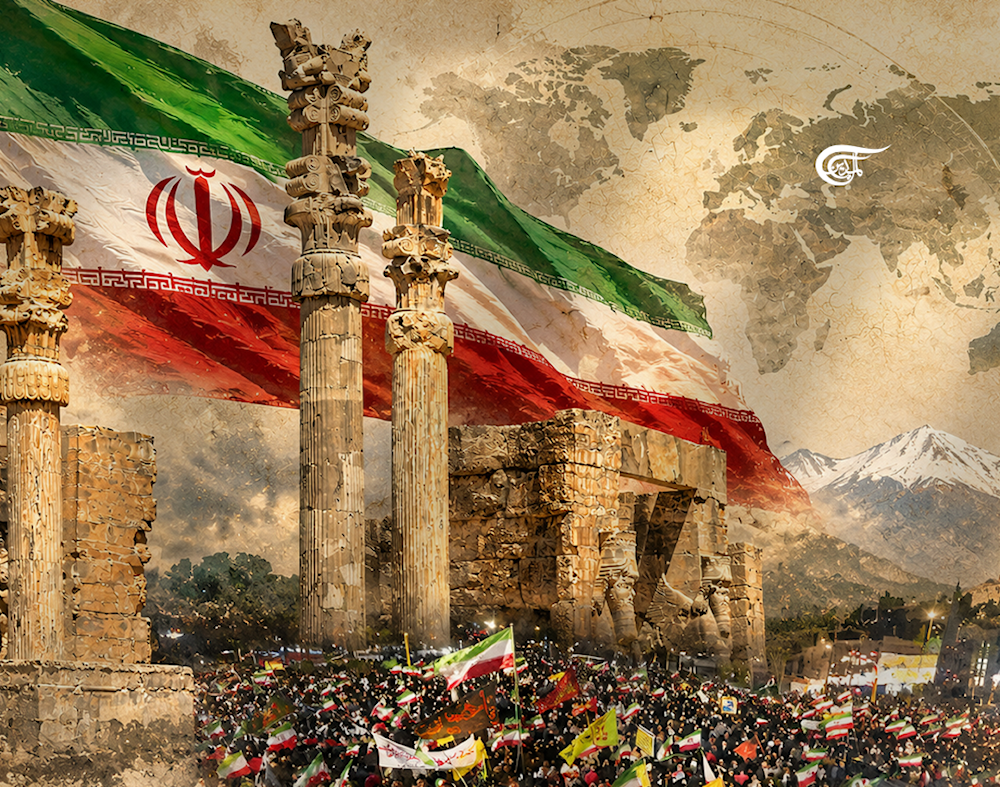
This Gate will be defended by those who understand that sovereignty is not a gift from above, but a covenant: a covenant of the head laid low at the threshold…(Al Mayadeen English; Illustrated by Batoul Chamas)
The abiding Gate of all Nations
The “Gate of All Nations” at Persepolis, built by Xerxes I in the 5th century BC, served as a welcome to a realm renowned for its hospitality – a threshold through which delegations from all corners of the empire could pass. It was not a wall. It was an opening. The massive doorways were guarded by lamassu – mythological winged bulls with bearded human heads – intended to ward off evil and protect the unity of the multi-ethnic empire coming together at the capital.
Although Greater Iran was conquered by the Greeks, the Mongols and the Arabs, it was never formally colonised. Instead, its invaders were culturally “Persianised”. Their dynasties were impermanent, but the synthesis they created with Persian culture remains embedded in Iran today. There was a famous historical maxim "Persia always conquers her conquerors".
Nearly three millennia have passed; many invasions, wars and plunderings have ravaged this great land… and yet this Gate still stands. Now more firmly than ever.
The Gate is both an invitation and a deterrent. It conveys the steadfastness of a people who will not be colonised, but who are also willing to open their door to others who wish to be sovereign.
The lull before
Time has passed since the April ceasefire breached by the Americans, then the July MoU signed yet derided by Trump, then the stifling lull of active hostilities. But the war being waged against Iran by the Axis of Barbarism is ongoing; it is merely subdued for the moment.
Because this war is not just about power, geopolitics and economics. It is about the nature of sovereignty itself – about whether nations have the right to exist on their own terms.
The Islamic Republic of Iran, for all its complexities, has placed itself at the vanguard of this struggle. Not because it is an impeccable, altruistic force. But because it has refused to be colonised – not only from without, but also from within. Iran is fighting not just for its resources and its borders but for its soul.
And in this respect, it is a civilisational war. The “soul” that is being fought for here is a soul that believes there lies a far more sacred purpose for it beyond individual enrichment, material gain, power, and supremacy.
The roots of a political consciousness
Unlike other populations, the majority of the citizens of the Islamic Republic of Iran possess a political consciousness and an acute awareness of what is going on in their country and in much of the rest of the world.
This consciousness is deeply rooted in Iran’s history – a history which, in 1891, was shaped by the collective action of the population against royal absolutism and attempts by the British to gain a hold on Iran’s resources (tobacco, later, oil) which would lead to foreign economic domination.
Through this collective action, a seed was planted: the idea that the people, when united, can hold power accountable. By 1979, this accumulated history – the memory of the Constitutional Revolution (1905-1911), the trauma of the 1953 coup that overthrew Mossadegh, the experience of authoritarian rule and foreign domination – reached a boiling point. The revolution that followed was marked by massive popular participation on an unprecedented scale. Millions of people, from all classes, joined demonstrations and assemblies to demand the fall of the Pahlavi regime.
What emerged was a political culture in which the line between "the people" and "the government" was not one of passive subjection, but of active, often contentious, participation. And, though this was already centuries in the making, it was crystallised by the Revolution…
The revolution that exports itself
Ayatollah Ruhollah Khomeini hoped the Revolution would be exported to other countries – not its religious form, but its universal essence, its consciousness. It was, in effect, conceived as the emanation of a principle: that the oppressed can overthrow their oppressors, and that sovereignty belongs to the people, not to the empire.
At the same time, he stated: “Revolution is not a cargo that can be transported to another place or exported to another country. If a revolution is correct and logical, and if it is attractive to nations, it exports itself; without anyone needing to export it.”
The export of the revolution was defined in the Constitution itself (Article 154) - not as military interference or ideological imposition, but as "support for the oppressed (the mustazafân) and the amplification of liberation movements," while explicitly stressing non-interference in the internal affairs of other nations.
In his message of congratulation to Khomeini on the victory of the revolution in April 1979, Fidel Castro declared that "not only the Cuban people but all the revolutionaries of the world celebrate this day". Khomeini replied with gratitude, and the two revolutions recognised in each other a shared anti-imperialist essence that transcended their different ideologies – two nations that refused to be colonised recognised in each other the same refusal.
The essence of the Revolution is ultimately universal, as it transcends religious and sectarian divisions. When a Cuban delegation came to Qom in 1979, Khomeini spoke of human nature (fitrat-e ensaniyat): "This movement, because it is a human movement and for humanity, all humans who remain in their human nature must support it."
With its resistance to Western dominance and its message of self-determination and independence, the Revolution also resonated with African nations in their struggles against colonial and neocolonial oppression. The Sahel Alliance drew inspiration from Iran’s sustained resistance to international pressure and its concepts of self-reliance and strategic partnerships. Ali Hassan Mwinyi, a former president of Tanzania, described the revolution as having "devoted its forces to the struggle for Africa's liberation from colonialism as well as to the global struggle against oppression and exploitation".
Read in this light, what Ayatollah Khomeini described was not merely a national revolution but the outline of a Global Axis of Resistance – a solidarity of the oppressed that would not stop at any one border. That outline was never completed. It is being drawn still.
Toward a global mosaic of sovereign peoples
The original Axis of Resistance was born out of Ayatollah Khomeini's concept of the solidarity of the oppressed: an informal coalition of anti-imperialist movements and parties across West Asia – in Lebanon, Palestine, Yemen, Iraq and Syria – brought together to counter colonial expansion and the war crimes of the Zionist and Western imperial powers in the region.
However, colonial oppression and war crimes are not confined to West Asia but affect the entire non-Western world. And now a desperate hegemon is steering the planet toward a cliff. We cannot ask Iran to fight this war alone.
If the essence of the Revolution is to reach a world majority seeking independence, self-sufficiency and dignity, the Axis must become global. But it must not become an empire in the process. An empire seeks to make the world one. A global Axis must let the world be many – and help it stay many. It must be, in other words, not a bloc but a mosaic: distinct tesserae that do not dissolve into one another but act on their own needs, while sharing a common commitment to the mustazafân worldwide.
Such a world needs a gate, a gate that stands open to that mosaic. A gate perhaps to a new and fairer United Nations that can genuinely promote global peace and security.
The people at The Gate
Who are those standing at The Gate… ensuring that The Gate will remain standing?
It is not just the army, not just the security services, not just a government administration. It is the citizens themselves. With the exception of a small Euro-Atlanticist faction – those who have always looked to the empire rather than to their own country – this is a people that refuses to be colonised, to be humiliated, to be robbed of their dignity… And in this, they recognise their own responsibility to act.
Where else do citizens gather nightly, not to petition their government, but to affirm it? And where else has a leader designated himself as a “humble servant” to the people?
For some 250 nights, Iranians have taken to the streets to voice their support for the Leader of the Revolution and the Armed Forces against the aggressions committed against their country. In recent nights, they have expressed joy over the new directive issued by Ayatollah Seyyed Mojtaba Khamenei, in which Iran will not be geographically restricted in defending itself against its adversaries – something they have been demanding for a long time.
In the streets of Tehran, people approach Professor Seyed Mohammad Marandi with questions: "Why don't we have a nuclear weapon?" "Why don't we start the war ourselves? Why should we wait till they attack?" The questions are not rhetorical. They are the voice of a people who have decided that no price is too high to put an end to this ordeal.
These night-time gatherings, in which the street presents itself as a legitimate and habitual arena for the affirmation of self-rule, have now become part of people’s everyday lives, and they will not cease until victory is achieved… “They will remain in the streets even if it takes 250 years.”
And these citizens are not simply demanding their rights and the protection of their country, but they are actively participating in its defence. Over 31 million civilians have signed up for the nation-wide popular defence initiative “Jânam fadâye Iran“ (“My Life for Iran”). Even some in the diaspora have sought to join, asking how they can register from abroad.
These are a people who have been threatened for 50 years and have not been intimidated.
On the 4th of November, mass rallies swept Iran marking the National Day of Struggle Against Global Arrogance. The message the crowds sent to the world was one sentence: "Resistance is not a choice, but a spiritual, moral, and humanitarian duty."
This Gate will be defended by those who understand that sovereignty is not a gift from above, but a covenant: a covenant of the head laid low at the threshold…



