Strategic cities fall to Russian forces in Donbass; Ukraine denies what is happening
-
 Dmitri Kovalevich
- 16 Nov 2025 13:51
- 2 Shares
 14 Min Read
In his newest report, Dmitri Kovalevich chronicles the collapse of Ukraine’s defenses in key Donbass cities now encircled by Russian forces, exposing how Kiev’s denial, political calculations, and propaganda deepen the military disaster. As strategic strongholds fall, Ukraine’s leadership continues to sacrifice troops for media optics rather than survival.
-
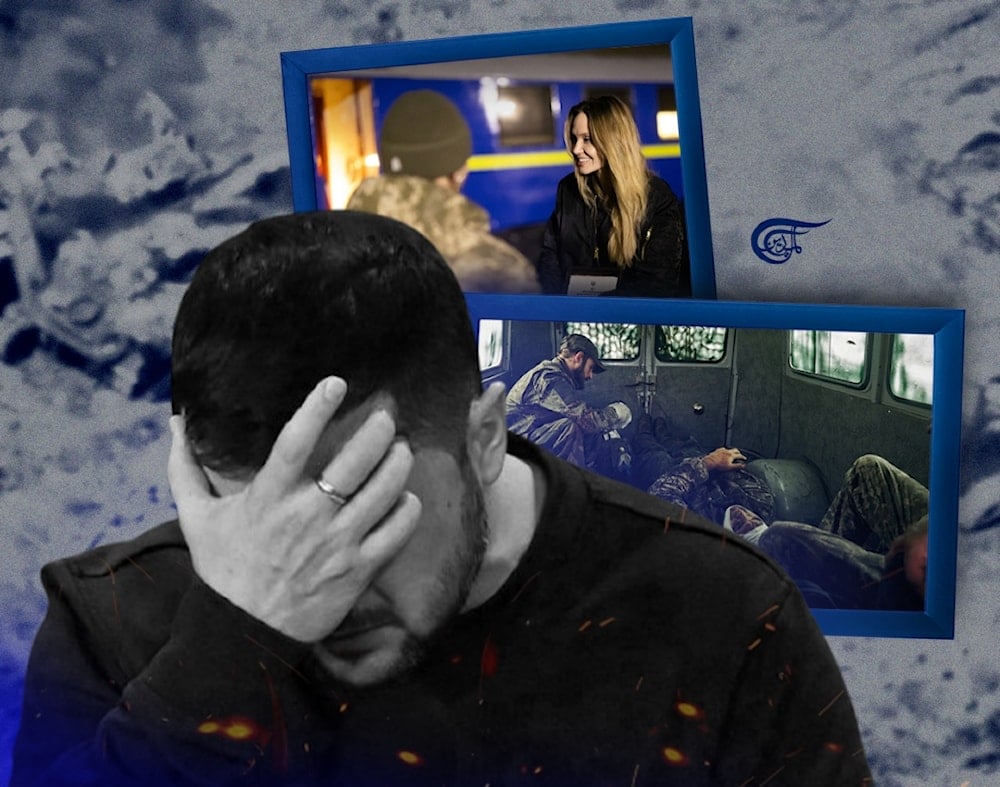
Ukrainian political analyst Mikhail Chaplyha has written that Jolie was ‘called’ to Kherson in order to divert attention from Pokrovsk. (Al Mayadeen English; Illustrated by Zeinab el-Hajj)
The beginning of the last month of autumn for Ukraine is now marked by the fall of a number of ‘fortress-cities’ in the Donbass region. Today, the region’s republics, Donetsk and Lugansk, consider themselves constituents of the Russian Federation. Several strategically important cities in the Donetsk Republic are now surrounded by the Russian army, becoming ‘sinkholes’ swallowing desperate units of the Armed Forces of Ukraine.
Ukraine’s units are either entrenched and unable to escape, or they are being sent on reckless fools’ errands seeking to ease the siege conditions under which they are now living and surviving. Two key cities in the Donetsk Republic are being enveloped. They were all renamed during the past ten years as part of Ukraine’s ‘decommunization’ drive seeking to disrupt and destroy the legacy and history of Soviet Ukraine and the broader Soviet Union (USSR): Pokrovsk, which will return to its Soviet name ‘Krasnoarmeysk’ (in honor of the Soviet Red Army of the past), and Mirnohrad (previously ‘Dimitrov’, in honor of the Bulgarian communist Georgi Dimitrov (1882-1949). A third surrounded city is Kupyansk, in the Kharkov oblast (province).
Each of these cities was populated by tens of thousands of residents prior to the current war which began in February 2022. And this war, in turn, is but the latest stage of the civil war launched by Kiev since February 2014. The civil war targeted those regions of Ukraine which most vigorously opposed the regime change that took place since.
‘Recurring pattern’
On October 30, Russian President Vladimir Putin announced that Ukrainian troops were now surrounded in these cities and that Russian armed forces would allow Western journalists access to the surrounded Ukrainian troops to observe and report on their situation. Not surprisingly, major Western media outlets refused the proposal. The Ukrainian military has acknowledged the encirclements and the catastrophic situation overall. Many analysts in Ukraine are reminding their readers or followers that they have long warned of the need to withdraw Ukrainian troops from semi-encirclements.
Western media outlets are beginning to write about the encirclements and looming military catastrophes in and around these cities. The Washington Post headlined a November 6 report with ‘In fight over Pokrovsk, Ukraine must choose between saving territory or saving its men’.
All the experience of combat operations in recent years suggests that Ukrainian President Volodyomyr Zelensky will choose to do nothing in response to the deteriorating military situation. This is in order to buy more time and postpone the inevitable end to the proxy war it is waging along with the Western powers. Kiev (and its patrons in the NATO military alliance) will instead choose to lose both territory and soldiers in order to buy an extra week or two of time.
“It’s a recurring pattern by Kiev, seen before in Vuhledar and Kursk. There is a reluctance to conduct a controlled, militarily justified withdrawal from a threatened salient when the situation no longer favors the defender,” writes the pro-war Guardian newspaper in Britain on November 5, citing a military analyst in Finland.
On November 6, the Russian Ministry of Defense published video footage of prisoners of war of the 68th Separate Rifle Brigade of the Armed Forces of Ukraine voluntarily surrendering in Pokrovsk. The captives told another pro-war newspaper in Britain that their command had abandoned them. They said supplies of food and medicine in the increasingly encircled city are dwindling sharply and in cases become non-existent, even with the help of drones. They had been hungry for a week and were eating whatever they could find in the basements of abandoned buildings and houses.
“No food, no medicine, nothing. Maybe some people got something somewhere, but not everyone. So, it was either surrender, die of starvation, or die from a land mine. That left a choice of simply lying down on the ground,” reported Russia’s Ministry of Defense, citing one of the Ukrainian POWs.
When lies in the media are more important than reality
In spite of all the evidence to the contrary, government and military authorities in Ukraine are refusing to acknowledge reality, causing misunderstandings even among their close allies. Ukrainian opposition political analyst Kost Bondarenko compares Zelensky's stubborn denial of reality to the propaganda issued by Nazi Germany during its dying weeks in the spring of 1945. “The situation near Pokrovsk and the reaction by Ukrainian authorities (and by Ukrainian media) evoke some unpleasant analogies. The Ukrainian propaganda machine is painfully reminiscent of the German propaganda system during World War II. In the spring of 1945, Third Reich propagandists continued to claim that Germany was ‘close to victory’.”
Bondarenko admits that it worked back then. According to the testimony of captured German soldiers and officers in August 1944, about 60% of them firmly believed in Germany's victory, and in March 1945, despite the obvious facts, at least 40% of the German army still believed in victory.
“When I read the reports from the front lines written by today's propagandists, I realize that all this has already happened, we've already been through it all. But history is cyclical and usually teaches us nothing,” Bondarenko sums up the situation on the Ukrainian front and in Pokrovsk in particular.
Ukrainian political strategist Andrei Zolotarev comments wryly about the fall of Pokrovsk and the denial of this fact taking place in Ukrainian media: “We have slightly upgraded an old joke dating from Soviet times which had Napoleon saying thoughtfully: "Had I a ‘Unified Telethon’ [Ukraine’s daily, television war propaganda machine, which all media outlets are obliged to broadcast], no one would ever have known of a Waterloo." With the current situation with Pokrovsk, this derisive humor is particularly relevant.”
NATO-style ‘demilitarization’
In each of the three cities now surrounded, the same military maneuvers are repeated: Russian troops surround the city on three sides, leaving only a narrow ‘bottleneck’ for entry and exit. The narrow bottleneck is completely exposed to fire, which becomes a death trap for those who try to pass through it.
Nevertheless, in such cases, the Ukrainian command always tries to bring in armored vehicles and reinforcements, which are destroyed or badly mauled as they arrive. For the sake of such reinforcements, troops and equipment are withdrawn from other sections of the Ukrainian front, turning the semi-encircled cities into ‘sinkholes’ sucking in troops, equipment and reserves, eventually leaving nothing but a trace. Along the ‘stripped’ sections of the Ukrainian fronts from which reserves were withdrawn, the Russian army advances slowly.


For months, Russian troops have left open narrow bottlenecks, tempting Ukrainian troops to try a harrowing retreat through corridors one to three kilometers wide. Soon, entire roads turn into death zones and graveyards of destroyed NATO-supplied military equipment. This is the grim reality of how ‘demilitarization’ is currently taking place in Ukraine.
Some Russian military experts have long been asking why Russia does not destroy the strategic bridges across the Dnieper River, which have long been used to transport Western-supplied weaponry to the Ukrainian front. Counter-arguments say that Western equipment should reach the front (and get caught in ‘sinkholes’) because otherwise it will be positioned somewhere else, far from the front lines or at NATO bases themselves. This will pose a continued threat to any country or region where NATO countries decide to impose their ‘rules’.
Based on conversations with Ukrainian military personnel, the publication Ukrainska Pravda reports that the fall of Pokrovsk will automatically mean the fall of the neighboring town and district of Mirnohrad. It says it is no longer possible to evacuate equipment from Mirnohrad. First and foremost, this concerns drones, which they estimate to be worth billions of hryvnia (1 USD equals 42 Ukrainian hryvnia). The Ukrainian military claims that “a bunch of Ukrainian UAV pilots have already been killed” in Pokrovsk. “Armed forces personnel are lying along our routes, but they cannot be evacuated because those are kill zones,” the publication reports in horror.
Fugitive legislator Artem Dmitruk writes from London on his Telegram channel that Zelensky is deliberately pushing his soldiers into encirclement for the sake of political ambitions, knowing that there will be no way out for them. “I have been receiving messages from soldiers in the Pokrovsk direction for a month now. Not one or two, but dozens. They all say the same thing: they are going to their deaths. There is no evacuation; there is no rotation; there is no support,” reports the former legislator from Zelensky’s party.
Ukrainian analyst Konstantin Mashovets from the Information Resistance group, describing the tactics of Russian troops, says that they first deliberately destroy Ukrainian UAV operators. Once Ukraine's drone activity declines, small Russian infantry groups advance.
Zelensky's game
These Russian tactics were first used in the long battles for the cities of Bakhmut and Avdiivka in the Donetsk Republic, and in the Kursk region of the Russian Federation. It has worked each time, prompting Zelensky ally and legislator Mariana Bezuhla to write back in the middle of October that “Russian generals are playing with our generals.”
This ‘playing’ has been repeated for four years without any significant changes in tactics. It is possible solely because Zelensky cares only about the media effect of his decisions. At the cost of thousands of lives and hundreds of pieces of destroyed Western equipment, cauldrons are maintained… until the next NATO or EU summit, or until the next meeting with Donald Trump or Emmanuel Macron.
Today, as imprisoned Ukrainian legislator Alexander Dubinsky wrote on November 6, Trump's support for Zelensky depends on the situation in Pokrovsk. If the defenses there collapse, this will set the stage for a next round of pressure against Ukraine from the West to keep Kiev obedient.
Ukrainian experts previously believed that all the lies and inaccurate assessments of the situation were intended for one audience only, Donald Trump, in the hope that Ukrainian lobbyists in the US administration would, in turn, repeat and propagate the same lies.
In this regard, the Ukrainian political elite has recently been questioning the preparedness and adequacy of the country's political and military leadership. Zelensky's stubborn denial of reality and excessive self-confidence in front of Western partners give rise to such suspicions. However, most people in Ukraine believe that Zelensky is only being given embellished information that he simply echoes.
Former legislator and ex-speaker of the fascist organization ‘Right Sector’, Boryslav Bereza, claims that Zelensky's inadequacy frightens many representatives of the Ukrainian political elite. He believes that Zelensky's access to information is being deliberately restricted and that this explains why he is supposedly uninformed of 90 per cent of what is taking place along the front lines. Bereza says that Ukrainian officials literally clutch their heads when orders from the Office of the President reach them. He says he recently spoke with two current Ukrainian ambassadors as well as a minister, and they all asked him to explain what is going on with Zelensky and why.
In the Middle Ages, there was a widespread saying used to lull restive and unhappy masses: ‘The king is a good man but is not informed about the misfortunes of his people.’
A Hollywood celebrity’s adventures in Ukraine
Negative news about the fall of cities in Ukraine is often countered by staged “support visits” from Hollywood stars or members of the British royal family (Zelensky's most ardent supporters). On Wednesday, November 5, Ukrainian media reported on the sudden visit of American actress Angelina Jolie to the city of Kherson on the Dnieper River, which is under the control of the Armed Forces of Ukraine (with the exception of some islands in the river that recently came under the control of the Russian army).
Jolie already visited Ukraine in 2022. As part of its crusade to better control the workings of the USAID agency, voices in the Trump administration are claiming that Hollywood stars are being paid large fees by USAID for such support visits.
On the way to Kherson, Jolie reportedly encountered some ‘difficulties’ which demonstrate the realities of the regime she supports. In the Mykolaiv (Nikolaev) region in southern Ukraine, her motorcade was stopped by military recruitment officers who then detained one of the security guards. The man was taken to the military recruitment center, where Jolie and her entourage reportedly arrived to try and secure his release (as it later turned out, without success). Her arrival was captured on video and broadcast across social networks.
Soon, the Ukrainian television channel TSN, citing the command of the Ukrainian Armed Forces' Ground Forces, reported that Jolie had only entered the recruitment office to use the restroom, after which she continued on her way to Kherson. Ukrainian commentators immediately asked whether there was really nowhere else for the famous celebrity to use the restroom but the conscription office. They reminded that the office in question is considered to be a military facility.
Ukrainian Telegram channels asked ChatGPT about the probability that Jolie would choose a military recruitment office for a restroom visit. The AI machines estimated the probability at less than one per cent.
Of all these contradictory stories about the celebrity’s trip, the only thing that is clear is that the entire public relations visit was poorly coordinated. That day and after, Ukrainian media talked about little else but Angelina Jolie's visit to Kherson and sought details about the condition of her bodyguard. Conveniently, this pushed news of the unfolding disaster of the Ukrainian Armed Forces in Pokrovsk into the background.
Ukrainian political analyst Mikhail Chaplyha has written that Jolie was ‘called’ to Kherson in order to divert attention from Pokrovsk and acknowledged, “I have to admit, the idea was great as was the execution. People loved it… for the idea and the execution. Excellent work!”
Alexander Shelest commented, “Well, that's that! Let’s all forget about Pokrovsk and stop wallowing in bad news!”
Considering Angelina Jolie's previous fees for one-day PR visits, it may be assumed that Zelensky's lobbyists paid no less than $20 million for the visit to Kherson, for her and her delegation. Since it is obvious that the situation in Pokrovsk and elsewhere can only get worse, American celebrities may anticipate earning good money for each such call. After all, mansions in California are becoming very costly to maintain, due to non-stop droughts, wildfires, rainfall disasters, and ocean storms.
Paradoxically, the current type of warfare taking place in Ukraine does meet the objectives of both sides, considering the constraints operating the Ukrainian side. Russia, with its great military advantage, is effectively ‘demilitarizing’ the aggressive and threatening countries of the European Union while it gains sovereignty over the mineral-rich Donbass region. The Zelensky administration and its Western lobbyists, meanwhile, are gaining much personal and ‘heroic’ publicity out of the situation and using this to uphold their entrenched positions.