
56 Iranian cultural sites damaged in US-Israeli aggression
 4 Min Read
Iran says attacks on cultural heritage amount to violations of international law.
-
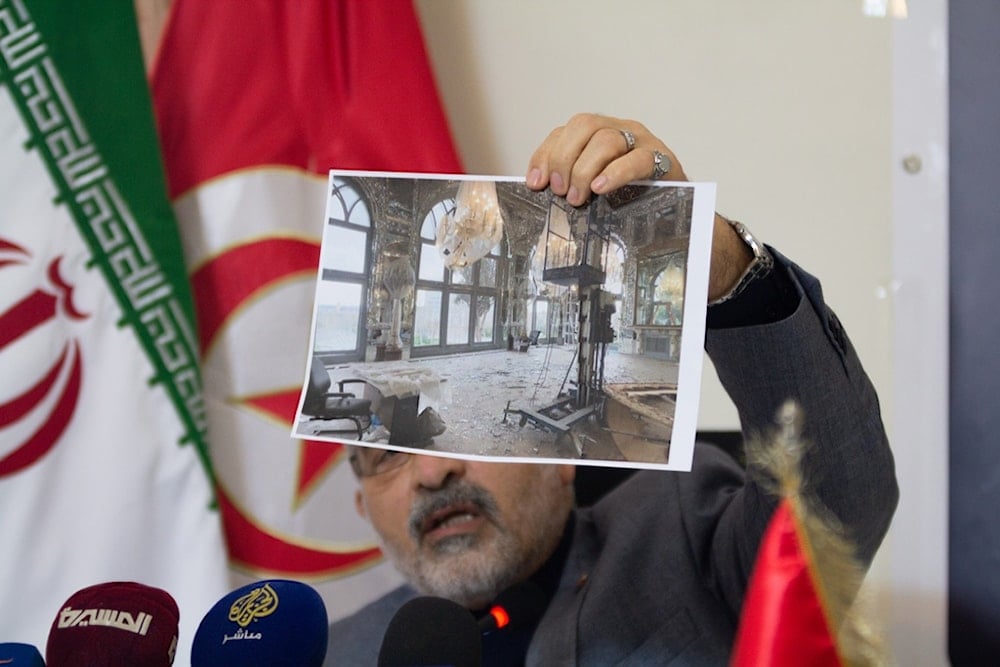
Iranian Ambassador Mir Massoud Hosseinian shows an image of damage to the historic Golestan Palace in Tehran, a UNESCO World Heritage site, during a press conference at his residence in Tunis, Tunisia, Thursday, March 12, 2026 (AP)
At least 56 museums, historical monuments, and cultural sites across Iran have been damaged since the start of the US-Israeli aggression, according to Iran’s Ministry of Cultural Heritage, Tourism, and Handicrafts.
In a report released on Saturday, the Ministry said the attacks have affected numerous museums and historically significant landmarks, including several sites recognized as part of the world’s cultural heritage. Officials warned that the damage extends across multiple provinces and includes monuments dating back centuries.
Tehran among the hardest-hit areas
The capital, Tehran, has been among the most affected locations, with at least 19 historical and cultural sites damaged during the strikes.
Among the locations impacted is the historic Golestan Palace, a landmark complex that dates back to the Qajar era and is listed as a UNESCO World Heritage Site.
Iranian authorities said the palace, which has long symbolized the country’s cultural and architectural heritage, sustained damage as a result of nearby attacks.
Heritage sites struck across several provinces
Damage has also been reported in several other provinces across the country. In western Iran, at least 12 historical locations in Kurdistan Province were affected, including sites recognized for their historical and cultural value.
Several major landmarks in Isfahan Province were also targeted, including the famed Chehel Sotoun and Naqsh-e Jahan Square, both of which are central to Iran’s Safavid-era architectural legacy and draw international visitors each year.
Authorities further reported damage to historical buildings in the Lorestan and Kermanshah provinces, regions known for their ancient cultural landmarks. In the ancient coastal settlement of Siraf, located in Bushehr Province, several monuments were also damaged during the strikes.
Meanwhile, in Ilam Province, the Ilam Museum of Archaeology, which houses numerous artifacts and historical objects, was reportedly targeted during the attacks.
Iranian officials condemn attacks on cultural heritage
Iranian officials have strongly condemned the strikes, saying that the United States and “Israel” are targeting sites that form part of the cultural heritage of humanity.
Iran’s Foreign Minister Abbas Araghchi denounced the attacks in a post on social media, stating that historical monuments dating back centuries had been struck.
“Israel is bombing Iranian historical monuments dating as far back as the 14th century. Multiple UNESCO World Heritage Sites have been struck,” Araghchi said.
“It is natural that a regime that will not last a century hates nations with ancient pasts. But where is UNESCO? Its silence is unacceptable,” he added.
Israel is bombing Iranian historical monuments dating as far back as the 14th century. Multiple UNESCO World Heritage Sites have been struck.
— Seyed Abbas Araghchi (@araghchi) March 12, 2026
It's natural that a regime that won't last a century hates nations with ancient pasts. But where's UNESCO? Its silence is unacceptable. pic.twitter.com/7eu09Cjiyf
Violations of international law
Iranian authorities have said that the attacks on cultural and historical sites constitute serious violations of international humanitarian law.
They pointed to several international legal frameworks that prohibit targeting cultural heritage during armed conflicts, including the 1954 Hague Convention for the Protection of Cultural Property in the Event of Armed Conflict, the Geneva Conventions, and the Rome Statute of the International Criminal Court.
Under these agreements, deliberate attacks against historical monuments and cultural property may amount to war crimes.
Escalation following US-Israeli aggression
The attacks on cultural sites come amid the broader military escalation triggered by the US-Israeli aggression on Iran, which began in late February with bombardment across Tehran and other areas of the country.
Since then, Iranian armed forces have responded with missile and drone strikes targeting positions in the Israeli-occupied territories and US military bases across the region.
Iranian officials have repeatedly stated that the country’s actions constitute legitimate self-defense, citing Article 51 of the United Nations Charter, which affirms the right of states to defend themselves against acts of aggression.


