
Berlinale, where mentioning genocide offends more than committing it
 4 Min Read
Berlinale erupts as speeches speaking against the genocide in Gaza at the closing gala threaten director Tricia Tuttle's job, while hundreds of filmmakers push back.
-
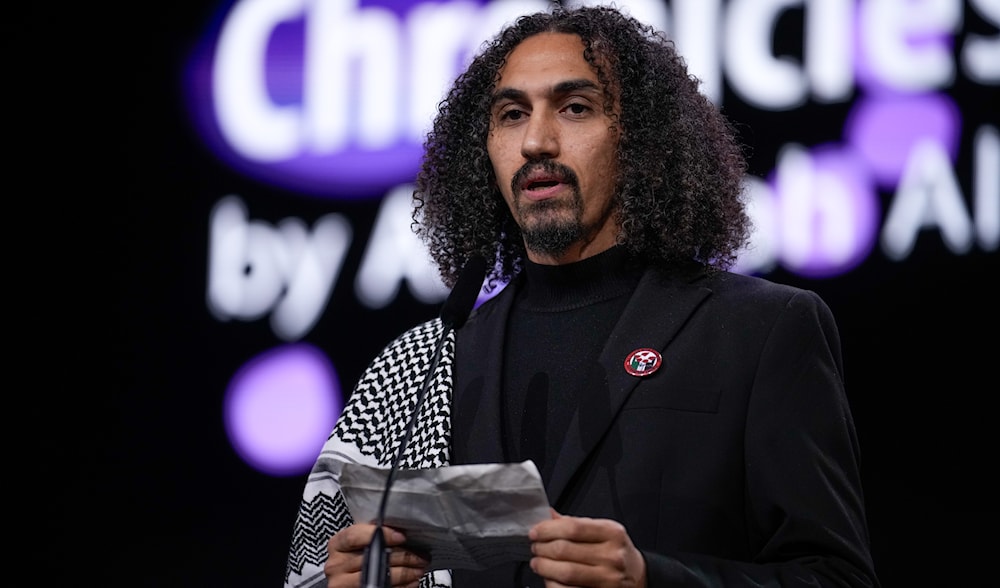
Director Abdallah al-Khatib addresses the audience after receiving the GWFF best first feature award for 'Chronicles from the Siege' during the awards ceremony for the Berlinale, in Berlin, Saturday, Feb. 21, 2026 (AP)
A political storm has engulfed the Berlin International Film Festival following a series of pro-Palestine speeches at its closing gala, sparking an emergency meeting over the future of its American director, Tricia Tuttle, and drawing a wave of international support from the filmmaking community.
Germany's federal government commissioner for culture and media, Wolfram Weimer, convened an extraordinary meeting of the KBB supervisory board, the state-owned company that runs the festival, on Thursday to discuss the "future direction of the Berlinale."
The gathering came after German tabloid Bild reported that Tuttle faced dismissal, citing sources close to Weimer. KBB initially dismissed the report as "fake news", while Weimer's office later confirmed the meeting had been "constructive and open," adding that discussions would "continue in the coming days."
Speeches at closing gala ignite backlash
The controversy centers on last Saturday's awards ceremony, where Syrian-Palestinian director Abdallah al-Khatib, who won the best first feature prize for his drama Chronicles From the Siege, told the audience: "My final word to the German government: you are partners in the genocide in Gaza by Israel."
Der Gewinner des besten Spielfilmdebüts („Chronicles from the Siege“) Abdallah Alkhatib bei der Berlinale!
— Shoura Hashemi (@ShouraHashemi) February 21, 2026
Er bezeichnet die deutsche Regierung als Partner des Völkermords in Gaza. Nutzen wir die Räume, die sich bieten. Und wer peinlich berührt ist, ist eben peinlich berührt. pic.twitter.com/N8bNOqu6Ed
Lebanese director Marie-Rose Osta, accepting the Golden Bear for best short film for Someday a Child, also condemned Israeli strikes, saying: "No child should need superpowers to survive a genocide empowered by veto powers and the collapse of international law."
View this post on Instagram
The speeches triggered immediate backlash from German officials. Environment Minister Carsten Schneider walked out of the ceremony, calling al-Khatib's remarks "unacceptable". "Israel's" ambassador to Germany, Ron Prosor, also condemned the speech, and Christian Social Union parliamentary group leader Alexander Hoffmann accused al-Khatib of "antisemitic slurs and threats against Germany."
According to Bild, Weimer was also offended by a photograph taken a week earlier showing Tuttle alongside al-Khatib's film crew, several members of whom were wearing koufiyyeh scarves with one holding a Palestinian flag, though the Berlinale director routinely photographs crews during the festival.
🇵🇸 Berlinale Direktörü Tuttle, Filistin bayrağının yanında durduğu için görevden alınacak
— harici (@haricitr) February 26, 2026
🚨 Almanya Kültür Bakanı Wolfram Weimer, festivalden sorumlu şirketi toplantıya çağırdı
⚠️ İsrail’i soykırım ile suçlamak “antisemitizm skandalı” sayıldı
🚩 “Solcular ve Filistinliler… pic.twitter.com/PTqCDjqalK
Filmmakers rally behind Tuttle
The prospect of Tuttle's dismissal, however, triggered a broad and swift backlash from the international arts community. Nearly 700 filmmakers signed a petition published in Variety backing her leadership, including Oscar winners Tilda Swinton and Todd Haynes, directors Sean Baker, Kleber Mendonça Filho, and Tom Tykwer, as well as Israeli filmmakers Oren Moverman and Ari Folman.
More than 500 Berlinale staff members also signed an open letter praising her "clarity, integrity, and artistic vision."
"What is at issue is the relationship between artistic freedom and institutional independence," the petition read. "If every controversy leads to institutional repercussions, discourse gives way to control."
PEN Berlin echoed the sentiment, warning that al-Khatib's speech was "protected by freedom of expression" and that Tuttle bore no responsibility for the views of festival participants. It cautioned that her removal would cause "immense damage" to the festival and amount to "wanton destruction of the German cultural scene."
Several Israeli cinema institutions, including the Jerusalem and Haifa film festivals, also voiced support for Tuttle, praising her "commitment to diversity of voices and non-censorship."
A festival under strain from the start
The tension was not new. The 76th edition of the Berlinale had been fraught from its opening day, when jury president Wim Wenders said film institutions should "stay out of politics" when asked about Gaza, remarks that prompted Indian author Arundhati Roy to cancel her appearance and drew condemnation from more than 80 film professionals in an open letter.
Tuttle forcefully defended artistic free speech throughout, while Wenders later walked back his comments at the closing ceremony, acknowledging that "activists fighting for human dignity" share the same causes as cinema.
The Berlinale, now in its 76th year, has long positioned itself as a politically engaged festival distinct from its more commercial rivals, Cannes and Venice. But the genocide in Gaza has sharpened the fault line between its international artistic community and the German political establishment, which has maintained a firm pro-"Israel" stance rooted in the country's post-Holocaust reckoning.


