
European countries boycott Eurovision final, air Gaza, other segments
 4 Min Read
Several European broadcasters have offered alternative programming ranging from comedy reruns to Gaza documentaries and music specials.
-
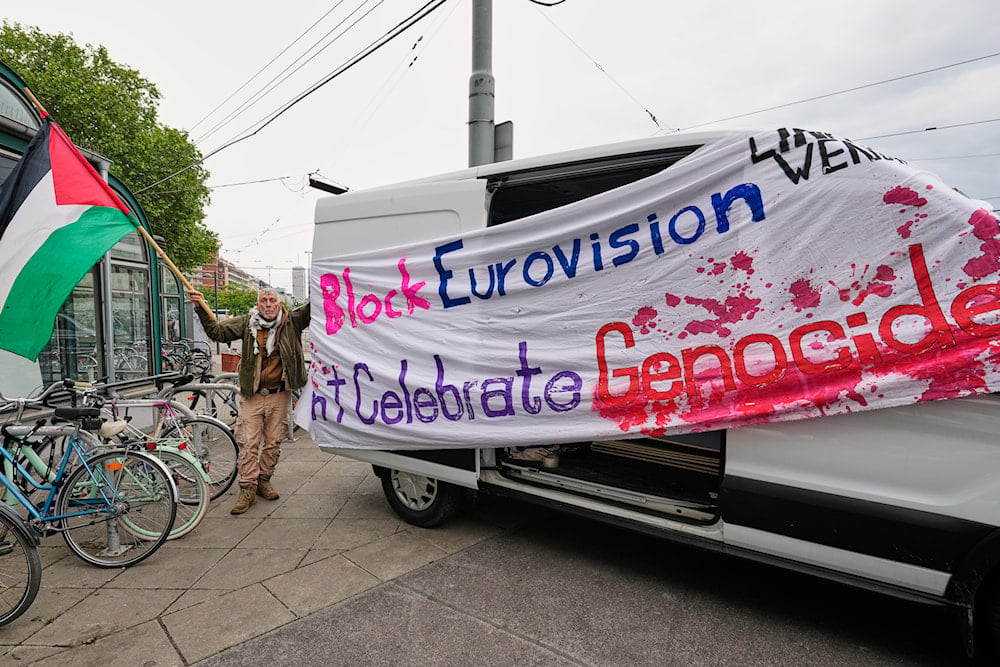
A man waves a Palestinian flag to protest against "Israel" ahead of the first semi-final of the 70th Eurovision Song Contest in Vienna, Austria, on May 12, 2026 (AP)
The growing wave of withdrawals and alternative broadcasts surrounding Eurovision reflects more than disagreement over a song contest, Reuters reported. It signals a widening political and moral divide in Europe over the war on Gaza and the continued Israeli participation in high-profile cultural platforms.
For many critics, Eurovision is no longer a purely “non-political” celebration of music. Instead, it has become another stage where geopolitical realities are normalized, even as civilian suffering in Gaza continues to dominate global headlines.
Five countries, Ireland, Spain, Slovenia, the Netherlands, and Iceland, are boycotting this year’s event over "Israel’s" continued participation in it, marking the biggest crisis in the contest’s 70-year history.
The moment "Israel’s" contestant, Naom Bettan, stepped onto the stage at the 2026 Eurovision Song Contest, the arena was overtaken by chants of "Stop, stop, stop the genocide," as pro-Palestine protesters disrupted the performance in a direct act of defiance against "Israel’s"… pic.twitter.com/wAMs7Zwmgm
— Al Mayadeen English (@MayadeenEnglish) May 13, 2026
Spain, one of the contest's longest-standing participants, announced it would withdraw and not broadcast the competition for the first time in its history. Spanish Prime Minister Pedro Sanchez said earlier this year that just as Russia was expelled after the Ukrainian war, "Israel" should also be removed.
"Spain's commitment to international legality and human rights must be constant and consistent, including in Europe," the Spanish prime minister said today during an event in Madrid.
Is neutrality an option?
The decision by broadcasters in these countries to replace or modify Eurovision coverage highlights a broader question: can cultural institutions remain neutral when wars and mass displacement are ongoing?
According to Reuters, supporters of the boycott argue that neutrality in such moments is itself a political stance. By continuing to whitewash Israeli crimes in an international entertainment format, they say institutions risk appearing indifferent to the war crimes, civilian deaths, and media restrictions in Gaza.
In this view, alternative programming, whether documentaries on Gaza, curated music shows, or even comedic reruns like "Father Ted", is not simply a symbolic protest. It is an attempt to redirect public attention toward narratives they believe are underrepresented in mainstream European broadcasting.
While some broadcasters have opted out or shifted their programming, others continue to air the contest, citing audience demand and the European Broadcasting Union’s principle that Eurovision is non-political.
Yet critics argue that such a position is increasingly difficult to sustain, pointing to visible protests during performances, declining viewership in some markets, and growing public polarization as evidence that Eurovision is already embedded in political reality, whether organizers acknowledge it or not.
Gaza genocide, the central fault line
At the center of this dispute is the ongoing war on Gaza, which has reshaped political discourse across Europe. The war has intensified public scrutiny of cultural and sporting events that include “Israel", with activists and some media organizations calling for boycotts or symbolic withdrawals.
For supporters of Palestinian rights, the Eurovision controversy is part of a broader campaign to apply cultural and economic pressure in response to the war, arguing that broadcaster decisions are not disruptions, but an alignment with public conscience in countries where solidarity movements have grown significantly.
Eurovision has long promoted itself as a space of unity through music. But its current crisis raises difficult questions about whether that identity can survive in an era of global polarization.
As broadcasters take divergent paths, some boycotting, others continuing coverage, the contest increasingly reflects the very divisions it was designed to transcend. Whether this moment marks a temporary disruption or a lasting transformation of Eurovision’s cultural role remains uncertain. What is clear, however, is that the boundary between entertainment and politics has become far harder to define.
This comes after broadcasters from Iceland, Ireland, Spain, and the Netherlands had threatened in December last year to withdraw from this year's contest if "Israel" is permitted to compete. Belgium, Finland, and Sweden indicated they were considering a boycott, expressing frustration over "Israel’s" crimes in Gaza and the contest being used for political influence rather than musical expression.
Read next: Eurovision 1994 winner to return trophy over 'Israel' participation


