
Black Sea grain crisis puts global wheat supplies under pressure
 6 Min Read
Black Sea wheat exports face disruption as Russia-Ukraine attacks threaten global grain supplies, driving food security concerns and higher prices.
-
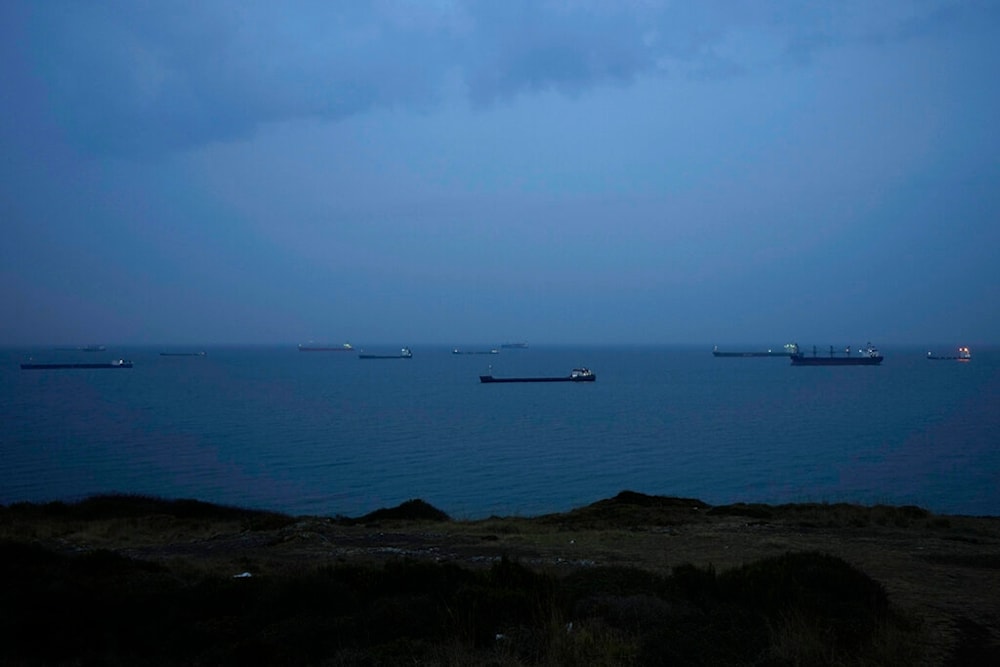
Cargo ships anchor at the Black Sea wait to cross the Bosporus strait in Istanbul, Turkey, Thursday, Nov. 17, 2022. (AP)
The disruption of grain shipments from the Black Sea is deepening concerns over global food security, with Russia and Ukraine’s reduced wheat exports threatening to push prices higher and intensify inflation pressures.
The two countries account for more than a quarter of global wheat trade, making the Black Sea a critical route for grain shipments to some of the world’s largest importers. However, escalating attacks on ports, grain terminals, storage facilities, and vessels have severely disrupted exports since July.
The crisis comes as markets remain focused on energy disruptions and rising oil prices linked tothe US and Saudi aggressions in West Asia, while food supply risks have received less attention from investors.
"We can think of the Black Sea as important for global wheat trade as the Strait of Hormuz is for global oil trade," Caitlin Welsh, a food security expert at the Center for Strategic and International Studies, said. "The world is underestimating the impact of these attacks."
Black Sea grain routes face mounting pressure
Tue Vuong, chief executive officer of Golden Wheat, a milling company based in Ho Chi Minh City, secured four cargoes of wheat from the Black Sea region, accounting for about a fifth of the company’s annual supply.
However, after the summer escalation in the Russia-Ukraine war, he was informed that some shipments would not be delivered.
"I was very panicked," Vuong said. He received replacement offers for two cargoes from Bulgaria but spent weeks searching for additional supplies to avoid shortages.
"We were too exposed to a crisis in the Black Sea," he added.
Golden Wheat eventually switched two vessels to load Bulgarian wheat from Burgas, located about 500 kilometers from the Ukrainian port of Odesa. Vuong also monitored shipping movements, insurance conditions, and developments in the Red Sea, where vessels face additional security concerns.
"Although the vessels were insured, if they had been attacked, we would have faced shortages," he said.
The company later turned to US wheat supplies at a significantly higher cost, while prices continued to climb.
Russia and Ukraine wheat exports disrupted
Russia and Ukraine are among the world’s largest wheat exporters, while also accounting for major shares of sunflower oil and corn shipments.
Combined Russian and Ukrainian wheat exports are expected to reach roughly half last year’s level during the July-September harvesting period, according to researcher SovEcon.
Egypt, the world’s largest wheat importer, has not received Black Sea grain shipments for about a month. Russia’s exports have been affected by Ukrainian drone attacks, while Ukraine has struggled to move grain after damage to ports and disruptions to shipping routes.
Ukraine has attempted to redirect exports through Romania’s Constanta port and alternative routes along Romania and Bulgaria’s coastlines, but these channels are facing congestion.
A backlog of around 80 mostly smaller vessels has formed around Ukrainian Danube ports as traffic moves away from major Black Sea terminals, according to ship-tracking data compiled by Kpler and Bloomberg.
Countries search for alternative wheat supplies
Importers have turned to alternative suppliers as Black Sea shipments remain uncertain.
France has sent its first wheat shipment to Sudan in 18 years, while Libya has used the port of Rouen for the first time in more than a decade, according to local shipping data.
Turkey, the United Arab Emirates, and other countries have sought grain from Baltic states including Lithuania, Latvia, and Estonia. Bangladesh has looked to suppliers such as Romania and Argentina while also securing smaller shipments from India after New Delhi lifted a long-standing export ban.
Australia, which has yet to begin collecting its latest harvest, has also received increased interest from buyers.
"Every day we're fielding inquiries from all over the world," William Reid, wheat trading manager at CBH Group, said. "It's been extraordinarily busy. We have to ration some demand because we can't literally continue to lose that volume of wheat."
Food security concerns grow worldwide
The disruption comes as other agricultural producers face their own challenges. Drought has reduced wheat and corn yields in the US, while heat waves have affected European crops.
The combination of supply disruptions, higher fuel costs, and fertilizer price increases has raised concerns over food inflation.
"When wildfires and droughts prompted Russia to ban wheat exports in 2010, it fueled food price spikes, a contributing factor in the Arab Spring," the report noted.
This time, dependence on Russian grain is even greater in parts of Africa and West Asia, where many countries rely on affordable Black Sea wheat to maintain subsidized bread programs.
Russia and Ukraine account for about half of Egypt’s wheat imports. Around two-thirds of Egyptian households receive subsidized bread, and rising flour costs are increasing pressure on bakeries.
Tarek Saeed Hassanein, head of the Grain Industry Chamber at the Federation of Egyptian Industries, said flour prices have increased due to the decline in Black Sea supplies.
Egypt has benefited from a strong domestic wheat harvest this year, allowing the government to maintain reserves for subsidized bread consumption until February, according to Hassanein.
No quick replacement
Russia has sought alternative export routes through Kazakhstan, the Baltic and Caspian seas, and the Far East, but these options carry higher transportation costs.
The Black Sea remains central to Russia’s agricultural exports, accounting for more than 70% of its grain shipments.
For Ukraine, the challenge is even greater. Ports around Odesa previously handled about 90% of the country’s grain exports, while agricultural shipments generate more than half of Ukraine’s export revenue.
Ukraine’s grain storage capacity could reach its limit by early November, forcing some farmers to rely on temporary storage solutions.
The European Union has supported alternative transit routes, but EU Foreign Affairs Chief Kaja Kallas warned that there is no replacement for the volume that can be transported by sea.
For now, hopes of a diplomatic solution have pushed wheat prices lower, but analysts at Bloomberg Intelligence warned that markets may be underestimating risks.
Vuong said he does not expect wheat prices to return to normal soon, regardless of developments in the Black Sea.
"The seller asked for a delivery extension to give them more time," he said, "waiting for some miracle to happen in Odesa."
Read more: ‘Not even grain of wheat will enter Gaza’: Israeli finance minister


