
Carney declares US economic ties 'weakness,' promises diversification
 4 Min Read
Carney's government is now pursuing trade diversification, a domestic defense industrial strategy, and internal market reform.
-
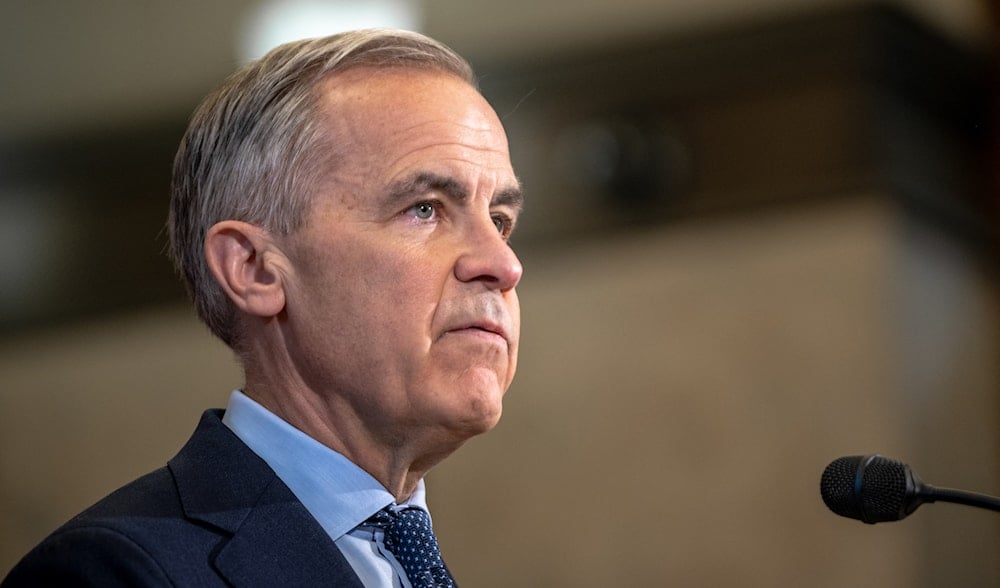
Canadian Prime Minister Mark Carney speaks during a press conference at the West Block on Parliament Hill in Ottawa, Ontario, Canada, on April 14, 2026. (Photo by ANDREJ IVANOV / AFP)
Canadian Prime Minister Mark Carney has declared that his country's once-close economic ties to the United States have become a "weakness that must be corrected," pledging to reorient Canada's economy away from its historic dependence on its southern neighbour.
In a 10-minute video address released Sunday, Carney said the strength Canada once derived from its deep integration with the US had been upended by the Trump administration's trade posture.
"The US has fundamentally changed its approach to trade, raising its tariffs to levels last seen during the Great Depression," he said.
"Many of our former strengths, based on our close ties to America, have become weaknesses. Weaknesses that we must correct."
A dependence decades in the making
The scale of the challenge Carney is confronting is significant. Approximately 70% of Canadian goods and services exports are destined for the United States, with the US also accounting for $459.6 billion in foreign direct investment in Canada as of 2024.
Around half of all bilateral goods trade moves between related companies across the border. The two economies are not merely trading partners but are structurally intertwined at the level of supply chains, energy infrastructure, and manufacturing.
That integration has become a liability. Carney said tariffs imposed by US President Donald Trump have hit workers in the auto and steel industries particularly hard, while businesses are holding back investments "restrained by the pall of uncertainty that's hanging over all of us."
'Hope isn't a plan'
Carney, who served as governor of both the Bank of Canada and the Bank of England, has made economic sovereignty a central pillar of his government since taking office.
He rejected any strategy built on waiting out the Trump administration. "Hope isn't a plan and nostalgia is not a strategy," he said, adding that simply hoping "the United States will return to normal" was not feasible. "We can't control our future on the hope it will suddenly stop."
In the address, Carney outlined plans to attract new investment, double clean energy capacity, reduce internal trade barriers, and increase defense spending, all framed as measures to build resilience against external disruption.
Earlier this month at the Liberal Party's national convention, Carney declared that "the days of our military sending 70 cents of every dollar to the United States are over," a reference to Canada's heavy reliance on US suppliers for military capital procurement. Ottawa has since launched a defense industrial strategy aimed at redirecting contracts toward domestic and European partners.
Majority mandate, growing pressure
The address comes days after Carney secured a majority government following special election wins, strengthening his hand to pursue the diversification agenda.
The opposition Conservatives have pressed him to prioritise a bilateral trade deal with Washington, a promise from last year's campaign, but Carney signalled Sunday that Canada's strategic direction runs broader than any single negotiation.
"We have to take care of ourselves because we can't rely on one foreign partner," he said. "We can control what happens here. We can build a stronger country that can withstand disruptions from abroad."
Canada has already begun redirecting trade flows, with merchandise exports to non-US markets rising 17% year-on-year in the 12 months to January 2026, even as exports to the US fell 10%.
Carney said he would give Canadians regular updates on diversification efforts, and promised not to soften the message. "I promise you I will never sugarcoat our challenges," he said.


