
Iran will not wait for 'bombs to fall' to retaliate | Excl.
 11 Min Read
Iran warns it could strike US military assets beyond West Asia if Washington resumes its war, Professor Mohammad Marandi says.
-
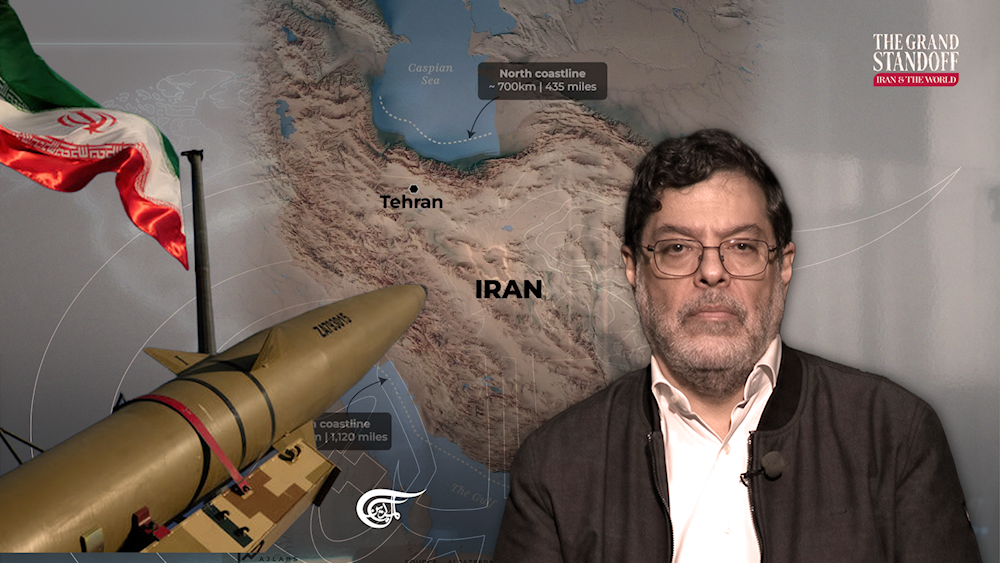
Iranian Professor of English Literature and Orientalist Studies at the University of Tehran, Mohammad Marandi (Al Mayadeen)
Iran is prepared to strike US military assets beyond West Asia if Washington resumes its war against the country, Professor Mohammad Marandi of the University of Tehran said, warning that Tehran would not wait for attacks to begin before responding.
Speaking on Al Mayadeen's The Grand Standoff: Iran and the World, Marandi said Iran had placed its armed forces on full alert and was prepared to respond to any escalation, including actions involving the United States and "Israel". He pointed to changes in Iran's military strategy, particularly the expansion of its ability to target assets beyond the previously maintained 2,000-kilometer missile range.
"Iran has said that it will not even wait till the bombs start falling," Marandi stated.
He added that Tehran would act as soon as it identified preparations for an attack, arguing that US military installations across the region and beyond could no longer be considered safe. Iran had already demonstrated its ability to strike American positions, he emphasized, and would extend that capability to assets being used against the country from more distant locations.
Iran expands its targeting scope as US military assets relocate
The relocation of US military assets following earlier Iranian strikes was central to Marandi's assessment of the changing military situation, which noted that American forces had initially concentrated much of their equipment and military infrastructure near Iran's borders, where Iranian attacks destroyed bases and assets.
According to Marandi, US forces subsequently moved equipment to Jordan, where Iranian strikes also hit American positions, before relocating further into occupied Palestine and other locations. Washington was now seeking to keep its military hardware in Europe and elsewhere while retaining the ability to use it against Iran.
"Iran does not want the Americans to feel that its military assets are safe in Diego Garcia or in bases across Europe," he argued.
Marandi further argued that Tehran's expanded targeting capabilities would complicate Washington's ability to sustain military pressure against Iran, maintaining that Iranian forces now had the means to strike American military hardware wherever it was being used against the country, including locations far beyond West Asia.
He also pointed to increased Iranian attacks against vessels violating instructions issued by the Islamic Republic's armed forces, saying ships linked to countries assisting Washington were facing more severe strikes.
"These ships, of course, are linked to countries that are assisting the United States in its war against Iran," Marandi said, adding that Iran was striking such vessels more frequently and inflicting greater damage than before.
Marandi accuses US media of manufacturing support for renewed war
Marandi also accused US political figures and media organizations of promoting allegations about Iran to generate public support for further military action. He argued that these narratives were intended to create fear among Americans who opposed the war and weaken resistance to a renewed escalation.
He cited statements by US President Donald Trump alleging that Iran intended to destroy Los Angeles and San Diego with nuclear weapons, as well as claims by Israeli Prime Minister Benjamin Netanyahu that Tehran was preparing chemical weapons. Marandi rejected the allegations, arguing that they formed part of a broader effort to portray Iran as an imminent threat.
"Now we all know that it was the United States that gave Saddam Hussein chemical weapons to use against his own people in Iran. Iran never used chemical weapons," he said.
He also questioned allegations linking Iran to cyberattacks in the United States and Europe, including reports about malfunctioning freezers in France, dismissing the accusations as implausible and criticizing media coverage suggesting that Tehran had been pursuing nuclear weapons for decades.
"They're manufacturing consent for war," he said, referring to a CNN program discussing Iran's nuclear ambitions and an article in The New York Times concerning Iranian dams.
Marandi argued that such coverage was intended to prepare the public for attacks on critical infrastructure, including water supplies and electricity facilities. He also rejected allegations that Iran was considering using a dirty bomb in Washington, accusing political officials and media outlets of spreading fear while attempting to shift American public opinion in favor of the war.
Global public opinion increasingly challenges Western narratives
Despite what Iran's limited ability to compete with the United States in international media, Marandi argued that public awareness of developments in West Asia had changed considerably, particularly since the beginning of the genocide in Gaza.
He explained that while Iran lacked the media influence and international communications infrastructure available to Washington and its allies, while media organizations in countries such as Qatar, Saudi Arabia and Turkey frequently advanced narratives acceptable to Western powers.
"Iran does not have the soft power capabilities of the empire. They don't have the media. They don't have the power that they traditionally have," Marandi noted.
However, he maintained that the spread of information about Gaza had made it increasingly difficult to shape international perceptions through established media channels. People in the United States, Europe and other parts of the world were becoming more aware of developments in the region and questioning the positions adopted by governments claiming to support the Palestinian cause.
"The good news is that the world has changed. And ever since the genocide in Gaza began, people have been gradually waking up," he said.
Marandi pointed to the silence of several regional governments as Israeli forces launched another offensive in Gaza, while those same governments were holding discussions about confronting Yemen, and argued that the contrast had exposed their political priorities and undermined their credibility among international audiences.
"They don't care about Palestine. But people see that now. People see right through their hypocrisy," he stated.
He acknowledged that Iran and the Axis of Resistance had limitations in their ability to influence international affairs, but maintained that the broader information environment had shifted in ways that made public opinion less susceptible to manipulation.
"But what has changed is that global public opinion cannot be deceived as easily as it was in previous decades," Marandi said.
Marandi questions Trump's position ahead of meeting with Russia and China
Turning to the broader international situation, Marandi expressed doubt that Trump would secure significant political gains, arguing that the US president was increasingly weakened by developments on several fronts, including the war against Iran, economic difficulties and the midterm elections.
"My guess is that Trump will not be able to achieve anything of substance," he said.
Marandi also pointed to developments in the Russia-Ukraine war, arguing that Moscow retained the upper hand despite recent US assistance to Ukrainian strikes against Russian refineries and the Crimea Bridge. He said Russia would continue advancing until its demands were met, further weakening Washington and its European allies.
"The Russians have the upper hand," Marandi stated, adding that they would "continue to push forward until they achieve their demands."
Relations with China presented another challenge for Washington, he continued, citing the trade war and new US restrictions targeting Chinese advances in artificial intelligence. He argued that these measures were generating further hostility toward Beijing at a particularly sensitive moment ahead of the planned summit.
Trump's influence over US foreign policy under question
Marandi questioned whether Trump could exercise sufficient control over US foreign policy, pointing to the continued Ukrainian strikes despite Trump's reported instructions to Ukrainian President Volodymyr Zelensky to stop targeting Russian refineries.
"Many believe it's the CIA that's behind this," he said, raising questions about Trump's authority if intelligence agencies continued pursuing policies opposed by the president.
He argued that Washington was approaching the summit with limited leverage, while China continued developing its economy and Russia maintained its battlefield position. Marandi also considered it unlikely that Moscow and Beijing would make major concessions to Washington, given their own interests and their growing relations with Tehran.
"Any success by the United States is not in their interest," he said, adding that Russia and China also maintained strong relations with Iran.
Iran's standing rises following war with US
Marandi argued that Iran's international standing had strengthened following the war, particularly in its relations with Russia and China. He attributed this shift to Iran's military performance and its ability to withstand the war without major external assistance, saying his recent visits to both countries had given him firsthand insight into the change.
"Iran won this war without any major help from anyone," he said, emphasizing the resilience of the Iranian people and the country's own military capabilities. He also cited Professor Robert Pape's assessment that Iran had become the world's fourth power, arguing that Washington would have to recognize Tehran's strengthened position.
"The Americans are going to have to, if they want to get out of this mess, they're going to have to deal with Iran and the Axis of resistance with respect," Marandi stated.
Tehran and Moscow expand strategic cooperation
Marandi stressed that Iranian-Russian relations extended beyond coordination ahead of a possible trilateral summit involving Trump, Putin and Xi Jinping. He said the partnership was expanding across economic, military and political fields, with both countries also taking US actions into account in their respective negotiations.
"The Iranian-Russian relationship is far more important and deeper than that," he noted.
He identified the North-South transport corridor as a key component of this cooperation, allowing Russia to develop direct trade routes with Asia and Africa through Iran. The potential for Iran to become a hub for Russian gas and grain would further strengthen bilateral ties.
"The North-South transport corridor is going to be very key for Russia in the years ahead," Marandi said, adding that "the two countries have, are expanding their relationship at multiple, at all levels."
Marandi warns Gulf governments over consequences of renewed war
Marandi warned that a renewed US attack on Iranian infrastructure could threaten the survival of several Gulf governments, particularly Saudi Arabia, Kuwait, Bahrain, Qatar and the United Arab Emirates. He argued that destroying regional oil and gas facilities would undermine their economies, while alternative pipelines could not replace maritime trade through the Strait of Hormuz.
"If Iran destroys their oil and gas infrastructure, empty pipelines mean nothing," he said, pointing out that commodities such as sulfur, helium and liquefied natural gas could not be transported through those pipelines.
"Ultimately, if these countries want to survive, if these regimes want to survive, their only way forward is to stop cooperating with the United States and its genocidal policies," Marandi stated.
Marandi criticizes regional governments over ties with "Israel"
Marandi also criticized regional governments for maintaining relations with "Israel" while presenting themselves as supporters of Palestine. He cited Turkey's continued transportation of oil from Baku and Egypt's gas purchases as examples of ongoing economic ties.
"Have any of these regimes, any of them, any regime except for Iran and Yemen, have they taken a stand against the Israelis?" he asked, warning that a US attack on Iranian infrastructure could fundamentally change the regional map.
"If Trump attacks, the map will change," Marandi said, stressing that Iran did not seek another war and had not initiated previous confrontations.
"No one should think that we want war. We have not started this war. We did not start the 12-day war," he said, warning regional governments against supporting military action against Yemen while expecting to preserve their access to maritime trade routes.
"These countries have to rethink their policies of obedience to the United States, whether it's al-Qaeda or ISIS or these family kingdoms," he concluded.


