
Marandi, Johnson: Iran’s military gains challenge US power: Exclusive
 13 Min Read
Professor and analyst Mohammad Marandi and former CIA analyst Larry C. Johnson warn that renewed US aggression against Iran could deepen military losses, strengthen Tehran’s strategic position, and trigger a global economic crisis.
-
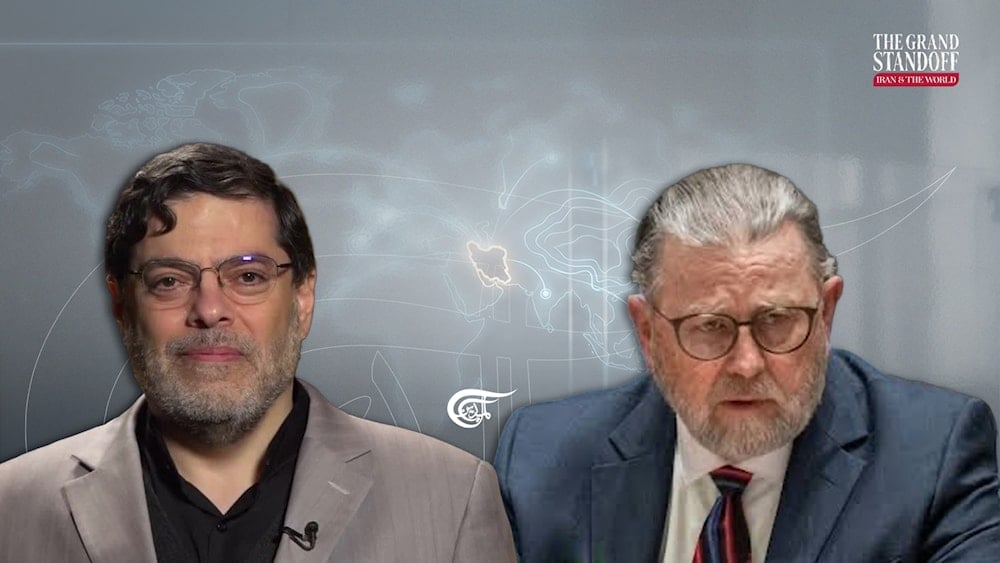
Iranian Professor and analyst Mohammad Marandi and former CIA analyst Larry C. Johnson for Al Mayadeen's The Grand Standoff: Iran and the World (Al Mayadeen English)
Iran’s military performance and the damage inflicted on US positions across the region have challenged Washington’s ability to project power and guarantee the security of its allies, Professor and analyst Mohammad Marandi and former CIA analyst Larry C. Johnson argued, warning that renewed US aggression could trigger a far more destructive phase of the war.
Speaking on Al Mayadeen’s The Grand Standoff: Iran and the World, Marandi and Johnson examined the future of Iran-US negotiations, Russia’s support for Tehran, the shifting balance of power involving China, and the vulnerabilities exposed by the war. Both argued that Washington’s traditional leverage over regional and global affairs has weakened, while Iran’s standing has risen following its military performance.
Speaking on Monday's episode of The Grand Standoff: Iran and the World, Professor Mohammad Marandi argues that #US influence is declining as Russia and China gain greater global leverage. Marandi says #Washington can no longer expect Moscow and Beijing to make concessions as they once did, questioning whether a potential trilateral summit with Trump could deliver meaningful gains for the US. @s_m_marandi
— Al Mayadeen English (@MayadeenEnglish) October 20, 2026
Marandi stressed that Tehran is not placing its hopes in US statements or diplomatic assurances, insisting that implementation of commitments is the only meaningful measure of Washington’s intentions. Johnson, meanwhile, argued that damage to US military facilities and pressure on regional air defenses have undermined the credibility of US security guarantees.
Their assessments converge on the risks of renewed escalation: both warned that another US attack would confront Washington with consequences extending well beyond the battlefield.
Iran-US MOU: Tehran demands implementation, not promises
Marandi said that Pakistan’s role in facilitating negotiations between Iran and the United States should not obscure where responsibility for the outcome lies. While acknowledging Islamabad’s constructive role in carrying messages between the two sides, he stressed that the decisive question is whether Washington will honor its commitments under the memorandum of understanding (MOU).
“At the end of the day, the role that was played was basically between Iran and the United States,” Marandi said, describing Pakistan as a facilitator rather than the party responsible for implementing the agreement.
He argued that Washington’s subsequent response had fallen short of what would be required to revive the MOU, adding that Tehran had little reason to trust assurances from President Trump.
“US statements are really of no value because Trump has lied in the past. He says one thing, does something else,” Marandi said. “He signs a piece of paper, then throws it in the trash can.”
For Tehran, he explained, the question is not whether Washington issues positive statements or signals an interest in negotiations, but whether it follows through on its obligations. Marandi expressed little expectation of an imminent breakthrough, arguing that Pakistan’s influence over US decision-making remains limited.
Johnson, meanwhile, highlighted uncertainty surrounding Pakistan’s closure of border crossings with Iran ahead of a meeting between Iranian officials and Pakistani Army Chief General Asim Munir.
He pointed to competing explanations for the closures. Pakistani accounts cited security concerns involving Baluchi elements, including an attack that killed an Iranian general, while other reports suggested that Washington had pressured Islamabad by threatening to withhold further International Monetary Fund assistance.
Johnson also noted disagreement over whether the decisions had been coordinated with Tehran, saying Pakistani sources had told him Iran had been consulted, while Iranian sources had categorically denied this.
He argued that Munir should clarify the discrepancies publicly following his visit to Tehran, underscoring the broader uncertainty surrounding regional diplomacy amid the US war against Iran.
Russia stands with Iran as US influence faces new limits
Both guests emphasized the strategic importance of Russia’s relationship with Iran, interpreting Russian Foreign Minister Sergey Lavrov’s visit to Tehran and his meeting with Iranian Foreign Minister Abbas Araghchi as a signal that Moscow is not distancing itself from the Islamic Republic.
Johnson rejected Trump's assertions that Russia was providing little or no meaningful support to Tehran, arguing that Lavrov's public appearance and statements contradicted Washington's narrative.
“If Russia's not doing anything for Iran, Lavrov wouldn't have wasted his time going,” Johnson said, describing the Russian foreign minister as a serious diplomatic figure whose statements should not be dismissed lightly.
He argued that Lavrov’s visit conveyed a message not only to Washington but also to Pakistan, Turkey, Egypt, and other regional countries: Moscow intends to maintain its relationship with Tehran rather than abandon it under US pressure.
Marandi likewise described Iran-Russia relations as particularly close, noting that cooperation had expanded since the collapse of the Soviet Union and accelerated following the war in Ukraine.
“The relationship is very close right now,” he said, pointing to the two countries’ political engagement, economic ties, military cooperation, and participation in broader multilateral arrangements. He also highlighted the International North-South Transport Corridor as a major shared economic undertaking.
For Marandi, the relationship reflects a wider reassessment of US power. Russia and China, he argued, possess greater international influence than they did several years ago, while Washington’s ability to compel concessions from other powers has diminished.
“The United States doesn't have all that many cards to play with, as they say in the West,” he said, adding that the world no longer operates according to the assumptions that shaped international relations a decade or two ago.
Marandi also argued that Russia and China understand the strategic importance of Iran’s position, particularly following the war. He said both countries recognize that a stronger Iran matters to their own security and to the broader international balance of power.
Iran's military performance reshapes calculations in Moscow and Beijing
Marandi argued that Iran’s performance during the 12-day war and the subsequent US war against the country has significantly altered perceptions of its military capabilities, particularly in Russia and China.
Drawing on conversations with contacts in Moscow and Chinese colleagues, including heads of think tanks, he said expectations before the war had underestimated Iran’s ability to withstand and respond to an assault.
“Before the war, the perception was that Iran would probably not perform nearly as well as it did, and they were stunned to see how confident Iran was,” he said.
Marandi added that some of his interlocutors had expected Iran to lose, making its subsequent performance all the more consequential for how its capabilities are viewed internationally.
He stated that the implications extend beyond Iran’s bilateral relationships. In his assessment, Russia and China have little incentive to accommodate Washington at Tehran’s expense, particularly if doing so would strengthen a US administration they regard as unpredictable and potentially aggressive.
Marandi pointed to the trade war and disagreements over Ukraine as examples of Moscow and Beijing maintaining their positions under US pressure. He also cited Washington’s actions in Venezuela as a warning of how perceived US successes can encourage further aggression.
Johnson offered a related assessment of Iran’s military development, pointing to improved accuracy in Iranian ballistic missile strikes since February 28, compared with the 12-day war in 2025.
He also suggested that Russia or China might be providing satellite intelligence that could improve the accuracy of Iranian and YAF missile operations. Johnson acknowledged that he did not know whether any such information was being shared directly with Ansar Allah or passed through Iran.
His assessment linked the possibility of intelligence cooperation to a January agreement among Iran, Russia, and China covering security, economic, diplomatic, and intelligence cooperation.
Together, the guests presented Iran’s military performance as a factor reshaping strategic calculations beyond West Asia, with potential implications for cooperation among Tehran, Moscow, and Beijing.
US security guarantees face growing scrutiny
Johnson said that the damage sustained by US military facilities across the region has raised serious questions about Washington’s ability to protect its regional partners.
He cited damage to the US naval facility in Bahrain, the withdrawal of US personnel from Qatar’s Al Udeid Air Base before the February 28 attack on Iran, and threats to US military positions in Kuwait and the United Arab Emirates. He also pointed to attacks on targets in Saudi Arabia and damage at Muwaffaq al-Salti Air Base in Jordan.
According to Johnson, these developments have undermined the credibility of US security assurances, exposing the limitations of Washington’s military posture in the region.
“What was an objective by Iran at the outset of when the conflict ensued was the removal of US presence from the Persian Gulf. It is, in fact, being accomplished in a way that I don't think either side really expected,” he said.
Johnson stressed that US air defense systems had failed to provide the level of protection promised to regional partners and warned that the depletion of interceptor missiles could further undermine those defenses.
He also cited repeated strikes on Saudi oil targets that, in his assessment, demonstrated the difficulty of intercepting incoming missiles. These vulnerabilities, he argued, could have serious implications if Iran resumes a sustained ballistic missile offensive.
For Johnson, the issue extends beyond individual bases or weapons systems. He argued that Washington’s ability to guarantee the security of its allies is increasingly in doubt, raising questions about the long-term viability of a regional security architecture built around the US military presence.
Marandi’s assessment of the broader balance of power complements this argument. He maintained that Washington no longer enjoys the same capacity to dictate outcomes, while countries seeking to preserve their political standing will have to reconsider how they deal with Iran and regional Resistance movements.
Renewed US aggression could trigger a far more destructive response
Both guests warned that another US attack on Iran could produce consequences far greater than those seen in previous phases of the war.
Marandi argued that the next phase would differ substantially from both the 12-day war and the subsequent 40-day war, particularly if Washington continued its economic pressure against Tehran.
He said Iranian officials had warned that US economic assets in the Gulf region could become legitimate targets if the United States escalated its actions. Such assets, he explained, could include facilities directly owned by Washington, those linked to US interests, or those in which US entities hold partial ownership.
Marandi stated that the potential scope of these targets was extensive and warned that strikes against US-linked economic interests could have devastating consequences. He also pointed to oil and gas infrastructure across the region as vulnerable to further escalation.
In his assessment, Tehran’s response would reflect the nature and severity of any US action, with different forms of escalation eliciting different responses. He said Iran would not simply repeat the pattern of retaliation seen in earlier phases of the war if Washington intensified its economic warfare.
Marandi warned that a major US-Iran confrontation could rapidly precipitate a global economic crisis.
“I personally believe, and I've said this before on your show, that if the United States attacks Iran and engages in a major confrontation with the country, the world will head towards, swiftly head towards a major economic crisis,” he said.
He argued that the economic consequences would extend far beyond West Asia, affecting Europe, North America, and other regions.
Johnson similarly warned that a renewed attack would expose US military positions and regional allies to a more devastating response. He predicted that Iran’s next round of retaliation could target remaining US military positions, particularly in Jordan, as well as “Israel.”
He cautioned that the consequences could threaten not only US interests but also the ability of regional allies to withstand the repercussions of a wider confrontation.
Johnson also advised Iran against cutting internet cables if the war escalates, arguing that doing so would undermine one of Tehran’s most effective instruments of international influence.
He praised Iranian-produced online videos, including Lego-style political animations, for challenging US, European, and Israeli narratives. While describing this output as propaganda in the broad sense of political messaging, he stressed that the term did not necessarily imply falsehood or deliberate deception.
Johnson argued that Iran’s ability to communicate its position to international audiences had helped it counter Western information campaigns, and that abandoning this capability would be strategically counterproductive.
Trump’s statements and the uncertain prospect of a trilateral summit
Marandi and Johnson both expressed deep skepticism toward Trump’s public statements, arguing that Washington’s diplomatic messaging should be assessed against its actions.
Marandi said the record of previous encounters between Trump and the Russian and Chinese presidents offered little reason to expect a trilateral meeting to produce major concessions from Moscow or Beijing.
He pointed to the Trump-Putin summit in Alaska and two meetings between Trump and Chinese President Xi Jinping, arguing that neither had yielded significant results. Given the strength of Russian-Chinese relations, he questioned how Washington could easily secure concessions from both countries in a three-way meeting.
Marandi also noted that China had rejected the US demand for a trilateral arrangement on nuclear weapons, maintaining that Beijing was not prepared to negotiate on Washington’s terms. He said China’s position reflected its assessment that its nuclear arsenal had not yet reached the level at which it would be comfortable entering such negotiations.
He cautioned that any prospective trilateral meeting should not be treated as a confirmed event or as evidence that China would accept US conditions.
Johnson, meanwhile, rejected Trump’s statements about Russia’s lack of support for Iran, arguing that Lavrov’s visit directly challenged the US president’s account. He said that Moscow’s actions, rather than Washington’s descriptions of them, provided a more meaningful indication of the relationship.
Both guests portrayed US policy as increasingly constrained by the consequences of its own actions. Marandi argued that Washington’s ability to extract concessions had weakened as Russia and China gained influence and Iran demonstrated greater military resilience than many had anticipated.
Johnson focused on the practical implications for US military power, arguing that weaknesses in air defenses and damage to military facilities had exposed the limits of Washington’s promises to regional allies.
Their central warning was that a renewed US attack on Iran would not take place under the same strategic conditions as earlier confrontations. In their assessments, Iran’s strengthened position, its relationships with Russia and China, and vulnerabilities in the US regional posture would make any new escalation more dangerous, with repercussions extending from the Gulf to the global economy.


