
US midterms and new Iran war risks: Marandi, Sandmark weigh in | Excl.
 7 Min Read
Speaking on Al Mayadeen's The Grand Standoff, Mohammad Marandi said that an Iran-US agreement requires Washington to implement its commitments.
-
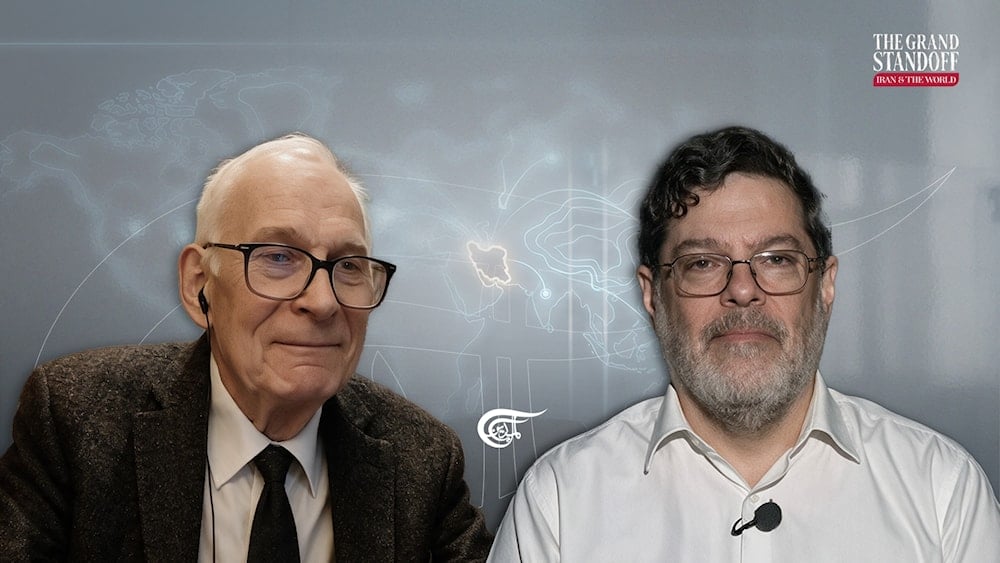
University of Tehran Professor Mohammad Marandi and chairman of the Schiller Institute in Sweden, Ulf Sandmark, on Al Mayadeen's The Grand Standoff: Iran and the World (Al Mayadeen English)
Iran’s position on an agreement with the United States depends on Washington implementing its obligations, irrespective of the outcome of the US midterm elections, University of Tehran Professor Mohammad Marandi stated.
Speaking on Al Mayadeen’s The Grand Standoff: Iran and the world, Marandi stressed that political promises alone would not satisfy Tehran.
On his part, Ulf Sandmark, chairman of the Schiller Institute in Sweden, warned that mounting political and economic pressure on US President Donald Trump could encourage further escalation against Iran. Nevertheless, he identified dialogue involving Washington, Moscow, and Beijing as a possible opening for peace.
The two guests examined the prospects for an agreement, the reasons behind Iran’s distrust of Washington, and the competing pressures shaping US policy.
Implementation determines Iran’s response
The Iranian professor said the memorandum of understanding under discussion and Iran’s seven conditions were compatible, with differences related to the sequence and pace of implementation.
“But at the end of the day, the nature of the seven conditions is fully compatible with the memorandum of understanding,” he said.
For Tehran, he argued, the decisive question is whether Washington would fulfill its commitments. Changes in the balance of power in Congress or the electoral fortunes of the US president would not alter that requirement, according to Marandi.
“The only thing that matters for Iran is actual implementation," he said.
The Iranian academic distinguished between the Iranian public’s hostility toward Trump, as he put it, and the considerations guiding the state’s negotiating position. He said Tehran’s approach rested on securing its demands and obtaining assurances that US obligations would be carried out.
“If Trump decides to implement the deal today, right before the elections, Iran will implement the deal,” he said.
He maintained that Iran would be prepared to move forward whenever those requirements were met, whether before or after the midterms.
Speaking on Tuesday's episode of The Grand Standoff: Iran and the World, Professor Mohammad Marandi argued that #Iran sees no difference between Democrats and Republicans in their approach to #Tehran, stressing that a just peace depends on concrete US guarantees and implementation of the MoU, regardless of the midterm election results. @s_m_marandi
— Al Mayadeen English (@MayadeenEnglish) October 21, 2026
Distrust of Washington drives demand for assurances
Marandi linked Iran’s insistence on implementation to a record of US agreements being undermined and negotiations being accompanied by preparations for military attacks.
He accused Washington of using diplomatic engagement while pursuing aggression against Iran, arguing that this has stripped US declarations of credibility.
“Because a piece of paper signed by an American leader means nothing to Iran,” he said.
According to Marandi, even an announcement by Trump accepting Iran’s conditions would be insufficient without concrete steps to implement them. He argued that Tehran’s approach reflected its experience with Washington, rather than a calculation about which American political party would be more favorable.
"For Iran, it doesn't matter whether it's the Democrats or the Republicans, whether Trump is the president or someone else is the president, whether Trump has a majority in the Senate or he doesn't," he noted, continuing, "What is important is the US position and, as I said, actual implementation."
“What is important for Iran ... is to be sure, is to be confident that the United States will carry out its obligations,” Marandi stressed.
Enriched uranium will remain in Iran
Addressing the nuclear issue, Marandi rejected the suggestion that Iran’s enriched uranium would be transferred abroad, saying that any discussion of the nuclear program would first require fulfillment of the existing conditions.
“That enriched uranium is not going anywhere. And in order for us to even discuss the nuclear program, first the MOU or the Iranian conditions have to be met,” he said.
Marandi said the Russian foreign minister’s visit to Tehran had covered bilateral relations, regional developments, and issues concerning the United States, but had not involved discussions about removing Iran’s enriched uranium.
“But there was no discussion about Iran’s enriched uranium being taken abroad at all,” he said.
His account was consistent with an October 20 statement reported by APA, in which Iranian Foreign Ministry spokesperson Esmaeil Baghaei said transferring enriched uranium to Russia had not been discussed during Sergey Lavrov’s visit. Baghaei distinguished that issue from broader nuclear matters, which he said were discussed.
Marandi also emphasized the need for credible assurances surrounding an agreement, while making clear that he was not claiming Russia had offered to serve as a guarantor.
Threats and leaks seek to pressure Tehran
The Iranian academic described threats against Iran and selected media leaks as instruments of psychological pressure, arguing that they were intended to influence Iranian perceptions and calculations.
He maintained that these efforts have failed to intimidate the Iranian public, which he described as confident in the country’s capabilities and prepared for further confrontation.
Marandi also argued that Benjamin Netanyahu remaining in power could deepen "Israel’s" international isolation. A change of leadership, he said, could instead allow Western governments and media to whitewash "Israel’s" image by concentrating blame on Netanyahu.
Sandmark warns of dangerous escalation
On his part, Sandmark portrayed Trump as facing a difficult combination of military commitments, economic pressures, and domestic political dissatisfaction.
He argued that the costs of the confrontation with Iran, including pressure from energy prices and broader financial strains, could encourage increasingly dangerous decisions in Washington.
“So there is a real danger of desperate actions,” he said.
Citing a warning from Ray McGovern, Sandmark also raised the danger of nuclear escalation against Iran. He presented this as a risk arising from the confrontation and the pressures US decision-makers are facing.
At the same time, Sandmark argued that growing public opposition to war and criticism of "Israel" inside the United States could push policy in another direction.
He said economic concerns would increasingly shape the American political debate, making further military confrontation a difficult electoral proposition for Trump.
Dialogue and public pressure could open a path to peace
Despite his warnings, Sandmark saw opportunities for diplomacy through dialogue involving Trump, Russian President Vladimir Putin, and Chinese President Xi Jinping.
He argued that discussions among the major powers could help address the wider security and economic issues driving confrontation.
“We need a solution on a higher level,” he said.
Sandmark called for an approach encompassing “a solution for the whole world with the security and the development for all nations” and expressed hope that BRICS countries would participate in that effort.
He also pointed to antiwar mobilization in Europe, including opposition to militarization in Germany, as a potential source of pressure for a change in policy.
In his assessment, those movements could converge with demands from the Global South for sovereignty and a different international order.
Sandmark argued that worsening economic conditions and public resistance to further conflict would increase pressure on Trump to pursue diplomacy, concluding that additional wars were unlikely to provide an electoral advantage in the United States.
Read more: Maalouf, Marandi warn midterm defeat may spur Trump escalation | Excl.


