
Iran stands firm as US's military, political options narrow | Excl.
 14 Min Read
Professor Mohammad Marandi and Geopolitical analyst Patrick Henningsen discuss Iran's conditions for resuming diplomacy, the expanding Tehran-Moscow partnership, US military calculations in the region, and the political consequences of Trump's midterm defeat.
-
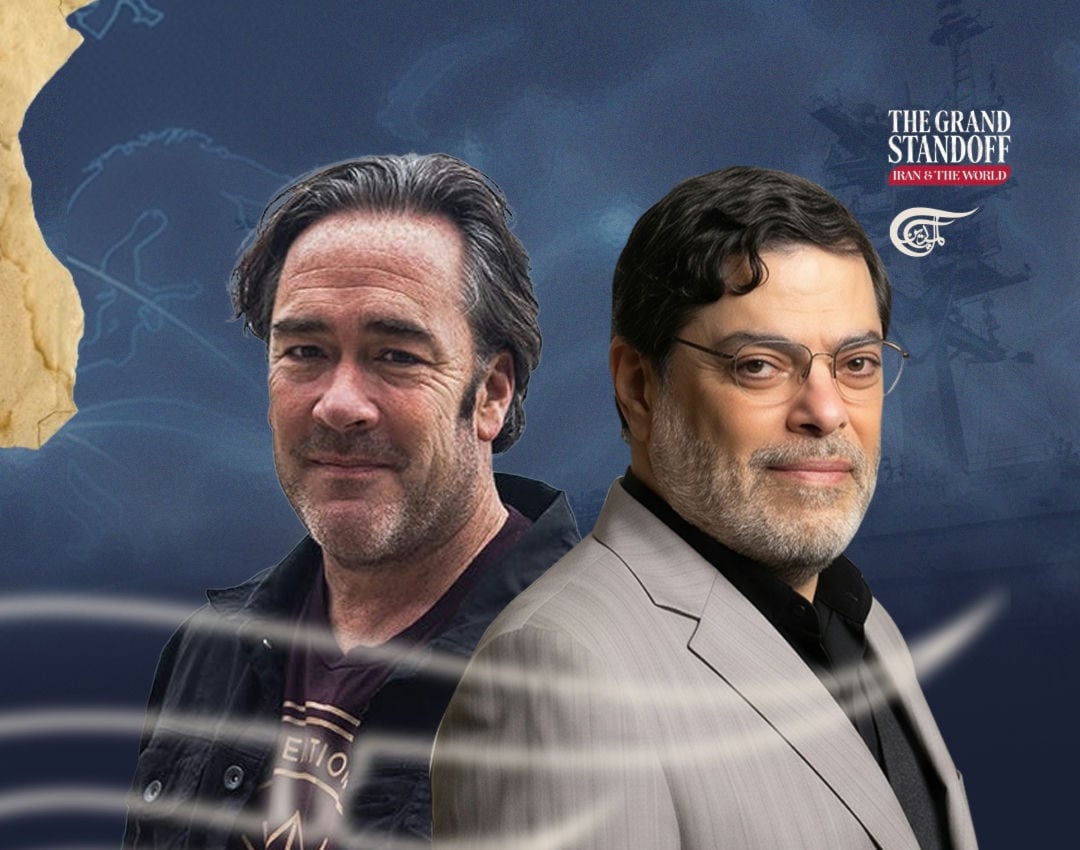
Geopolitical analyst Patrick Henningsen and University of Tehran Professor Mohammad Marandi for Al Mayadeen's The Grand Standoff: Iran and the World (Al Mayadeen English)
Iran has no intention of resuming negotiations over its nuclear program until the United States begins fulfilling its commitments under the memorandum of understanding (MOU), University of Tehran professor Mohammad Marandi said, arguing that Washington's attempts to move directly to the nuclear file will not change Tehran's position. Geopolitical analyst Patrick Henningsen, meanwhile, warned that Washington could continue pursuing a strategy of gradually weakening Iran's ability to control the Strait of Hormuz while using diplomatic overtures as a distraction.
Speaking on Al Mayadeen's The Grand Standoff: Iran and the World, Marandi and Henningsen both said that the US midterm election results have significantly weakened President Donald Trump's political position and complicated the prospects of another military escalation against Iran. Both guests maintained that Tehran has little incentive to change its negotiating position while Washington continues its military aggression operations and fails to implement the existing agreement.
The two analysts also discussed the growing strategic relationship between Iran and Russia, particularly in energy, trade, transport infrastructure, and military cooperation. They argued that US and European policies toward Tehran and Moscow have accelerated the emergence of closer economic and geopolitical alignments across Asia, while weakening Western influence.
Iran will not negotiate nuclear program before MOU implementation
Addressing reports concerning renewed diplomatic contacts between Tehran and Washington, Marandi questioned the credibility of information attributed to unnamed Iranian officials, particularly in reports published by Reuters.
The Iranian academic said he had repeatedly encountered fabricated information attributed to unidentified Iranian sources during his involvement with nuclear negotiators in Vienna in 2015 and in subsequent negotiations involving former Foreign Minister Mohammad Javad Zarif and former chief nuclear negotiator Ali Bagheri.
Marandi stressed that Iran's position has remained consistent: Washington must begin fulfilling its obligations under the MOU before Tehran considers moving to the next phase of negotiations. He explained that some commitments could be implemented immediately, while others would require additional time, but the United States must either have fulfilled certain obligations or be actively implementing the remaining ones.
He emphasized that the second phase would not be confined to Iran's nuclear program, but would also address the sanctions regime Washington has imposed on the country over several decades, saying that it is an issue that could not be resolved easily.
Marandi further pointed to a statement by a senior Iranian official indicating that Tehran would take no further diplomatic steps until its seven conditions were accepted, arguing that the Reuters report contradicted Iran's publicly stated position.
"Until the seven conditions are accepted, until we move towards implementation, nothing further will be done."
He rejected the idea that Iran would discuss how the second phase of the MOU could be implemented before Washington meets those requirements, arguing that Tehran has consistently maintained this position and has no reason to change course while it considers itself to be in a stronger position.
On his part, Henningsen said Washington had repeatedly attempted to move negotiations directly toward the nuclear issue for its own domestic political reasons, bypassing the sequence established by the original agreement.
He argued that the Trump administration had built much of its justification for the confrontation around the claim that Iran must not be allowed to acquire nuclear weapons, a message repeatedly invoked by Trump, Secretary of War Pete Hegseth, and Secretary of State Marco Rubio.
Henningsen warned that this narrative should be taken seriously, arguing that the repeated invocation of weapons of mass destruction had historically been used to generate public support for US military interventions. He also cautioned that such rhetoric could potentially be used to justify a much more dangerous escalation.
US using negotiations to weaken Iran's control of Strait of Hormuz
Henningsen stated that Washington's immediate strategy was not necessarily to pursue a comprehensive military confrontation, but to use negotiations as a means of distraction while continuing a longer-term campaign to undermine Iran's ability to manage the Strait of Hormuz.
He said the United States had consistently sought to degrade Iran's military and strategic capabilities along its southern coastline, identifying Bandar Abbas, Chabahar, and Qeshm Island among the areas he believed Washington intended to target.
Henningsen said this assessment was consistent with what he had been told during his reporting from Iran in July, adding that Tehran expected Washington to continue targeting its coastal positions in an effort to undermine Iran's most important strategic leverage.
He maintained that this approach would continue beyond the US midterm elections and into the new year, although he distinguished between the ongoing campaign of pressure and the possibility of a major military escalation.
Henningsen argued that both Trump and Israeli Prime Minister Benjamin Netanyahu were currently in a weakened political position, with Netanyahu facing accusations from political colleagues that he was using escalation to delay elections, remain in office as caretaker prime minister, or prevent a transfer of power.
He drew a parallel with Washington, arguing that Trump could seek to escalate the confrontation before the new Congress is sworn in on January 6, as the political space for such a move would narrow significantly afterward.
"The fact of the matter is the United States has a very poor position of which to mount and stage provocations or attacks against Iran. Their options are increasingly limited now."
Tehran and Moscow deepen strategic partnership
Turning to Iran-Russia relations, Marandi said recent contacts between the two countries reflected the growing closeness of their strategic partnership, pointing to Russian President Vladimir Putin's conversation with General Rezaei shortly before a meeting held on the same day.
He said the contact was significant because Rezaei was not the head of state, adding that the decision by Sayyed Mojtaba Khamenei to send a message to Putin at this particular moment also carried political weight. Although Marandi said he was not privy to confidential discussions, he considered it highly unlikely that Trump's electoral defeat had not featured in the talks.
Russian President Vladimir Putin received Iranian Supreme National Security Council Secretary General Major General Mohsen Rezaei at the Kremlin, #Kremlin spokesperson Dmitry Peskov confirmed. Meanwhile, Iranian television reported that Rezaei also delivered a message from the Iranian Leader, Sayyed Mojtaba Khamenei, to the Russian president. #Iran #Rusia
— Al Mayadeen English (@MayadeenEnglish) November 5, 2026
Marandi stressed that Iran wanted to consult with its close allies as the United States continued gathering military forces in the region and preparing for a possible assault. He said Tehran had likewise prepared for counter-strikes and warned that any future confrontation could extend beyond West Asia.
He stated that the Iranian-Russian strategic relationship evolved considerably, particularly following the war in Ukraine, when Iran provided Russia with support and assistance in confronting NATO. He argued that both countries now recognize that any US success in either the European or West Asian theaters would undermine their respective interests, making closer coordination increasingly necessary.
Henningsen echoed this assessment, describing the Tehran-Moscow ties as crucial to their economic and geopolitical interests. He highlighted the importance of the North-South transport corridor, which he said could connect Moscow to Mumbai through Iran and provide Russia with alternative trade routes toward Asia and Africa.
He argued that Iran's geographical position made it indispensable to the project and that Russia's future economic and geopolitical position was increasingly connected to its relationship with the Islamic Republic.
Henningsen also pointed to the potential involvement of other regional powers, including Turkey, the Gulf states, and Pakistan, stressing that greater sovereignty among these countries could contribute to a different regional security and economic framework.
North-South corridor, energy cooperation reshape regional trade
Marandi identified the International North-South Transport Corridor as a major component of the expanding Iranian-Russian partnership, noting that the project had become increasingly important for Moscow after the escalation of its confrontation with the West.
He said the corridor should have been developed decades ago but only became a serious priority following "NATO's proxy war against Russia." Moscow, he argued, increasingly viewed the Mediterranean as an unsafe route for its trade and sought to redirect commercial flows through Iran.
Marandi explained that Iran had encountered difficulties preparing the project because parts of the proposed route crossed privately owned land and protected forest areas. The government had therefore needed to find solutions that would minimize environmental damage while allowing it to acquire the necessary land.
However, he said the process had now been completed, and the project was ready for implementation, opening the way for deeper economic integration between the two countries.
He also highlighted plans for Russian gas exports to Iran and through Iranian territory, describing them as another indication of the growing interdependence between Tehran and Moscow. While US sanctions had forced Russian companies out of energy markets in several countries, he said Iran welcomed Russian investment in its oil and gas sectors.
Henningsen similarly stressed the importance of energy cooperation, arguing that the ability to diversify energy portfolios and exchange resources would provide both countries with greater resilience against sanctions and international market volatility.
He pointed to Europe's economic difficulties following its decision to cut off energy ties with Russia, arguing that the resulting costs were increasingly translating into political pressure on European governments.
He said the expanding cooperation between Iran and Russia reflected a broader shift in global economic and geopolitical alignments, with the center of gravity moving eastward and away from Europe and the Atlantic.
"The geopolitical and economic center of gravity is drifting eastwards, away from Europe, away from the Atlantic, and this has been the mission of the US and before that the British Empire, which has been to control and direct and steer trade and commerce globally."
Henningsen argued that Washington's confrontational policies toward Iran, Russia, and China had accelerated closer relations among these countries and their partners, strengthening their economic resilience and cooperation while leaving Western powers increasingly isolated.
US midterm results signal shift in public opinion on 'Israel'
Discussing the political implications of the US midterm elections, Henningsen noted that the results are a significant shift in American attitudes toward the Israeli lobby and its influence over US foreign policy.
He pointed to the election of several Democratic candidates who had expressed opposition to AIPAC and Israeli aggression, including James Talarico in Texas, Abdul El-Sayed in Michigan, and Jon Ossoff in Georgia.
Henningsen argued that the results demonstrated that opposition to Israeli influence in Washington was no longer confined to individual lawmakers, but was becoming a broader political force.
He described the elections as a referendum on "Israel" and its influence over US politics, conveying that American voters had increasingly rejected the role of the Israeli lobby in shaping Washington's foreign policy.
He added that the political consequences could constrain the Trump administration's ability to act in West Asia, particularly as the president's domestic standing had deteriorated following an unmitigated political failure over the past two years.
Marandi also highlighted the significance of Democratic candidates who had stated that the situation in Gaza is genocide, identifying three newly elected senators who had taken that position. Although he expressed no confidence in the Democratic Party itself, he argued that the developments reflected bigger changes within American society.
He maintained that voters who supported Democrats primarily in opposition to Trump would expect the party to respond to public demands, warning that failure to do so could deepen disillusionment with both major political parties.
"The Democratic Party, like the Republican Party, is Epstein-class material, but those who voted for it out of desperation and in opposition to Trump are putting the party in a, are putting, are going to have influence over the party and if the party does not respond to the demands of the public, then people will conclude that the Democrats and the Republicans are both dead ends and that is, that will have implications for the future security of the United States."
Henningsen also raised the possibility that Trump could seek to remove Hegseth from his position to avoid the political consequences of potential impeachment hearings, arguing that such a development could deal a significant blow to the Christian nationalist and Christian Zionist forces within the administration's political base.
Iran has no reason to change its position as Trump weakens
Marandi emphasized that the US midterm results had further strengthened Iran's negotiating position, particularly as Trump faced mounting domestic political and economic pressure. He said Tehran had continued pursuing its established policy throughout the election period and afterward, maintaining pressure on Washington rather than making concessions.
Marandi also pointed to the economic consequences of another war, arguing that renewed military escalation could drive oil prices sharply higher and worsen the US economic outlook, particularly amid falling stock markets and growing public dissatisfaction with Trump.
He said such developments could encourage some Republicans to join Democrats in efforts to remove the president from power, adding that a wider confrontation could push the global economy toward depression.
Marandi also suggested that Vice President JD Vance appeared to be distancing himself from Trump, although he acknowledged that the possibility of the president's removal would depend on how events unfolded.
Henningsen, meanwhile, maintained that Washington's options for military escalation had become increasingly limited and that the administration would have to decide whether to continue its current strategy or accept the loss of its previous strategic position.
Marandi, Henningsen reject reports of renewed US-Iran negotiations
Returning to reports of possible diplomatic contacts between Tehran and Washington, both guests questioned claims that the two sides were moving toward renewed negotiations.
Marandi reiterated that Iran would not take further diplomatic steps until its seven conditions were accepted and implementation began, dismissing reports attributed to unnamed Iranian officials as unreliable. He reiterated that Tehran had remained consistent throughout the process and that Washington's weakened political position gave Iran even less reason to reconsider its demands.
Henningsen was equally critical of reports suggesting that Trump was engaged in serious negotiations with Iran, arguing that Washington's actions contradicted its public statements.
He said the continuation of US military operations against Iranian targets, including on Qeshm Island, demonstrated that Washington was not genuinely pursuing a diplomatic settlement.
"If the fake news is originating from Reuters, you can be certain that that's at the initiative of the United States or Israeli intelligence, full stop."
Henningsen argued that Trump's statements about negotiations should be assessed against the actions of his administration, rather than accepted at face value, maintaining that continued military operations indicated Washington remained committed to its existing strategy.
"The only thing you need to know, really simple, is you don't listen to Donald Trump. Don't listen to what he says."
He concluded that Iran had remained consistent in adhering to the agreement it signed, while the United States continued to pursue military pressure and diplomatic messaging that, in his assessment, was intended to create the appearance of progress without addressing Tehran's conditions.
Read more: Midterm loss gives Congress power to rein in US war on Iran | Exclusive


