
‘Pacific not for sale’: US mining auction draws fierce local backlash
 5 Min Read
The US sold its first deep-sea mining leases off American Samoa days after a court ruling against the sale, drawing fierce local and legal opposition.
-
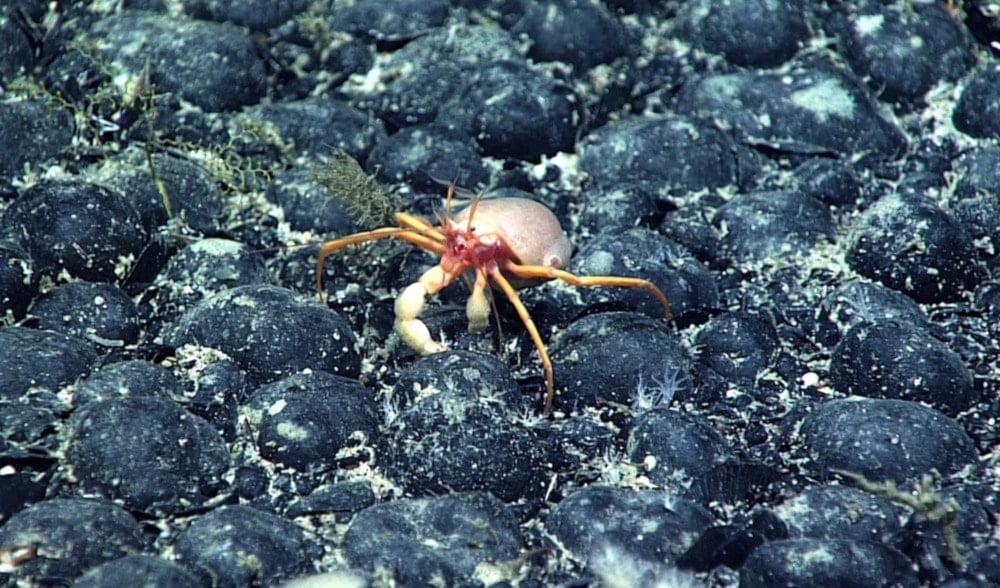
A crab with a coral across a field of nodules on the seafloor of Gosnold Seamount, explored during Dive 16 of the 2021 North Atlantic Stepping Stones expedition (NOAA via AP)
The federal government on Thursday auctioned the first-ever US deep-sea mining leases, offering seabed near American Samoa. The sale went ahead only days after a court decision against it and despite growing resistance from residents.
The auction was streamed live and covered about 12.7 million hectares (31.5 million acres) of ocean floor designated for mineral exploration. Wetstone US Ventures was the lone bidder and purchased two sections of the Pacific territory’s seabed at $3 million apiece, a spokesperson for the Marine Minerals Administration (MMA) told The Guardian.
Under the leases, the buyer may begin early-stage work, including bathymetric and geophysical mapping and other data collection. Miners are after golf ball-sized metallic nodules, which are promoted as a source of rare earths and other minerals used in electric vehicles, renewable energy systems, and defense technology.
Officials call it a milestone
Interior Secretary Doug Burgum framed the sale as a landmark. “This is the first time the United States has held an offshore critical minerals lease sale in the Pacific and a historic step for America’s energy and mineral security,” he said in a statement.
MMA Director Mike Olsen, speaking at the opening of the auction in California, said it fit the Trump administration’s goals “to advance the responsible development of America’s offshore critical mineral resources.”
“As we look to America’s next 250 years, we want future generations to inherit a nation that can build and innovate here at home, on the lands and in the waters that we’ve stewarded,” Olsen said.
Court ruling came days earlier
The sale proceeded even though a federal judge in Hawaii had, earlier in the week, thrown out the environmental approval underlying it. The court found the Endangered Species Act (ESA) had been violated. Judge Jill Otake wrote: “NMFS [National Marine Fisheries Service] failed to even attempt to consider the potential effects on ESA-listed species.”
Earthjustice, the group that brought the case, argued the decision made the auction illegal. “We will use the full extent of the law to vigorously push for the leases to be voided,” Earthjustice attorney Chris Eaton said in a statement.
Opponents push back
Finafinau, an American Samoan youth and environmental nonprofit, filed a new petition with the Hawaii district court the day before the sale, asking for an injunction. The bid to halt the auction failed. The group’s lawsuit accused the Trump administration of rushing ahead “without sufficient information to comprehensively evaluate the impacts of issuing the first-ever commercial deep-sea mining leases.”
The nonprofit’s founder, Sabrina Suluai-Mahuka, said, “More than 76,000 public comments, repeated calls for meaningful consultation, and now a federal court ruling that the government violated the Endangered Species Act. Yet here we are, watching our ocean being auctioned to the highest bidder.”
In this week’s filing, Finafinau also asked the court to cancel the sale. “Despite venturing into largely uncharted territory, MMA recklessly accelerated environmental review,” its court filing states. “With this lease sale, the federal government has rushed to open the ocean floor to commercial mining for the first time, despite its limited understanding of the significant environmental consequences.”
Concerns about what comes next
Taryn Kiekow Heimer, who directs Ocean Energy at the Natural Resources Defense Council (NRDC), cautioned that this sale could serve as the model for future mining applications.
“These leases last at least 20 years. The Commonwealth of the Northern Mariana Islands and Guam are next in line,” Heimer said. “If this goes through, the administration will have shown it can open the deep sea over the objections of the people who live closest to it.”
A second auction, covering 27.9 million hectares (69 million acres) of seabed between the Northern Mariana Islands and Guam, is tentatively planned for December 16. That sale is also the subject of a pending lawsuit in federal court in Hawaii.
Guam Senator William Parkinson urged Washington to call off that auction, telling The Guardian, “You don’t get to sell off our ocean first and ask whether it’s legal later. Washington needs to understand that the Pacific is not for sale.” He added that this week’s court decision “exposes the arrogance and recklessness of an administration that treats our ocean as a corporate commodity and Pacific Islanders as expendable.”
Supporters weigh in
Not everyone in the territory opposes the plan. American Samoa Governor Pulaali’i Nikolao Pula has said in the past that the auctions could “unlock scientific knowledge” and “create economic opportunities” for the territory.
John Wasko, executive director of the American Samoa Development Council, a nonprofit that backs deep-sea mining there, called the nascent industry, which is promoted as a boost to electric vehicle production, a solution to climate change.
“Everybody wants unlimited renewable energy. Nobody wants to admit their part in planet Earth’s atmospheric destruction,” Wasko concluded.


