
EU has no funds to cushion Iran war energy shock amid soaring debt
 3 Min Read
European governments are struggling to shield citizens from skyrocketing gas and oil prices, with public debt and borrowing costs limiting their ability to provide financial relief.
-
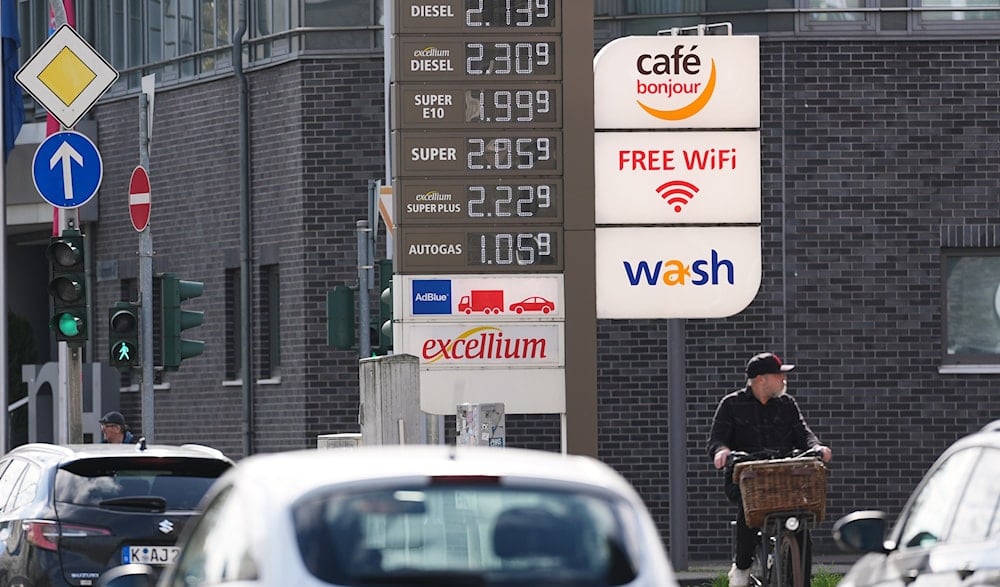
Fuel prices are listed at a gas station in Cologne, Germany, on March 12, 2026 (AP)
The US and Israeli aggression on Iran has triggered a sharp rise in oil and gas prices, posing a serious threat to the European economy. According to The Wall Street Journal, European authorities currently lack the financial means to cushion the impact.
The public debt of several European countries, particularly the UK and France, has reached levels not seen in six decades. Borrowing costs are climbing across the continent, leaving businesses and households without the relief programs that were available during the COVID-19 pandemic.
During the 2022 energy crisis, caused by Europe’s refusal to import Russian energy, EU governments provided billions of euros in support to households and companies. This time, such financial resources are unavailable, the report noted.
Rising energy prices hit taxpayers
At a European Parliament session on March 11, European Commission President Ursula von der Leyen highlighted the steep cost of the war: gas prices have risen 50%, while oil prices are up 27% across the EU since the US-Israeli aggression began.
Von der Leyen added that the first 10 days of the war have already cost European taxpayers an additional 3 billion euros in fossil fuel imports.
US doesn’t like EU, seeks its fracture: Kaja Kallas
On March 13, European Union foreign policy chief Kaja Kallas accused the United States of seeking to weaken European cohesion, highlighting growing tensions in transatlantic relations.
Speaking to the Financial Times, Kallas suggested that US policies toward the EU resemble strategies employed by the bloc’s traditional adversaries.
"The U.S. has been very clear that they want to divide Europe. They don't like the European Union," the EU foreign policy chief stated.
Kallas' remarks come amid ongoing disputes over trade and defense. US President Donald Trump has repeatedly criticized the EU, imposing tariffs on member countries and exploring measures that could strain NATO, including Trump's insistence on seizing Greenland.
The EU official emphasized that member states should address US policies collectively rather than negotiating individually, arguing that unity strengthens Europe’s negotiating position. On defense, Kallas acknowledged Europe’s dependence on US military assets while urging greater investment in the bloc’s own defense industry to build strategic autonomy.


