
EU split over 'Israel' association pact as Spain pushes suspension
 3 Min Read
EU members remain divided on suspending the EU-"Israel" association agreement as Spain and Ireland push for action over settlements, Gaza, and human rights abuses.
-
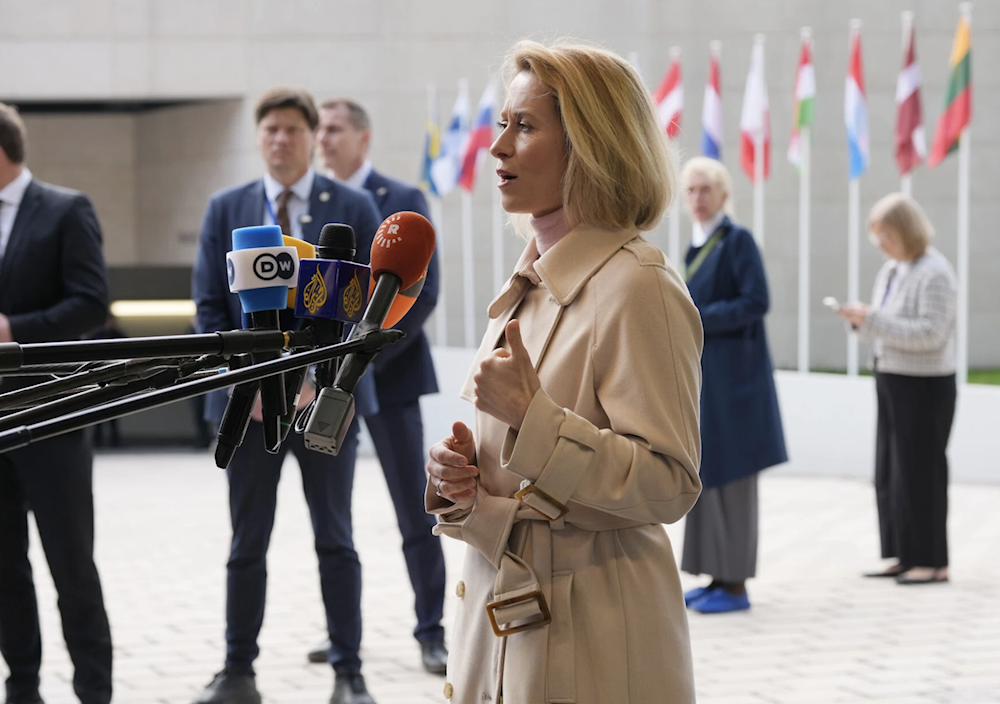
European Union foreign policy chief Kaja Kallas speaks with the media as she arrives for a meeting of EU foreign ministers at the European Council building in Luxembourg, April 21, 2026. (AP)
European Union member states remain divided over suspending the EU-"Israel" association agreement, as Spain and Ireland intensified calls for action but failed to secure sufficient backing from other countries.
Spanish Foreign Minister Jose Manuel Albares urged EU counterparts on Tuesday to consider suspending the EU “Israel” association agreement, arguing that the bloc’s credibility was at stake.
"Today, Europe's credibility is at stake," Albares told reporters ahead of a foreign ministers’ meeting.
Spain was joined by Ireland and several other countries in pushing for either a full or partial suspension of the pact, citing concerns over settlements in the occupied West Bank, the humanitarian situation in Gaza, and recent legislative developments, including a death penalty law for Palestinian prisoners.
Prime Minister Pedro Sanchez also appealed to the European Union to suspend its association agreement with "Israel", signaling a potential move toward increased diplomatic and economic pressure.
EU fails to reach consensus
Despite mounting pressure, EU foreign policy chief Kaja Kallas confirmed that member states did not reach the required level of support to suspend the agreement. "I didn't see the shifting of positions in the room regarding the suspension," she said following the meeting.
A partial suspension of trade provisions would require a qualified majority among EU members, while a full suspension of the EU-"Israel" association agreement would need unanimous approval.
Amnesty International issued a strong rebuke on Tuesday of the European Union’s approach toward "Israel", accusing the bloc of failing to act in line with its stated values and of enabling breaches of international law.
Germany and Italy signaled they would maintain their current positions, favoring continued engagement rather than punitive measures.
Trade and political stakes
The EU-"Israel" association agreement governs a significant economic relationship.
The European Commission previously proposed suspending certain trade-related provisions affecting approximately 5.8 billion euros in Israeli exports.
Overall trade between the European Union and "Israel" reached 42.6 billion euros in 2024, making the EU "Israel’s" largest trading partner.
In parallel, the EU is considering sanctions targeting violent Israeli settlers and some Israeli officials. These measures also require unanimous approval among member states.
Diplomats indicated that progress could depend on political developments, including a potential shift in Hungary’s position following the formation of a new government.
Ahead of the meeting, France and Sweden circulated a proposal urging stronger EU measures to limit commercial engagement with settlements, which are considered illegal under international law.


