
Widespread condemnation of 'Israel’s' new prisoner execution law
 4 Min Read
Palestinian groups and Al-Azhar condemn "Israel's" approval of an execution law for prisoners, calling it a criminal act and a violation of international law.
-
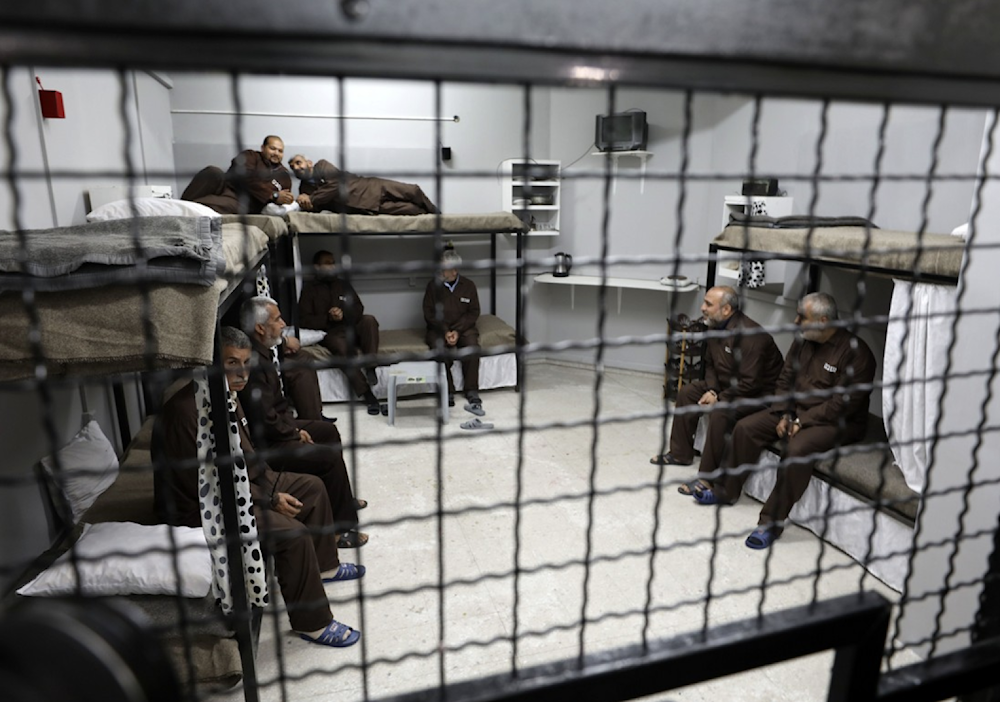
Palestinian activists sit in a mock prison during a protest in solidarity with Palestinian prisoners in Israeli jails. (Undated, WAFA)
Palestinian leaders, human rights groups, and Al-Azhar have condemned the Israeli Knesset’s approval of a law allowing the execution of Palestinian prisoners, describing it as an act of brutality and a flagrant violation of international law.
The bill allowing the execution of Palestinian detainees introduces sweeping changes that expand judicial powers to impose capital punishment, including executions by hanging. It allows judges to issue death sentences without a prosecutor’s request and removes the need for unanimous rulings, enabling decisions by a simple majority.
The law also extends authority to military courts in the occupied West Bank, permitting them to sentence Palestinian detainees to death, with the Israeli war minister allowed to present an opinion during proceedings.
Hamas: a blood-soaked law and a criminal precedent
Hamas described the legislation as "a blood-soaked law that exposes the occupation’s true murderous nature". The movement said it “embodies the mentality of bloodthirsty criminal gangs” and constitutes a dangerous precedent that threatens Palestinian prisoners’ lives inside Israeli prisons.
The group urged the international community, human rights institutions, the United Nations, and the Red Cross to take urgent action to halt the law, calling on Palestinians home and abroad to act across legal, political and media platforms and warning that the occupation's leaders will face consequences for their "fascist policies", which it said would be met with a response proportionate to the crime.
'The pinnacle of criminality'
According to the Palestinian Prisoners Club, 9,500 Palestinians are currently held in Israeli prisons. Many of them face harsh conditions, torture, and medical neglect. The Prisoners’ Media Office criticized the law after it passed in the Knesset’s second and third readings, saying it "represents the pinnacle of criminality reached by the occupation and its jailers against our brave prisoners".
The office added that the death penalty should instead be applied to the leaders responsible for these crimes, including Israeli Prime Minister Benjamin Netanyahu and his ministers, holding them fully accountable for the consequences.
Islamic Jihad, Fatah, and other factions react
The Islamic Jihad movement said the law reflects “the bloodlust of the leaders of the occupying entity” and exposes the judicial system as "a tool for political revenge".
The Popular Front for the Liberation of Palestine called the law “a dangerous criminal decline” that could ignite a comprehensive and devastating escalation.
Fatah stated that the Knesset’s approval “legalizes the killing of prisoners and flagrantly violates the Fourth Geneva Convention.” The Palestinian Presidency also strongly rejected the law, emphasizing that it constitutes a direct assault on Palestinian human rights.
Al-Azhar: A desperate cover for crimes
Al-Azhar condemned the law as “a desperate attempt to cloak criminality in legal form", stressing that it reflects the occupation’s “barbarity and moral collapse".
The institution warned that attempts to legalize executions cannot hide the ongoing violence against Palestinian prisoners, expressing deep concern over the failure of the international community and legal institutions to prevent the law.
Al-Azhar urged the UN, human rights organizations, and other international bodies to stop the executions, hold perpetrators accountable, and protect innocent lives from this “unjust fate.”
A long history of extrajudicial killings
In practice, the Israeli occupation has executed tens of thousands of Palestinian civilians in streets, homes, hospitals, and schools without trial, premeditation, or justification. Human rights groups warn that this law attempts to give legal cover to a brutal practice, opening the door to a new, more lethal phase of oppression against Palestinian prisoners.
Last month, Hamas affirmed that a recent report by the UN Office of the High Commissioner for Human Rights constitutes irrefutable evidence of the Israeli occupation’s brutality toward Palestinian prisoners. The report, based on testimonies of recently released detainees, outlines widespread torture and inhumane treatment inside Israeli prisons, practices that amount to war crimes.
According to the statement, the documented violations include systematic torture, coercion, blackmail, and denial of basic human rights such as medical care and access to toilets. Hamas emphasized that these findings reflect the occupation’s "fascist" and "unprecedented" violations of international law.


