
Europe bands together in mini-alliances without US lead: Report
 6 Min Read
As American support recedes, Europe and Canada are scrambling to fill the gap with a mix of fresh coalitions.
-
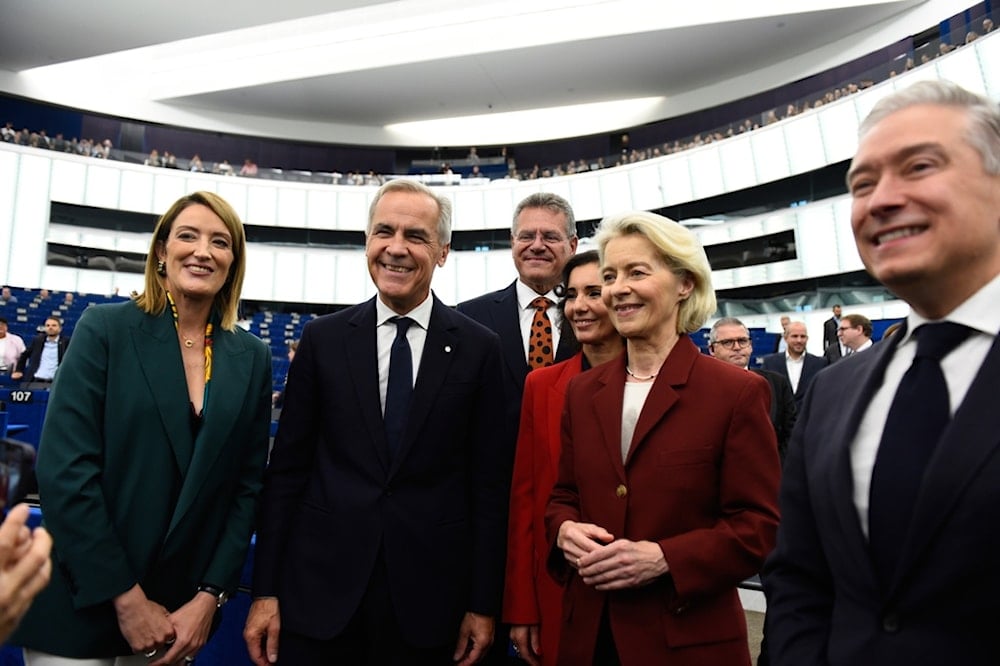
Canada's PM Mark Carney poses with European Commission President Ursula von der Leyen and the President of the European Parliament Roberta Metsola at the European Parliament in Strasbourg, eastern France, Thursday, Sept 17, 2026. (AP)
Europe and its partners are shaping a fresh approach to cover the gap left by America's pullback from global leadership, forming smaller, purpose-built alliances to handle the tasks Washington has stopped taking on, Politico reported.
The push reflects Canadian Prime Minister Mark Carney's appeal for "middle powers" to join forces as the world order changes.
It took clearer shape over the weekend at the annual security forum on Canada's Atlantic coast, where officials promoted a tangle of multinational groupings, from strengthening NATO's Arctic flank to expanding rare earth mining.
Over a dozen European countries sent representatives to the forum, and many signaled they are planning for a future in which the US is no longer in front, though the details remain murky.
"This is middle powers trying to keep the system alive, and eventually also improve it," said Norwegian Foreign Minister Espen Barth Eide. "We can't make everything an issue about what we hear from Washington today. The rest of us had to go on with our lives."
Officials said American help is still welcome, since US economic and military strength can't easily be matched. Yet the missing Pentagon and State Department delegations, once regular attendees, said a lot about the administration's priorities.
Last year the War Department barred employees from attending think tank conferences and singled out the Halifax event by name.
New groupings take shape
Concerned by President Donald Trump's erratic behavior and what looks like closeness to Russia, allies felt they must act, as per the report. They are moving ahead without their longtime protector, setting up assorted offshoots within and around the NATO and EU frameworks.
Under a German-led Maritime Security Partnership, participants will collaborate on Arctic defense. Five Nordic countries in the Nordic Defense Cooperation will work on adjusting road systems and troop movement plans to help blunt a "possible Russian invasion". A separate group of countries intends to develop a sixth-generation fighter to take the place of America's F-35.
Canadian Defense Minister David McGuinty also pointed out that Ottawa has finalized 22 new trade and defense agreements over the last 18 months.
The speed of it all left some officials unsure who was responsible for what.
"We have so many coalitions," said one European official, who was granted anonymity to discuss sensitive military matters. "It's hard to keep track."
What's driving the shift
Several forces are behind the change: the US retreat from financing Ukraine's military, worries that some American troops could be pulled out of Europe, and lingering resentment from long-running tariff fights with Trump, the report added.
"We're trying to find different groups for different purposes," the European official said.
Meanwhile, administration supporters cast the development in a positive light, saying Europe and Canada are taking more responsibility for their own defense. Sen. Mike Rounds, the only Republican lawmaker at the Halifax forum, said it was sensible for allies to be "in a better position" to cover for the US where it can't.
Confusion over overlapping coalitions
Still, the growing web of coalitions is already causing befuddlement, even among European officials accustomed to bureaucracy, thousand-page zoning applications and exhaustive environmental rules.
The EU's "partners for multilateralism" pact stretches from the 27-member bloc to Canada, Brazil, India, Australia and Kenya. A fighter jet project involving France, Germany and Spain was dropped in favor of a British, Japanese and Italian design that now counts Canada as a participant too. European officials have yet to settle on a name for a new partnership with Norway and Canada.
It also remains uncertain how many of these groupings will deliver a real substitute for the US. A few of the new alliances are already dealing with teething problems and coordination troubles, the report stressed.
'It's a kind of variable geometry'
For his part, Dutch Procurement Minister Derk Boswijk said his government has approached Sweden, Norway and Denmark about a new "coalition of the doing" centered on digitization, bringing AI into battle management systems and rare earth mining. The European official said Sweden had not heard about the idea.
The same official minimized the danger that so many groupings might clog decision-making, contending that the new formats would simply reinforce existing partnerships.
"It's a kind of variable geometry," the official said. "It's better that it is happening than what the alternative would be."
A page from Trump's playbook
The effort may serve as a rebuke of Trump, yet it borrows from his approach: deals are easier to strike at a smaller table.
"The pie is so big we can all get something from it," said Boswijk. "What frustrated me the most is that so much time is wasted competing with each other. We do not have the luxury."
Democrats blame Trump, but return is uncertain
Democrats attending the forum put the blame for Europe's drift from multilateralism directly on Trump's confrontational treatment of allies.
"How can we be surprised as Americans if Europeans take their own interests into account and begin to explore other options?" said Sen. Chris Coons, who is expected to take over as chair of the Senate Foreign Relations Committee in the next Congress.
"We can't blame Europe," Coons declared.
With so many other items on Democrats' agenda in January, lawmakers are unlikely to address allies' concerns quickly, as per the report. And even then, it's uncertain that Europe would simply come back into the fold.
"No one is saying, 'Get back to us when you have your shit together,'" said Sen. Andy Kim. "They understand that things are going to be challenging even two years from now."
Read more: Hegseth curbs military ties with Canada, Trump feud deepens: WashPo


