
Gold, silver surge to historic highs as Fed uncertainty fuels demand
 5 Min Read
Gold and silver surged to historic highs in 2025 as investors sought safe-haven assets amid interest-rate uncertainty, central bank buying, and supply constraints.
-
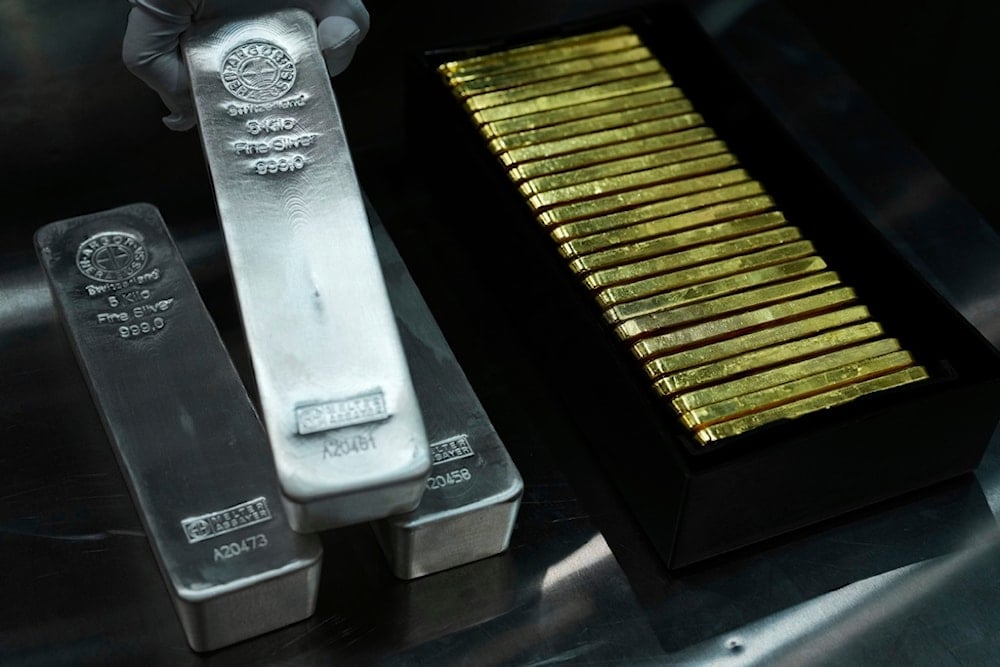
FILE - An employee of Pro Aurum gold house lifts 1 Kg silver bars of 999.9 purity besides 1 Kg gold bars in the safe deposit boxes room in Munich, Germany, Friday, April 25, 2025 (AP Photo/Matthias Schrader, File)
Gold and silver are closing the year at historic levels after one of their most volatile and powerful rallies in decades, as uncertainty over US monetary policy, global economic risks, and tightening supply conditions continues to reshape investor behavior.
Gold prices surged more than 60% over the course of the year, reaching an unprecedented peak above $4,549 an ounce before easing slightly in late December. By New Year’s Eve, the metal was trading near $4,330 an ounce. Silver followed a similar trajectory, climbing to an all-time high of $83.62 earlier in the week before retreating to around $71 an ounce.
Monetary Uncertainty
The extraordinary gains have unfolded against a backdrop of heightened uncertainty over the future path of US interest rates. Expectations that the US Federal Reserve will move toward easier monetary policy have been a central driver of demand for precious metals, which tend to benefit when rates fall, and yields on competing assets weaken. Rania Gule of trading platform XS.com told the BBC: "Gold and silver prices are experiencing a notable rise due to the interplay of several economic, investment, and geopolitical factors." She added that expectations of further rate cuts in 2026 remain a key source of support for prices.
At the same time, the US dollar advanced modestly this week following the release of minutes from the Fed’s December meeting, as investors attempted to interpret policymakers’ intentions. Despite recent gains, the greenback is on track for its worst annual performance since 2017, down nearly 10%, reflecting broader uncertainty over monetary policy direction. Thin trading volumes due to year-end holidays have added to short-term volatility.
Policy Uncertainty
Minutes from the Fed’s December 9-10 meeting showed that officials agreed to reduce interest rates only after what was described as a deeply sensitive debate over risks to the US economy. Updated projections released after the meeting indicate that the Fed currently expects just one rate cut next year, while policy language suggests rates are likely to remain unchanged until inflation shows renewed signs of easing or unemployment rises more than anticipated. Markets, however, are pricing in roughly 50 basis points of cuts.
Joseph Trevisani, senior analyst at FX Street, told Reuters that the lack of clarity is weighing across markets. "We don't have any direction in Fed policy, and so you're seeing that reflected in the dollar and the currency rates, you're seeing it reflected in the interest rates as well in the Treasury rates, so the market doesn't have a lot to work with right here," he said. Trevisani added: "If we're looking for movement in the new year in the dollar and the currencies and maybe even interest rates, we're going to have to start looking to the economy and see if that will move things."
Safe-Haven Demand
Beyond monetary policy, sustained buying by central banks has played a critical role in supporting gold prices. Central banks worldwide added hundreds of tons of gold to their reserves this year, according to the World Gold Council, reinforcing gold’s appeal as a long-term store of value amid geopolitical tension and fiscal instability.
Investor demand has also been driven by concerns over inflation, volatile equity markets, high government debt levels in the United States and the United Kingdom, renewed trade frictions linked to Donald Trump’s tariff policies, and anxiety surrounding a potential artificial intelligence-driven market bubble. Speaking to BBC, Dan Coatsworth, head of markets at AJ Bell, said investors have been "latching onto precious metals in response to concerns over inflation", adding that "The market backdrop looks unchanged as we move into 2026."
Correction Risks
However, Coatsworth cautioned that the scale of recent gains leaves gold and silver vulnerable to reversals. He warned: "If financial markets go through a difficult patch, investors looking to liquidate positions might first reach for assets that have delivered strong gains in the past year or so, or ones that are easy to sell. Gold ticks both boxes."
Silver’s rally has been supported not only by investment demand but also by supply-side constraints. Daniel Takieddine, co-founder of Sky Links Capital Group, cited "supply tightness and industrial demand" as key factors behind the metal’s ascent. China, the world’s second-largest silver producer, announced new restrictions on exports of silver, tungsten, and antimony in October. The Chinese Ministry of Commerce said the measures were intended "to step up the protection of resources and the environment."
Volatility Ahead
The export controls have raised concerns among industrial users, given silver’s importance across multiple manufacturing sectors. Reacting on social media, Tesla CEO Elon Musk said: "This is not good. Silver is needed in many industrial processes."
Takieddine also pointed to heavy inflows into exchange-traded funds tracking precious metals, which allow investors to gain exposure without holding physical bullion. While he sees further upside potential for silver, he cautioned that "rallies may be followed by sharper corrections."
Looking ahead, analysts remain cautious about the pace of future gains. Gule said she expects gold prices to continue rising next year, though "at a more stable pace compared to the record highs observed in 2025."
Read more: Silver price holds near $80 as precious metals pull back


