
Dollar heads for worst yearly drop since 2003 as rate cuts loom
 5 Min Read
The US dollar is on track for its worst annual drop in more than 20 years, as expectations of further Federal Reserve rate cuts, political uncertainty, and diverging global policies weigh on confidence.
-
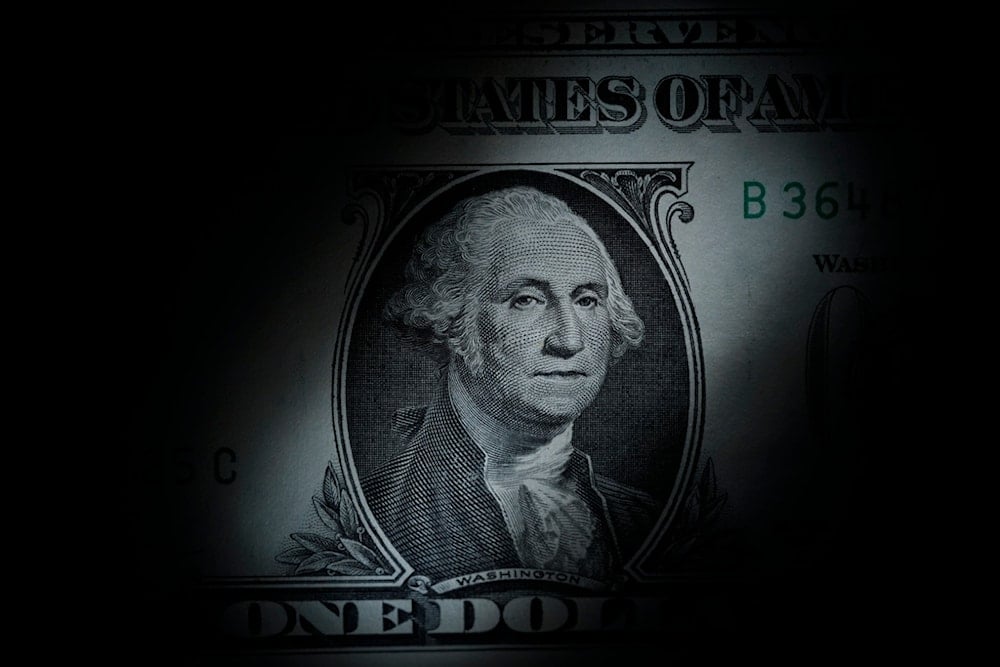
The likeness of George Washington is seen on a US one-dollar bill, on March 13, 2023, in Marple Township, Pa. (AP)
The US dollar was set for its steepest yearly decline in more than 20 years, Reuters reported on Wednesday, as markets bet that the Federal Reserve will continue cutting interest rates while several other major central banks move in the opposite direction.
The greenback remained under pressure in Asian trading, with fresh US growth data failing to change expectations that the Federal Reserve still has room to ease policy. Investors are currently pricing in around two additional US rate cuts in 2026, reinforcing a shift away from the dollar’s yield advantage that has supported it for much of the past decade.
"We expect the FOMC to compromise on two more 25 bp cuts to 3-3.25% but see the risks as tilted lower," Goldman Sachs Chief US Economist David Mericle said, pointing to slowing inflation.
Dollar confidence erodes
The dollar slipped to a two-and-a-half-month low against a basket of currencies and was on track for an annual loss of nearly 10%, marking its worst performance since 2003. The scale of the decline reflects not only monetary policy expectations but also a broader reassessment of US macro stability amid rising fiscal deficits, persistent trade tensions, and renewed political risk.
Analysts say political uncertainty has added to downward pressure on the currency. President Donald Trump’s tariff policies earlier this year rattled confidence in US assets, while his growing influence over monetary policy has revived concerns about the independence of the Fed, a cornerstone of global trust in the dollar system.
"The USD risk premium widened in December, which suggests USD weakness may reflect growing concerns around Fed independence, not just the monetary policy outlook," HSBC analysts said.
"With many other G10 central banks on hold, we think Fed liquidity operations and a slight dovish Fed bias leaves the USD outlook tilted to the downside."
Dollar inertia
The recent slide comes amid broader, longer-term efforts by countries across the Global South to reduce exposure to the dollar through local-currency trade settlement, gold accumulation, and alternative payment systems. These initiatives have accelerated in response to sanctions, trade restrictions, and concerns over the weaponization of the dollar-based financial system.
Economists caution, however, that while diversification has gathered momentum, it has not yet produced a viable replacement for dollar-based reserves. The dollar continues to dominate global trade invoicing, reserve holdings, and cross-border financing, underpinned by the depth and liquidity of US financial markets.
American economist James K. Galbraith has previously noted in comments to Al Mayadeen that the dollar-reserve system retains powerful inertia due to the unmatched liquidity and scale of US Treasury markets. He argued that while trade invoicing can shift more easily into national currencies, replacing a single dominant reserve asset remains structurally difficult in the absence of a comparable alternative at scale.
By contrast, the euro climbed to a three-month high and was on course for its strongest annual gain in more than two decades, supported by expectations that the European Central Bank is nearing the end of its easing cycle. Traders have also begun factoring in the possibility of tighter policy next year, narrowing the policy gap that has long favored the dollar.
Similar dynamics lifted the Australian and New Zealand dollars, as markets increasingly view the next policy move in both countries as a rate hike rather than a cut. Sterling also reached a three-month peak, with investors betting the Bank of England will start easing cautiously in 2026, reinforcing a broader shift toward currencies backed by comparatively firmer policy outlooks.
Yen intervention risk
Meanwhile, attention in currency markets has turned sharply to Japan, where authorities have signaled readiness to intervene to halt further yen weakness. Finance Minister Satsuki Katayama warned that Tokyo retains full freedom to act against excessive moves, temporarily stabilizing the currency.
"Moves that are out of line with any observable fundamentals, and year-end trading conditions are a compelling backdrop for intervention, and the risk of action over the holiday season is significant," said Kit Juckes, chief FX strategist at Societe Generale.
Although the Bank of Japan delivered a long-anticipated rate hike last week, markets were underwhelmed by the lack of a more aggressive stance. That has kept the yen vulnerable and left traders alert to the possibility of direct action from Japanese authorities, particularly as thinning year-end liquidity increases the risk of abrupt currency swings.
Read more: Gold hits historic $4,400 high amid rate cut expectations


