
Gulf states reconsider US investments amid war-driven economic fallout
 4 Min Read
Three major Gulf economies are reviewing investment pledges and contracts to offset mounting economic damage from the US-Israeli war on Iran.
-
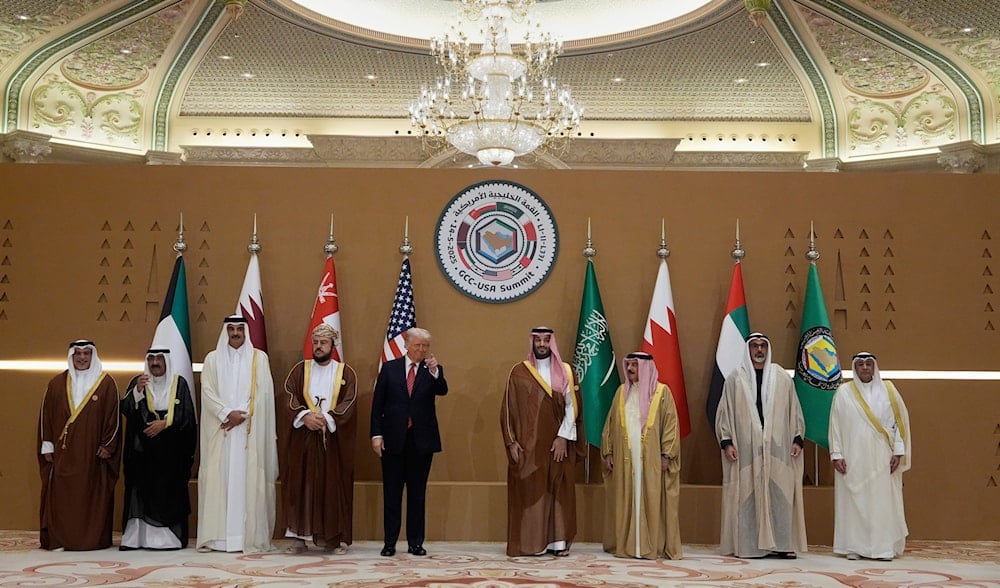
US President Donald Trump poses with Gulf Cooperation Council leaders at the GCC Summit in Riyadh, Saudi Arabia, May 14, 2025 (AP Photo/Alex Brandon)
At least three of the four major Gulf economies have quietly begun reviewing their overseas investment portfolios and contractual commitments, weighing whether to invoke force majeure clauses to offset the mounting financial damage caused by the US-Israeli war on Iran, the Financial Times reported Thursday.
A Gulf official told the FT that Saudi Arabia, the United Arab Emirates, Kuwait, and Qatar, or at least three of the four, have held joint discussions on the economic strain the war has generated.
The review, described as precautionary, could affect a wide range of financial commitments, from investment pledges to foreign governments and corporations to sports sponsorships, business contracts, and existing asset holdings.
"A number of Gulf countries have begun an internal review to determine whether force majeure clauses can be invoked in current contracts, while also reviewing current and future investment commitments in order to alleviate some of the anticipated economic strain from the current war," the official said, "especially if the war and related expenses continue at the same pace."
The official attributed the pressure to a convergence of damaging forces: declining energy revenues due to output slowdowns and disrupted shipping, a sharp drop in tourism and aviation activity, and a surge in defence spending, all a direct consequence of a war the Gulf states neither initiated nor invited.
Washington is watching
An adviser to a Gulf government told the FT that the prospect of an investment pullback has already drawn attention at the White House. The Gulf states manage some of the world's largest sovereign wealth funds, and Saudi Arabia, the UAE, and Qatar collectively pledged hundreds of billions of dollars in US investments following President Donald Trump's regional visit last year.
The Gulf is also a heavyweight backer of international sports and has been channelling vast sums into domestic development and economic diversification.
Any reversal on US-bound investments would raise the political temperature on an administration that has treated those pledges as flagship achievements, and could increase pressure on Washington to pursue a diplomatic exit from the conflict it started.
The cost of a war they were dragged into
The Gulf states had urged Washington to hold off on military action and exhaust diplomatic channels before striking Iran. Instead, they have been left absorbing the blowback.
Iranian retaliation has battered the region's infrastructure. At least ten tankers have been struck in the Gulf, the Strait of Hormuz, through which roughly a fifth of global oil and gas passes, has seen shipping grind to a near-halt, and strikes have hit US bases, embassies, airports, hotels, and residential buildings across the region.
Qatar, the world's second-largest liquefied natural gas producer, declared force majeure this week, suspending output at its main LNG facility. Saudi Arabia's largest oil refinery has also been hit.
Gulf anger goes public
The frustration is no longer confined to closed-door meetings. Prominent Emirati businessman Khalaf al-Habtoor addressed Trump directly in a post on X, giving voice to a sentiment that has been building across the region.
"A direct question: Who gave you the authority to drag our region into a war with Iran? And on what basis did you make this dangerous decision?" he wrote. "Did you calculate the collateral damage before pulling the trigger?"
سيادة الرئيس دونالد ترامب،
— Khalaf Ahmad Al Habtoor (@KhalafAlHabtoor) March 5, 2026
سؤال مباشر: من أعطاك القرار لزجّ منطقتنا في حرب مع #إيران؟ وعلى أي أساس اتخذت هذا القرار الخطير؟
هل حسبتَ الأضرار الجانبية قبل أن تضغط على الزناد؟ وهل فكّرت أن أول من سيتضرر من هذا التصعيد هي دول المنطقة!
من حق شعوب هذه المنطقة أن تسأل أيضاً: هل كان…
Al-Habtoor pointed to the billions Gulf states contributed to Trump's Gaza reconstruction plan and his broader "Board of Peace" framework, asking: "Are we funding peace initiatives or funding a war that exposes us to danger?"
The question is one Washington may soon be forced to answer, not just diplomatically, but financially.


