
Iran war costs US $38B, with $3B more projected each month
 4 Min Read
The CBO says the six-month US war on Iran has cost $38 billion and could add $3 billion monthly, while also pushing inflation higher in 2027.
-
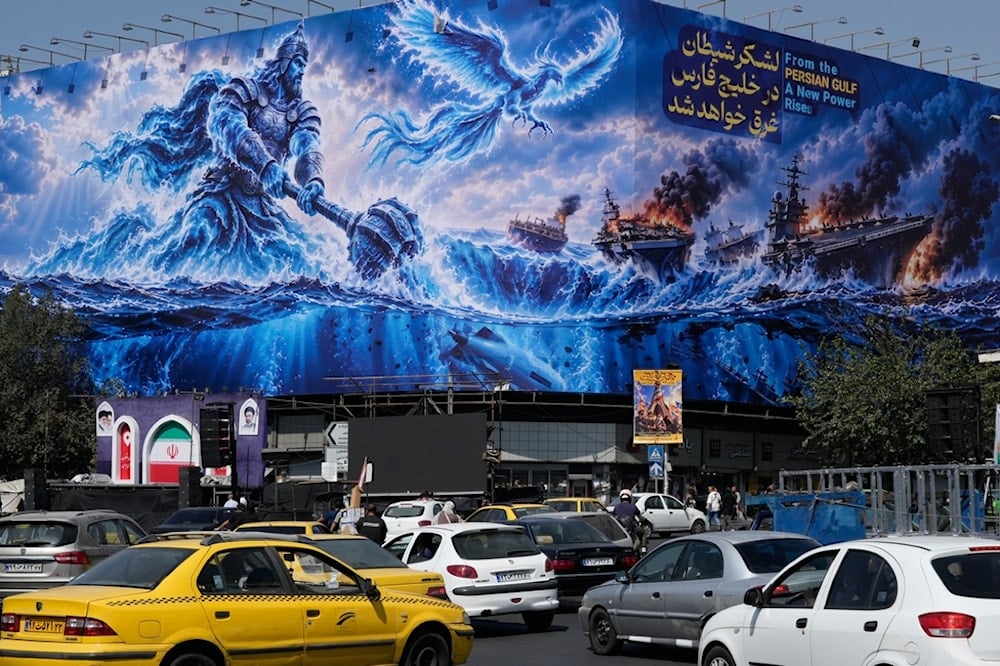
Vehicles drive past a billboard depicting a Persian legendary hero and flying figure hitting US aircraft carriers alongside a message in English and Farsi: "From the Persian Gulf a new power rises" at Islamic Revolution Square in downtown Tehran, Iran, Monday, Sept. 14, 2026 (AP)
The six-month-old US war on Iran has already cost Washington $38 billion, with the Congressional Budget Office (CBO) projecting that the bill could grow by another $3 billion every month as the war drags on, Reuters reported Tuesday.
The estimate covers costs through August 1 and comes as the Trump administration seeks an end to the war and the reopening of the Strait of Hormuz, a vital energy route whose disruption has contributed to a sharp rise in energy prices.
The CBO also projected that the war could push US inflation 0.5% higher during the first three months of 2027.
The growing financial burden comes alongside mounting pressure on US military stockpiles. According to the CBO, the rapid expenditure of munitions accounts for most of the war's costs, with replenishing some depleted stockpiles potentially taking as long as five years.
Reuters reported in August that the US had used "virtually all" of its long-range precision missiles during the war.
Pentagon disputes ammunition concerns
The CBO's findings have drawn a response from the Trump administration, which rejected concerns that the war has left the US military without sufficient weapons.
White House spokesperson Anna Kelly described Trump's military aggression against Iran as "decisive action" aimed at preventing Tehran from threatening US personnel or interests.
She claimed that the US military has "more than enough munitions, ammo, and stockpiles to serve all of the Commander-in-Chief’s strategic goals and beyond.”
Chief Pentagon spokesperson Sean Parnell likewise disputed the assessment, saying, "We have everything required to strike at the time and place of the president’s choosing." The CBO inquiry was requested by Representative Brendan Boyle, the top Democrat on the House Budget Committee.
“Donald Trump’s disastrous war in Iran has already taken the lives of brave American servicemembers and left others wounded," Boyle said.
"Beyond that human toll, this nonpartisan CBO report makes clear that the war has also cost American taxpayers tens of billions of dollars and counting, while continuing to drive up costs."
War places pressure on US military readiness
Beyond the immediate financial cost, the CBO warned that the war could have longer-term consequences for US military preparedness.
The agency identified shortages in critical munitions, including missile interceptors, as a potential constraint on Washington's ability to respond to another major war. It specifically cited a possible confrontation involving China and Taiwan.
At a Senate hearing in July, War Secretary Pete Hegseth requested nearly $90 billion in emergency funding to replenish depleted weapons stocks.
“Without these funds, we face critical shortfalls,” Hegseth said at the time.
The latest CBO estimate is broadly in line with the $37.5 billion figure Hegseth gave lawmakers in July.
Separately, the Pentagon's inspector general reported this week that Iranian strikes had damaged or destroyed hundreds of buildings at US military bases across West Asia, along with fighter aircraft, refueling planes, and drones.
The inspector general estimated the war had cost $33.4 billion through June 19, including approximately $184 million in damage to US diplomatic facilities.
Hormuz disruption adds to economic costs
The war has also generated wider economic consequences through disruptions around the Strait of Hormuz.
Roughly 20% of global oil supplies traveled through the strategic waterway before the war, and strikes on shipping and energy infrastructure in and around the Gulf have contributed to higher energy prices for consumers and producers.
The CBO's $38 billion calculation does not include the costs of more recent strikes on commercial vessels in the Strait of Hormuz or strikes on US military installations in the region.
It also excludes the interest costs associated with borrowing to finance the war, which could add tens of billions of dollars to the overall bill.
The additional spending comes as US public debt has already surpassed $40 trillion.
Trump has repeatedly contrasted the war on Iran with the US wars on Iraq and Afghanistan. The eight-year US war in Iraq cost about $2 trillion, according to figures reported by Reuters, while Brown University's Costs of War project estimated the two-decade US war on Afghanistan at $2.3 trillion.


