
White House weighs Defense Production Act to boost US refining
 3 Min Read
The White House is considering using the Defense Production Act to expand US oil refining capacity as the Iran conflict drives fuel prices higher.
-
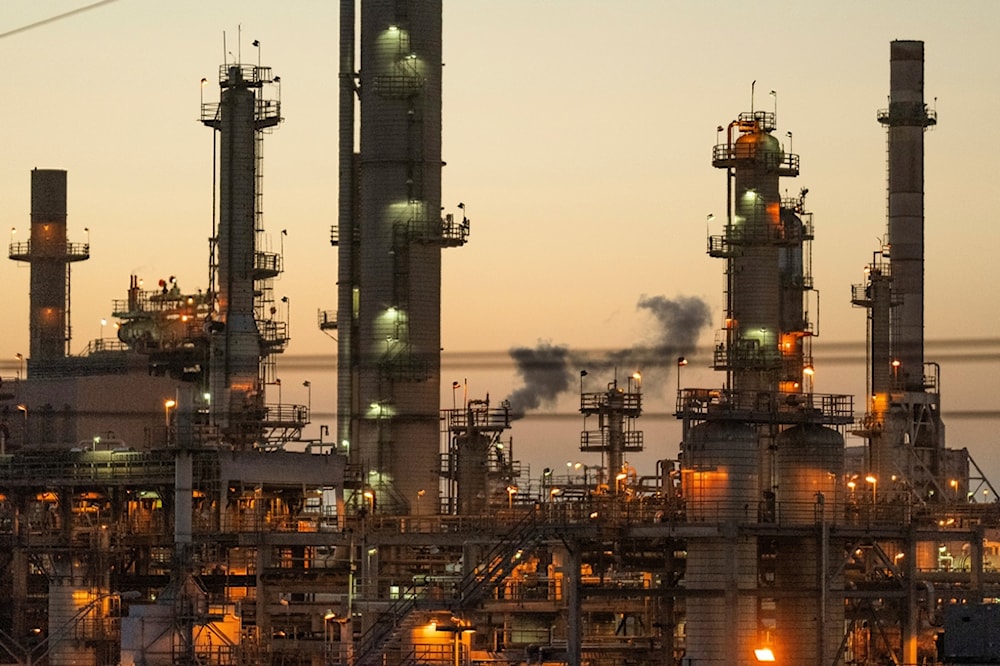
Lights illuminate an oil refinery in Carson, California, on May 29, 2024. (AP)
The White House is weighing how to use the Defense Production Act to expand US oil refining capacity, as the conflict with Iran exposes the country's vulnerability to global crude supply disruptions and price spikes, according to two sources familiar with the administration's plans, Reuters reported.
The proposal surfaced during a recent meeting between US President Donald Trump and nearly a dozen US refiners, where officials sought input on how federal support could best add capacity.
No final decisions were made, and participants expect the conversations to continue. Refining executives reportedly told officials that federal funds would be better spent improving efficiency or expanding existing plants than financing an entirely new refinery, which would take years and cost considerably more.
A tool never before used for refining
The Defense Production Act is considered a tool of last resort, giving the US president broad powers to direct industrial resources and offer financial incentives for production of goods deemed important to national defense. It has never previously been used to expand refining capacity.
The current discussions build on a presidential determination issued in April that authorized using the act to support US petroleum production, refining, and logistics.
White House spokeswoman Taylor Rogers said expanding refining capacity is a top priority for Trump and his energy team, who are evaluating options including regulatory reform, faster permitting, and additional investment.
Refiners already near capacity
US refiners are running at close to full tilt, with utilization near 98% according to the latest data, even as diesel prices have climbed above $6 a gallon for the first time and gasoline remains elevated. Refining capacity has shrunk over the past decade as unprofitable plants shut down, concentrating more of the country's capacity along the Gulf Coast.
The push to expand domestic refining is part of a broader attempt to offset the impact of the war on Iran has had on fuel prices ahead of November's midterm elections. Washington is also working to secure additional foreign crude supplies, including a deal giving the US government a 35% equity stake in North American Blue Energy Partners, a Venezuelan oil company with rights to develop fields holding an estimated 65 billion barrels of reserves, along with rights to purchase Venezuelan crude at production cost.
A test case with ties to Trump's family
A proposed refinery in Brownsville, Texas, has become a test case for the push to expand capacity. America First Refining plans to build a 168,000-barrel-per-day facility there, announced by Trump in March as the first new US refinery in nearly 50 years and backed by a 20-year offtake deal with India's Reliance Industries. It remains unclear whether the project would receive Defense Production Act funding.
The project has notable ties to Trump's inner circle, as Donald Trump Jr. holds a passive minority investment in America First Refining, according to disclosures reported by ProPublica, while Cantor Fitzgerald, led by Commerce Secretary Howard Lutnick's former firm, is serving as the project's financial adviser.
Read more: Trump seeks to revive Iran negotiations despite own claims: Source


