
Trump seeks to revive Iran negotiations despite own claims: Source
 4 Min Read
A senior Iranian source tells Al Mayadeen that Trump is seeking to revive talks with Tehran as his war's repercussions push oil prices higher.
-
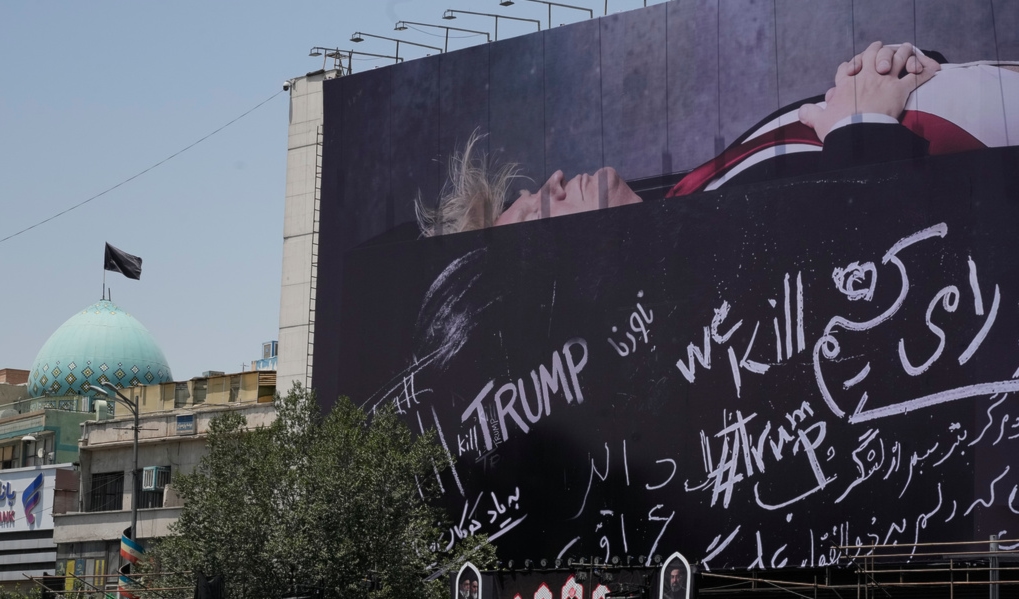
A billboard depicting US President Donald Trump lying on a coffin and bearing messages, including the phrase "We Kill Trump," is seen at Islamic Revolution Square in downtown Tehran, Iran, July 15, 2026. (AP)
Contrary to his claims and "intimidatory rhetoric", US President Donald Trump is seeking to revive negotiations with the Islamic Republic of Iran, a senior political and security source told Al Mayadeen on Friday.
According to the source, Trump and his "hawkish advisors" have realized that military escalation and shows of force against Iran "are ultimately destined to fail," particularly following the recent retaliatory strikes they have suffered and are currently scrambling to conceal.
Global energy markets have correctly interpreted Iran’s “signals on the ground” and military messages, the senior Iranian source told Al Mayadeen, pointing to the rise in oil prices to $110 per barrel and warning that prices could climb further.
Iran's capabilities forcing Trump's hand
Turning to Iran's military capabilities, the source said the country's heavy missile strikes against US bases across the region, together with the successful test of a new anti-ship missile, constitute continued strategic signals.
Moreover, the Islamic Revolution Guard Corps’ (IRGC) successful interception of an advanced US submarine, coupled with Iran’s decision not to close the Strait of Hormuz, sends an increasingly forceful message and will, “without a doubt,” exert further pressure on global oil prices, they said.
Against this backdrop, Tehran assesses that Trump is seeking to revive the negotiating track and raise the level of talks in an effort to bring oil prices down somewhat.
At the same time, the senior Iranian source stressed that, as Tehran has repeatedly made clear, negotiations will only be possible if the United States accepts Iran’s established and well-known conditions.
In a statement, the IRGC navy announced that its forces intercepted and destroyed an American unmanned surface vessel (USV) at the entrance to the strategic Strait of Hormuz.
— Al Mayadeen English (@MayadeenEnglish) September 10, 2026
According to the IRGC statement, the targeted vessel was an enemy "Saildrone" USV bearing hull number… pic.twitter.com/AaoV3PskEj
Series of losses push US to brink
Currently, senior US officials are reportedly preparing for the possibility that the war with Iran could last for years, despite President Donald Trump’s repeated claims that Tehran is nearing defeat.
According to The Wall Street Journal, Vice President JD Vance, Secretary of State Marco Rubio, and other senior officials have privately warned that Iran may be able to withstand Washington’s military pressure, naval blockade, and economic siege far longer than publicly acknowledged.
While Trump has said the war could end “immediately” after the November midterm elections, officials have discussed scenarios extending beyond January 2029, highlighting the widening gap between Washington’s victory rhetoric and its internal assessments.
The prospect of a prolonged confrontation also carries mounting risks for global energy markets. Analysts at Bank of America, cited by the Associated Press, warned that oil prices could climb to between $95 and $120 per barrel if attacks and restrictions on shipping through the Strait of Hormuz continue.
Damage to critical energy infrastructure could push prices as high as $150 per barrel, adding another layer of economic pressure on Washington as the conflict disrupts one of the world’s most strategically important energy corridors.
At the military level, US efforts to deter Iran have so far failed to halt Iranian operations against American forces, according to Bloomberg. Washington has attacked Iranian oil tankers in retaliation for missile operations targeting US naval assets, with US Central Command claiming that eight tankers were destroyed in recent days.
Yet the strikes have not stopped Iran from continuing to threaten significantly more expensive American military assets, while the US is being forced to expend large quantities of increasingly scarce air-defense interceptors.
Read more: US economic pressure miscalculation: Iran Central Bank governor


