
Trump advisors warn war on Iran could extend beyond presidency: WSJ
 7 Min Read
Senior Trump administration officials have privately warned that the US war on Iran could continue beyond 2029, despite Trump’s public claims that Tehran is nearing defeat.
-
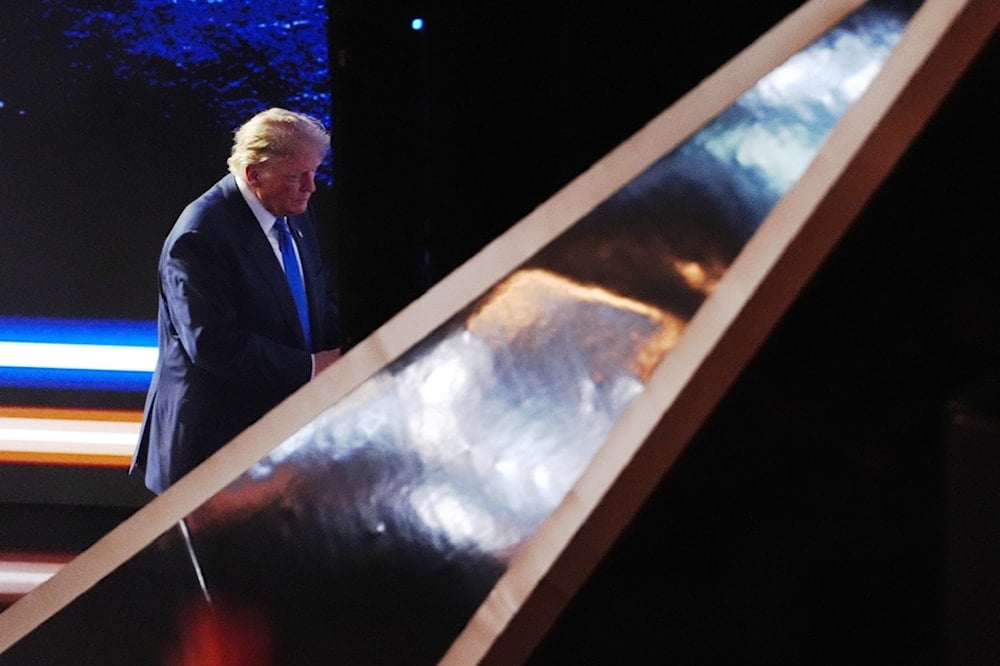
US President Donald Trump walks after speaking at the Republican convention, Wednesday, Sept. 9, 2026, in Dallas (AP)
Senior officials in US President Donald Trump’s administration have privately acknowledged that Washington’s war on Iran could continue for years and potentially extend beyond Trump’s current term, despite repeated public claims that Tehran is nearing defeat, The Wall Street Journal reported.
According to US officials cited by the newspaper, Vice President JD Vance, Secretary of State Marco Rubio, and other senior figures have warned Trump that Iran may be capable of withstanding Washington’s military pressure, naval blockade, and economic siege for far longer than the White House has publicly suggested.
The discussions expose a widening gap between the administration’s rhetoric of an approaching victory and its preparations for an open-ended confrontation with Iran.
Trump told reporters Wednesday that the war would end “immediately” after the November midterm elections “because they can’t hold out any longer.”
Behind closed doors, however, senior officials have reportedly discussed scenarios in which the confrontation continues beyond January 2029, when Trump is scheduled to leave office.
Washington prepares for yearslong confrontation
The assessment comes as the Pentagon increasingly organizes its military presence in West Asia around a prolonged conflict rather than an imminent end to hostilities.
Secretary of War Pete Hegseth has extended some US military deployments in the region into 2027, while several air-defense units could remain deployed indefinitely, according to people familiar with Pentagon planning.
Around 50,000 US troops are currently stationed across West Asia, backed by air-defense batteries, fighter aircraft, naval forces, and Marine units.
US forces rotate rather than withdraw
Rather than withdrawing those forces, Washington is continuing a system of rotations intended to preserve its military presence.
A third Marine Expeditionary Unit is preparing to deploy to the region later this year, following the arrival of the 31st Marine Expeditionary Unit in March and its replacement by the 11th Marine Expeditionary Unit in June.
The US Air Force is likewise rotating fighter squadrons, with Air National Guard F-16s replacing aircraft returning to Aviano Air Base in Italy.
The moves suggest that Washington is preparing its forces for a sustained military campaign even as Trump publicly insists that Iran will soon be forced to concede.
Economic siege fails to produce quick victory
The Trump administration has increasingly relied on a combination of naval blockade, sanctions, and military strikes in an effort to force Tehran into accepting US demands regarding its nuclear program.
Treasury Secretary Scott Bessent has promoted the strategy, dubbed “Operation Economic Outcast,” as an alternative to maintaining continuous large-scale combat operations.
Trump has privately expressed a preference for bringing the conflict to a rapid conclusion, according to the WSJ, but he has simultaneously backed a prolonged economic siege aimed at weakening Iran and restricting its ability to export energy and conduct maritime trade.
White House spokeswoman Olivia Wales claimed, “President Trump has destroyed Iran’s military capabilities and is crippling what’s left of its abysmal economy with the most powerful naval blockade in world history and crushing sanctions.”
“Only President Trump knows what he will do and when,” she added.
However, the private warnings reportedly delivered to Trump by his own advisors indicate that Washington does not expect those measures to necessarily force an Iranian capitulation in the near term.
Vance refuses to set end date
Vice President JD Vance last week also declined to offer a timeline for ending US military operations, while simultaneously refusing to describe the confrontation as a war.
“It would be irresponsible for us to write out our strategy and our timeline for an Iranian nation that simply cannot honor its commitments and cannot stop shooting at commercial ships,” Vance told reporters.
He said Washington would not provide an “artificial timeline” that Iran could exploit.
Iranian retaliation complicates US blockade
Tehran has continued responding to the US aggression and blockade, including through operations targeting US military assets and vessels amid escalating confrontations around the Strait of Hormuz.
The continuing exchanges underscore Washington’s difficulty in imposing its blockade without facing Iranian retaliation across one of the world’s most important energy corridors.
Prolonged war carries growing costs for Washington
A confrontation stretching into 2028 or 2029 would also deepen the military and economic burden facing the United States.
Keeping tens of thousands of troops, fighter aircraft, missile-defense systems, and naval assets deployed across West Asia would constrain Washington’s ability to redirect military resources toward other theatres, particularly Asia and Europe.
US officials are also reportedly concerned that Iran could use a prolonged conflict to adapt its military tactics and replenish stocks of missiles, drones, radar systems, and other equipment.
Economic fallout looms over 2028 election
The economic repercussions are already becoming increasingly visible.
US gasoline prices averaged $4.22 per gallon on Wednesday, according to AAA, compared with $4.01 a month earlier and $3.19 one year ago.
Further disruption around the Strait of Hormuz and Gulf energy infrastructure could sustain pressure on global oil markets and the US economy through the 2028 presidential election.
The political implications are particularly significant for Vance and Rubio, both of whom are considered potential Republican presidential candidates.
Analysts cast doubt on US blockade strategy
Experts cited by the WSJ also questioned Washington’s assumption that prolonged economic and military pressure could ultimately force Iran to submit to US demands.
“The U.S. naval blockade is unlikely to produce a decisive outcome in the near or even medium term, so the only realistic use of this tool would have to be predicated on plans for a long-term siege,” said Suzanne Maloney, vice president for foreign policy at the Brookings Institution.
“Even then its prospects for success are dubious, mainly because of the unintended consequences,” she added, citing the possibility of Iranian attacks on energy and economic infrastructure across Gulf states.
Ali Vaez of the International Crisis Group similarly argued that neither side has yet reached a point at which the costs of confrontation are sufficient to compel it to accept the other’s conditions.
“Washington can keep grinding Iran down at a manageable cost, while Tehran can shift much of the pain onto its population and still protect the institutions essential to regime survival,” Vaez said. “Everyone pays, but neither leadership is yet paying enough to accept the other side’s terms.”
Washington braces for protracted war of attrition
The assessments reported by the WSJ point to a growing recognition inside Washington that the campaign against Iran has failed to secure the rapid outcome repeatedly suggested by Trump.
Instead, US military planning increasingly appears oriented toward a protracted war of attrition, combining a naval blockade, economic sanctions, sustained troop deployments, and periodic military attacks, with no clear end to the confrontation in sight.
Read more: Iran strikes on NSA Bahrain expose US Gulf vulnerabilities: Opinion


