
US refineries run at nearly full capacity as global oil supply falters
 4 Min Read
US oil refineries are operating near full capacity as the US war on Iran and Ukraine disrupt fuel supplies and deplete US reserves.
-
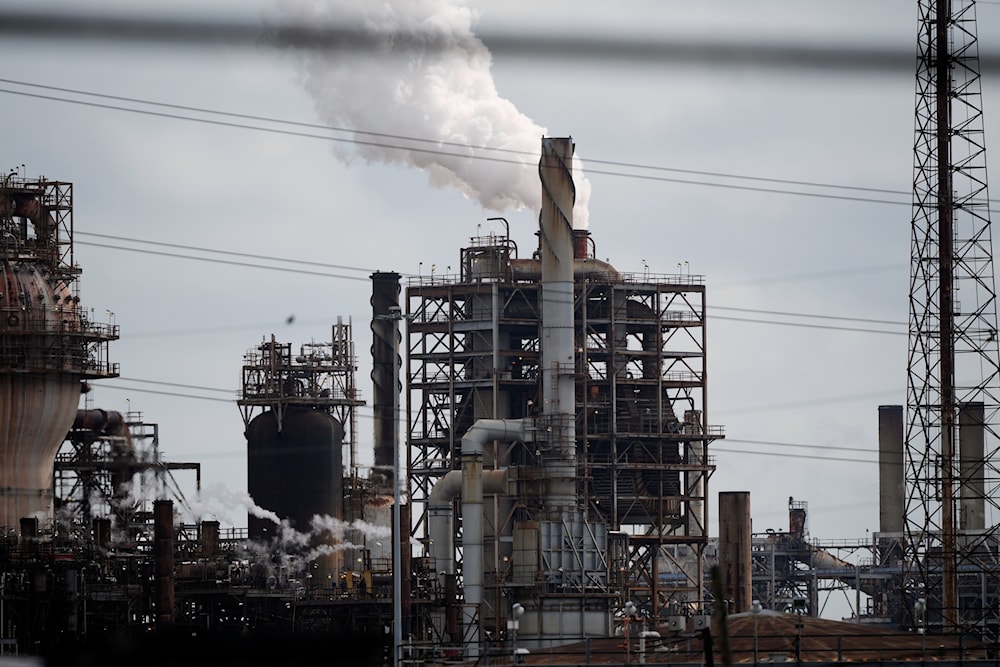
The Shell Norco petroleum refinery and the Valero St. Charles oil refinery are seen in Norco, La., Thursday, April 2, 2026 (AP)
US oil refineries are operating at nearly full capacity as ongoing wars in the Middle East and Ukraine disrupt global fuel supplies, raising the risk of shortages and outages at a time when energy prices are already climbing sharply.
Refineries across the United States are running at 96 percent of their capacity, with facilities in the Midwest and Rocky Mountains regions operating at 100 percent, according to the US Energy Information Administration.
US energy companies have stepped up exports of petroleum products, including diesel and jet fuel, to record levels following Iran’s closure of the Strait of Hormuz, through which approximately one-fifth of global oil supplies passed before the Middle East conflict began in February.
Global wars causing dwindling supplies
While transits through the waterway had increased briefly following a ceasefire between the US and Iran last month, renewed war launched by the US has again frozen the strait. Ansar Allah have also threatened a Red Sea route that Saudi Arabia is using to transport most of its crude to market.
Ukrainian drone strikes on Russia’s infrastructure have simultaneously reduced the country’s refining capacity, while Moscow this month banned diesel exports.
In a sign of the tightening market, US wholesale diesel futures have jumped 26 percent so far this month. The rush for oil products has pushed the average per-barrel margin US refiners receive for converting crude into gasoline and diesel to the highest level on record.
High refinery utilization has helped maintain market supplies and boosted groups such as Valero and Marathon Petroleum, whose stocks have almost doubled since the start of the year. However, it has also left the world’s largest oil consumer with little margin for error, analysts said.
An outage, whether caused by a breakdown or a natural disaster such as a hurricane, would affect consumers worldwide who are already dealing with high energy costs, analysts warned.
Dwindling reserves leave US vulnerable to further shocks
The high refinery runs are occurring alongside a sharp drawdown in US strategic reserves. Washington has released about 77 percent of the 172 million barrels from the country’s Strategic Petroleum Reserve that it pledged in March to use as a cushion for the supply shock resulting from the closure of the Strait of Hormuz and to keep prices low, according to official figures.
The SPR, which is stored in underground salt caverns in Texas and Louisiana, has fallen to 311 million barrels, its lowest level since 1983. Its operational minimum, below which further withdrawals risk damaging infrastructure and disrupting pipeline operations, is estimated at 180 million to 200 million barrels, according to industry analysts.
Meanwhile, inventories at the United States' largest commercial storage complex in Cushing, Oklahoma, have hovered at around 20 million barrels since the end of June, a level near its operational minimum.
Drained supplies mean Washington is increasingly vulnerable to future supply shocks in the absence of a substantial buffer provided by the releases from the SPR, setting the stage for crude prices to increase significantly when the reserve hits its operational minimum, analysts said.
“The US export increase is helping but it’s a band-aid on a big gunshot wound,” said Joe DeLaura, senior energy strategist at Rabobank. “We’re trying to make up this deficit by running all out, but that means the second refineries go down that’s really bad.”
“Commercial stocks are at tank bottom, US SPR stocks are potentially going to approach tank bottom, where is the flexibility to react to additional escalations?” said Sean Vale, an energy market analyst at Rystad Energy.


