
Japan releases oil reserves, rules out warship deployment to Hormuz
 4 Min Read
Tokyo is opting for economic rather than military tools to navigate the Hormuz crisis.
-
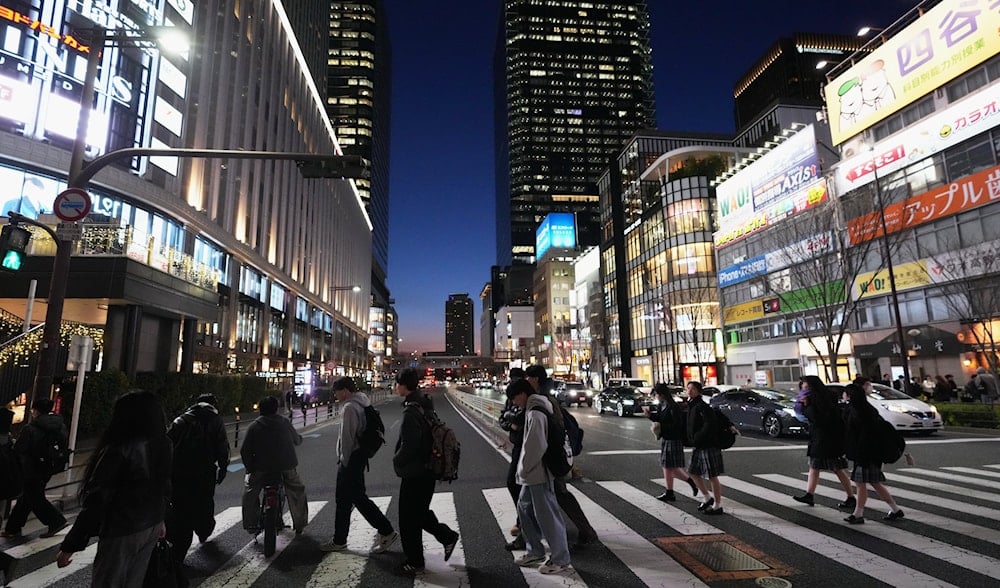
People walk across an intersection near the Osaka station in Osaka, western Japan, Thursday, March 12, 2026. (AP Photo/Hiro Komae)
Japan has commenced the drawdown of its strategic petroleum reserves, the government confirmed Monday, as the International Energy Agency (IEA) rolls out its largest coordinated emergency oil release in history, in response to supply disruptions stemming from the war on Iran.
A notice published in Japan's official government gazette declared that domestic oil reserve levels "are being lowered," a legally binding directive that compels reserve managers to begin releasing stocks. Japanese media widely interpreted the notice as confirmation that the release was already underway.
Government spokesperson Minoru Kihara confirmed Monday that Japan would initially release 15 days' worth of private-sector petroleum reserves, with Economy Minister Ryosei Akazawa noting that private stocks would be drawn down before government stockpiles are tapped.
Prime Minister Sanae Takaichi had previously indicated that the government intended to release approximately one month's worth of national reserves, with the overall unilateral drawdown amounting to around 80 million barrels, equivalent to roughly 45 days of supply.
Japan held approximately 470 million barrels in combined strategic and mandated reserves as of late December 2025, enough to cover 254 days of domestic consumption, split across state holdings (around 146 days), private-sector stocks (101 days), and joint producer reserves (7 days).
No warships, despite Trump pressure
Tokyo is opting for economic rather than military tools to navigate the Hormuz crisis, at least for now. Defense Minister Shinjiro Koizumi told parliament Monday that Japan was not currently weighing a maritime security operation, even as US President Donald Trump urged allied nations, Japan among them, to send warships to escort commercial ships through Hormuz.
Prime Minister Takaichi said she had yet to receive a formal request from Washington. "The question is what Japan should do on our own initiative and what's possible within our legal framework," she told parliament, adding that relevant ministries had been asked to examine the issue. Deploying forces would be "extremely difficult legally," she said.
The hesitation reflects deep-rooted political sensitivities in a country constitutionally committed to pacifism. Dispatching the Self-Defense Forces abroad remains contentious among Japanese voters, many of whom regard the US-drafted, war-renouncing 1947 constitution as inviolable.
Takayuki Kobayashi, policy chief of the ruling Liberal Democratic Party, said Sunday the bar for sending warships was "extremely high."
Why Japan is exposed
The scale of Japan's response reflects its acute vulnerability to West Asia supply shocks. The country holds proven in-ground oil reserves of only around 44 million barrels, a negligible fraction of global totals, and is almost entirely import-dependent, sourcing between 90 and 95 percent of its crude oil from Gulf producers.
In January 2026, Japan imported approximately 2.8 million barrels per day of crude, with Saudi Arabia alone accounting for roughly 1.6 million bpd.
IEA's record coordinated release
On March 11, the IEA's 32 member states agreed to release a combined 400 million barrels from emergency reserves, dwarfing the two-tranche 2022 response to the Ukraine war, which totalled approximately 182.7 million barrels.
View this post on Instagram
The IEA said 271.7 million barrels of government-managed stocks would be released globally, with Asia-Pacific nations, including Japan, going first. Member countries in the Americas and Europe are expected to begin their releases from late March onward.
Early national pledges include 13.5 million barrels from the United Kingdom, 22.46 million from South Korea, and 14.5 million from France, with larger contributions expected from the United States and Japan.


