
QatarEnergy declares force majeure on LNG after missile strikes
 3 Min Read
After missile strikes damaged key facilities, QatarEnergy has declared force majeure, cutting export capacity and flagging risks over long-term supply disruptions.
-
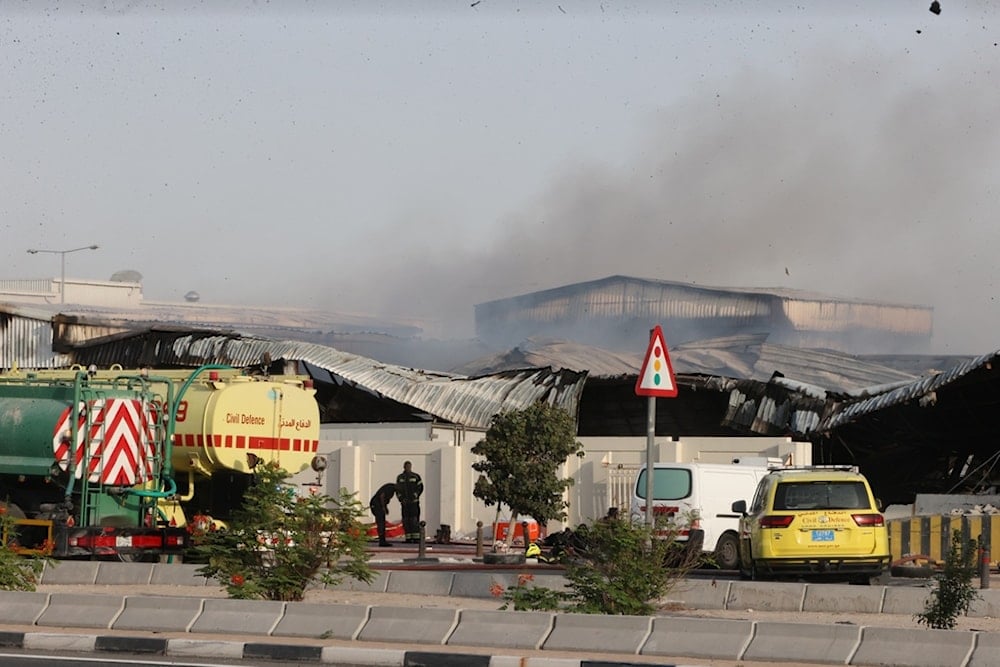
Firefighters work as smoke rises outside a damaged warehouse in an industrial area in Al Rayyan, Qatar, following an Iranian strike, Sunday, March 1, 2026 (AP)
QatarEnergy announced Tuesday that it has declared “force majeure” on some liquefied natural gas (LNG) supply contracts with four countries following strikes that damaged key infrastructure.
The measure applies to contracts with China, Italy, Belgium, and South Korea, according to a company statement.
“Force majeure” is a legal clause in long-term energy contracts that allows suppliers to suspend obligations such as deliveries without penalties when extraordinary events beyond their control, such as attacks on infrastructure, occur.
Export capacity cut and long-term losses expected
QatarEnergy said missile strikes targeted its Ras Laffan industrial complex on March 18 and 19, causing significant damage to critical facilities.
The attacks impacted two LNG processing units, as well as a gas-to-liquids facility, prompting the company to assess the full extent of operational disruptions and the timeline required for repairs.
On March 19, Energy Minister and QatarEnergy CEO Saad al-Kaabi said the strikes reduced Qatar’s LNG export capacity by 17% and could result in an estimated $20 billion in annual revenue losses.
He warned that repairs could take up to five years, forcing the company to declare what he described as a “prolonged force majeure.”
The strikes allegedly damaged production lines known as trains 4 and 6, which together have a capacity of 12.8 million tons per year, equivalent to 17% of Qatar’s total LNG exports.
QatarEnergy had already notified customers of force majeure on March 4 after production was disrupted due to the war.
LNG supply crisis
Previously, reports indicated the global energy market is nearing a critical turning point as the flow of LNG shipments from the Gulf is expected to stop due to the blockade of the Strait of Hormuz. Carriers that left before the start of the US-Israeli war on Iran were expected to arrive within about 10 days, marking an abrupt halt in one of the world’s key energy supply routes. Qatar, which produces about one-fifth of global LNG, has already suspended exports, raising immediate concerns over supply shortages and market instability.
The fallout has already reverberated across global markets, with LNG prices in both Asia and Europe surging sharply.
Iran retaliation shakes helium, global tech supply chains
The Associated Press on Sunday reported that Iranian strikes on US-linked gas infrastructure in Qatar are now threatening to disrupt not only global energy markets but also key technology supply chains, due to the role Qatar plays in helium production.
The strikes come in direct response to the earlier targeting of Iran’s own energy sector, particularly the attack on the South Pars gas field, the country’s largest and most strategic source of natural gas. Iranian officials had warned that any attempt to hit its economic infrastructure would be met with reciprocal measures across the region, signaling a shift toward targeting energy assets tied to the broader war effort.
Read more: Gulf energy producers losing billions as war on Iran halts exports


