
Saudi Arabia crude supply falls to 6 million bpd in August: IEA
 3 Min Read
Saudi Arabia's crude supply fell to 6 million bpd in August, its lowest level in more than three decades, according to the IEA.
-
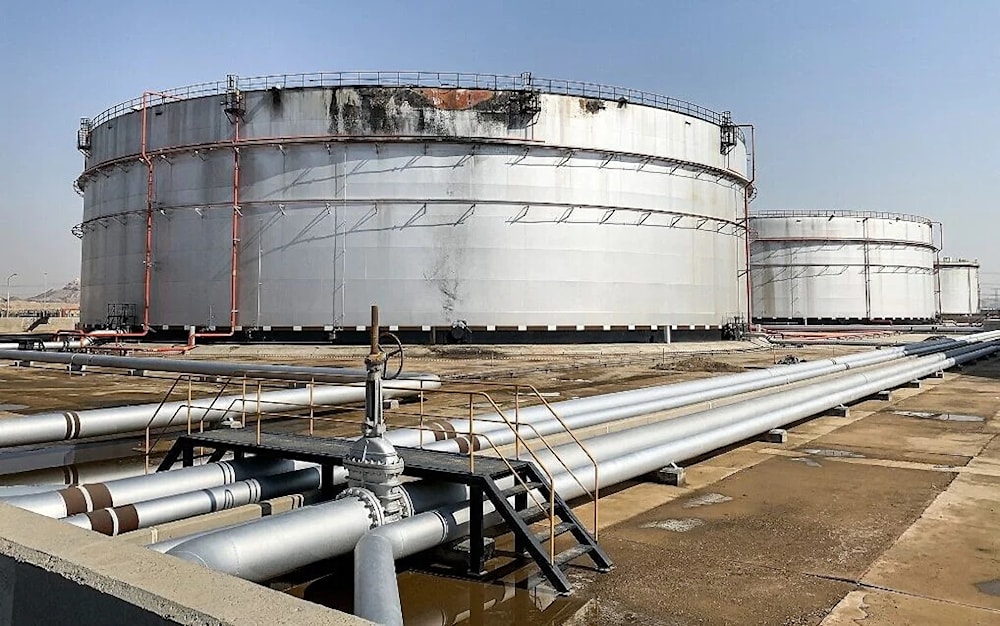
A damaged silo at the Saudi Aramco oil facility in Saudi Arabia's Red Sea city of Jeddah, November 24, 2020. (AFP)
Saudi Arabia's crude supply fell by 2.3 million barrels per day on the month to 6 million bpd in August, the lowest level in more than three decades, the International Energy Agency said on Friday, citing the retaliatory operations involving Saudi energy facilities.
The drop follows Yemen's Armed Forces targeting ships transiting the Bab el-Mandab, as part of its "Blockade for Blockade" equation, in addition to Saudi Arabia's Jazan refinery and shipping near Yanbu, the IEA said in a report, and Iraqi resistance forces striking the Abqaiq oil processing site.
The IEA's assessment of Saudi supply in August is lower than that of Saudi Arabia itself, which informed the Organization of the Petroleum Exporting Countries that it supplied 7.122 million bpd last month. Saudi Arabia also told OPEC it produced 6.238 million bpd in August, similar to the IEA's supply figure.
Supply is an oil industry term aimed at providing a clearer picture of how much oil is reaching the market, as it refers to the sum of a country's oil exports, including loadings from storage, plus domestic use in refineries and power plants.
The IEA in its monthly oil market report revised its forecast for Saudi Arabia's crude supply in 2026 down by 885,000 bpd to 7.6 million bpd, citing a delayed recovery for Middle East Gulf production.
Saudi crude loadings, including from the Red Sea and assessed so-called dark shipping transits, declined by 1.1 million bpd on the month to 3.5 million bpd, while inventories declined by 400,000 bpd, the IEA said.
YAF strikes energy sites in southern Saudi Arabia, Saudi Ministry confirms
The Yemeni Armed Forces launched a major drone operation on September 10 targeting sites in southwestern Saudi Arabia, with reported strikes and fires detected around Jazan, Abha, and Khamis Mushait.
According to data compiled by Egypt's Intel Observer, the operations appear to have affected several strategic facilities, including Aramco's Jazan oil refinery and the Jazan Bulk Plant, where multiple hotspots were detected. Another hotspot was also identified near King Abdullah Airport in Jazan.
Satellite data from NASA's Fire Information for Resource Management System (FIRMS) VIIRS also showed multiple heat signatures at Aramco's bulk plant in Abha, suggesting the facility was directly hit in a recent operation. Additional hotspots reportedly appeared around oil and gas storage facilities at the Asir Central Power Plant in Abha, which supplies baseload electricity to southern Saudi Arabia.
The Saudi Ministry of Energy announced that a number of energy facilities and infrastructure in the southern region of the Kingdom were targeted this morning. The ministry said the attacks caused fires to break out at several sites, resulting in the temporary suspension of some operations.
Meanwhile, the Yemeni Armed Forces announced early Tuesday that it is preparing a statement to "announce a large-scale military operation deep inside Saudi territory." The Yemeni Armed Forces also repelled an advance by Saudi-backed mercenaries toward the al-Labanat Mountains east of al-Jawf province, according to Mohammed al-Farrah, a member of Ansar Allah's political bureau.


