
Strait of Hormuz closure sends global stock markets into freefall
 3 Min Read
Trump has promised US Navy escorts for tankers, but investors aren't convinced.
-
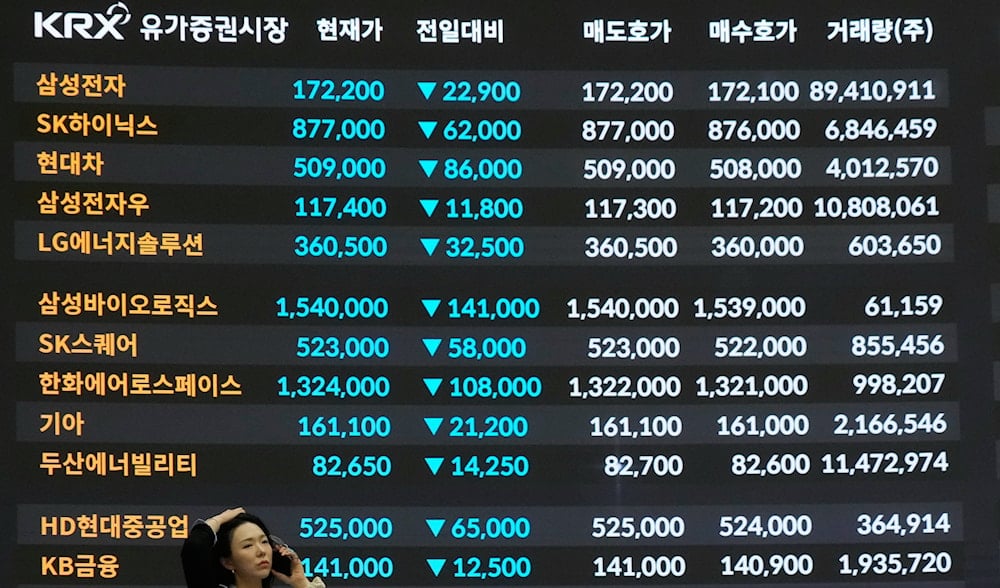
An employee talks on the phone in front of a screen showing stock prices at the Korea Exchange in Seoul, South Korea, Wednesday, March 4, 2026 (AP)
Global stock markets extended their sharp declines on Wednesday, as investors grew increasingly skeptical that US military deployments in the Gulf could prevent a prolonged disruption to global energy supplies.
The sell-off intensified despite assurances from Washington that it would protect commercial shipping through the Strait of Hormuz.
South Korea's Kospi benchmark index fell as much as 12%, its steepest single-day drop since the 2008 global financial crisis, prompting a brief trading halt. Japan's Nikkei 225 declined 3.9%, while China's CSI 300 shed 1.3% and India's Nifty 50 fell 2%.
In West Asia, the Dubai and Abu Dhabi exchanges reopened for the first time since US and Israeli strikes on Iran over the weekend, with the Dubai index falling 4.7% and Abu Dhabi's ADX dropping 3.5%. US futures pointed to further losses at the open on Wall Street.
The Strait of Hormuz
At the center of the crisis is the Strait of Hormuz, where roughly a fifth of the world's oil supplies and a significant share of seaborne liquefied natural gas pass through daily, making it one of the most strategically critical chokepoints on earth.
Since the US and "Israel" launched their aggression against Iran on Saturday, shipping through the Strait has largely ground to a halt. The UK Maritime Trade Operations reported incidents affecting vessels near the UAE and Oman on Tuesday.
Despite US Central Command chief Brad Cooper's claim Tuesday that there is "not a single Iranian ship underway in the Arabian Gulf, Strait of Hormuz, or Gulf of Oman," the statement has done little to restore confidence among shipping operators.
Iran had warned on Monday that the strait is officially closed, with Brigadier General Ebrahim Jabbari, Advisor to the Commander of the IRGC, warning that any ship attempting to pass through "will burn". He also vowed to block all oil exports from the region, warning that pipelines could be targeted and predicting prices would hit "$200 in the coming days."
Oil prices surge as Trump promises escort service
Oil prices continued to climb on Wednesday. Brent crude rose 1.4% to $82.53 per barrel, its highest level since January 2025, as traders priced in the prospect of a sustained supply disruption.
In an attempt to calm markets, Trump posted on Truth Social that the US Navy would begin escorting tankers through the strait "as soon as possible," and offered political risk insurance to vessels navigating the Gulf. The intervention appeared to do little to reassure investors, who remain uncertain about how quickly commercial traffic could safely resume.
Markets yet to process the shock
Goldman Sachs CEO David Solomon, speaking in Sydney on Wednesday, warned that markets are still in the early stages of digesting the crisis.
"I'm actually surprised that the market reaction has been more benign given the magnitude of this," he said, adding that it would take "a couple of weeks for markets to really digest the implications."
His remarks suggest the worst of the market turbulence may not yet have arrived.


