
Trump rolls back punitive India tariffs over Russia oil purchases
 4 Min Read
The US president rescinds 25% tariff on Indian imports after a new US-India trade agreement tied to India's cut in Russian oil imports.
-
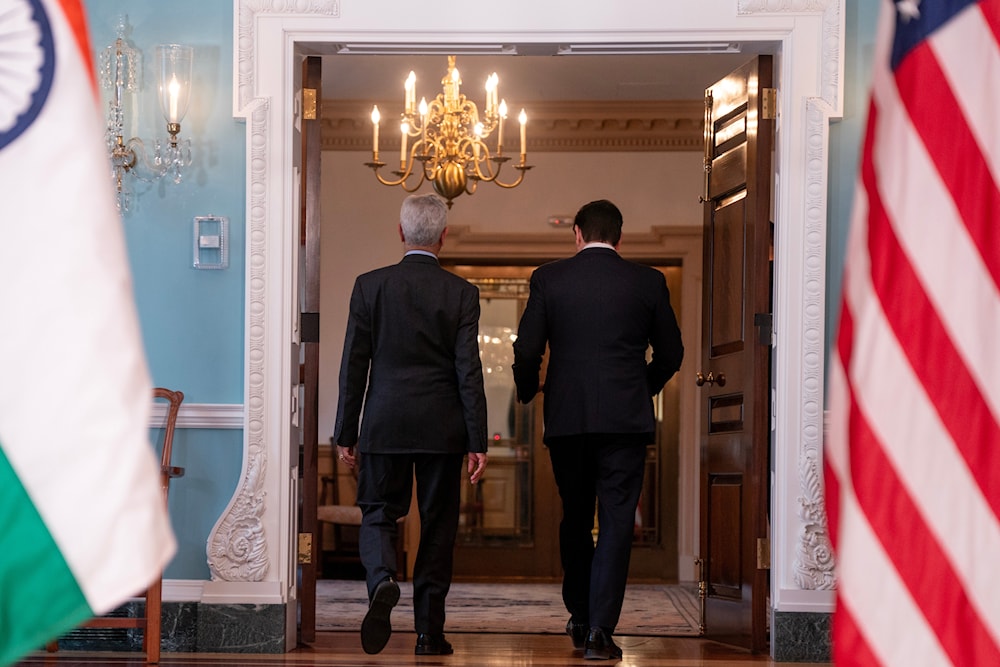
US Secretary of State Marco Rubio, right, and India's External Affairs Minister Subrahmanyam Jaishankar depart following a meeting at the State Department in Washington, Tuesday, Feb. 3, 2026 (AP)
US President Donald Trump signed an executive order on Friday rescinding a 25% duty on all imports from India, the White House announced. The tariffs were initially imposed due to India’s continued purchase of Russian oil.
The move follows a trade agreement announced by Trump on Monday, under which US tariffs on Indian goods were reduced to 18% from 50%. In return, India agreed to halt purchases of Russian oil and lower other trade barriers, according to Trump, marking a significant step in US-India economic relations.
India, which relies on imports for nearly 90% of its oil needs, had benefited from buying cheaper Russian oil after the war in Ukraine in 2022 and the subsequent Western sanctions on Russian energy. According to a Reuters report, India’s purchases of Russian crude have recently begun to decline, from around 1.2 million barrels per day in January to projected levels of 1 million bpd in February and 800,000 bpd in March.
The tariff rollback is expected to ease trade tensions between the two nations and strengthen economic ties, while supporting India’s energy transition amid fluctuating global oil prices.
Trump penalizes India for purchasing Russian oil
Trump imposed steep tariffs on Indian imports in 2025, citing New Delhi’s continued purchase of Russian oil as a threat to US economic interests and global pressure on Moscow. The punitive 25% duty, announced in press statements on August 12, 2025, was framed by Trump as a necessary step to “stand up for American workers” and counter what he described as unfair trade practices.
In speeches following the tariff announcement, Trump repeatedly linked India’s energy choices with broader geopolitical concerns, arguing that buying cheaper Russian crude undermined Western sanctions and “rewarded” Moscow for destabilizing actions. He often used strong rhetoric, emphasizing his commitment to leveraging US economic power to influence international behavior.
Trade officials in Washington echoed his language, saying the tariffs were both a penalty and a bargaining chip. Trump’s team maintained that the duties would remain until New Delhi significantly reduced or halted its Russian oil imports, portraying the policy as a test of alliance and partnership values.
Officials in New Delhi responded sharply to the tariff move. On August 6, 2025, the Ministry of External Affairs called the US action “unfair, unjustified, and unreasonable,” saying India’s oil imports were driven by market realities and the need to “ensure energy security for 1.4 billion” people rather than political posturing.
MEA spokesperson Randhir Jaiswal said it was “extremely unfortunate” that the US targeted India when other countries also traded with Russia and added that New Delhi would “take all actions necessary to protect its national interests.” Other Indian leaders highlighted what they described as double standards by Western nations, which continued to buy Russian energy while singling out India.
A consequential move
India’s decision to cut imports of Russian oil could have significant economic consequences, both domestically and globally. With Russian crude historically priced lower than Middle Eastern alternatives, reducing these imports may push India to purchase more expensive oil, raising costs for businesses and consumers.
India imports nearly 90 % of the oil it consumes, making its economy highly sensitive to changes in global energy flows, especially if it moves away from Russian crude. Discounted Russian oil once made up around 35–40 % of India’s crude imports, helping reduce the overall cost of energy for consumers and businesses.
According to CSIS estimates, discounted Russian barrels delivered annual savings of roughly $10 billion on India’s import bill in past years, easing pressure on inflation and helping keep fuel and transport costs lower.
Higher oil prices could feed into inflation, as transportation, manufacturing, and energy-intensive sectors face rising input costs. Analysts warn that India’s economic growth, which depends heavily on affordable energy, may slow if oil prices remain elevated.
Globally, decreased Russian oil exports to India may tighten energy markets, contributing to higher crude prices and influencing trading patterns. Countries that previously exported less expensive oil to India could see increased demand, while Russia may need to find alternative buyers to replace Indian purchases.


