
UAE economy hit as Dubai, Abu Dhabi airports shut amid regional war
 2 Min Read
UAE airports in Dubai and Abu Dhabi shut amid ongoing clashes in the region as a result of the US-Israeli war on Iran conflict, causing $5B+ in economic losses and disrupting aviation, trade, and tourism.
-
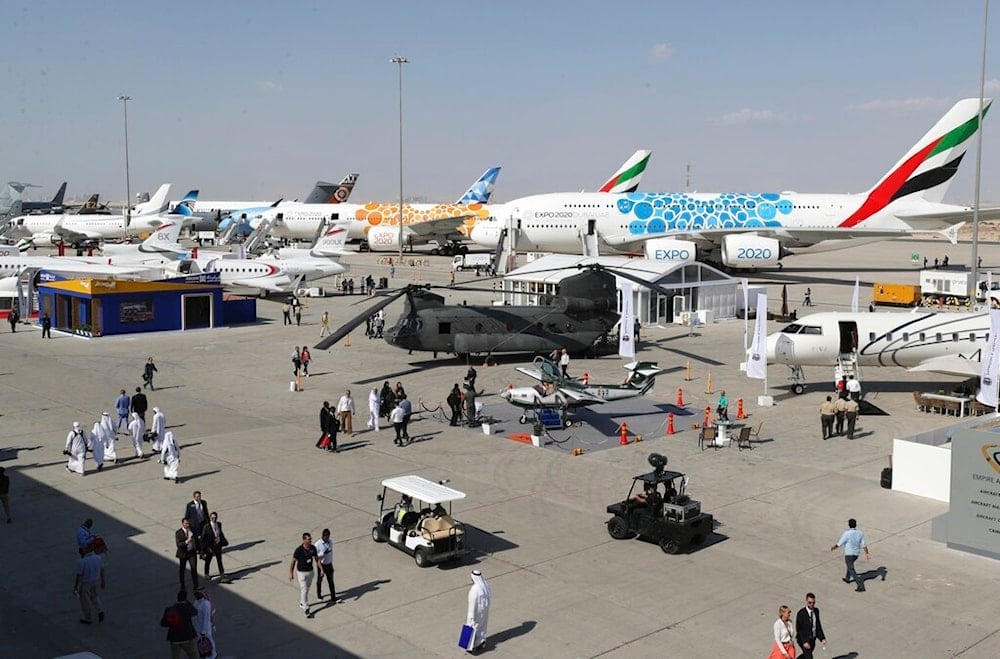
People visit planes during the opening day of the Dubai Airshow, in Dubai, United Arab Emirates, Sunday, November 17, 2019. (AP Photo/Kamran Jebreili)
The ongoing regional conflict as a result of the joint US-Israeli aggression on Iran has caused severe disruptions at the UAE’s major airports, leading to significant economic losses.
Dubai International Airport (DXB) and Al Maktoum International (DWC) experienced near-total shutdowns between February 28 and March 3, 2026, as the US and "Israel" launched violent strikes on Iran, sparking a regional war. The closures have caused a verified economic loss of approximately $1 million per minute, with total damages surpassing $5 billion, according to the Dubai Civil Aviation Authority.
The UAE’s aviation-dependent economy has been hit hardest. Dubai, where aviation contributes roughly 27% of GDP, faced cancellations of over 12,300 flights since February 28, leaving thousands of passengers stranded and disrupting trade and tourism. Abu Dhabi’s Al Maktoum International Airport and Zayed International Airport also suspended operations, affecting cargo and airline activity throughout the region.
Stock markets reacted sharply, with both the Dubai Financial Market (DFM) and Abu Dhabi Securities Exchange (ADX) recording significant declines in market capitalization due to the operational and economic disruptions.
Read more: First 100 hours of US war on Iran cost $3.7 billion: Analysis
UAE economic vulnerabilities amid regional war
Gulf economies are highly exposed to conflicts affecting regional airspace and trade routes. Airports such as DXB and DWC function as major hubs for international commerce and tourism, meaning that shutdowns have immediate and broad economic consequences.
Since the conflict between the joint US-Israeli coalition and Iran escalated on February 28, 2026, Gulf-based airlines and logistics companies have struggled with cancelled flights, rerouted cargo, and delayed shipments, further impacting trade-dependent sectors.
Financial markets in the UAE have historically reacted strongly to geopolitical instability, with investor sentiment closely tied to operational continuity at key transport hubs. Recent closures illustrate the interconnectedness of aviation, trade, and stock market performance in Gulf economies.
Analysts also note that regional wars can create ripple effects beyond immediate borders, influencing supply chains across the Middle East and exposing economic vulnerabilities in countries dependent on transit hubs like Dubai and Abu Dhabi.


