
UK keeps Venezuela's gold frozen despite earthquake catastrophe
 6 Min Read
Britain continues to withhold approximately 31 tonnes of Venezuelan gold despite the country’s devastating earthquake crisis and urgent reconstruction needs.
-
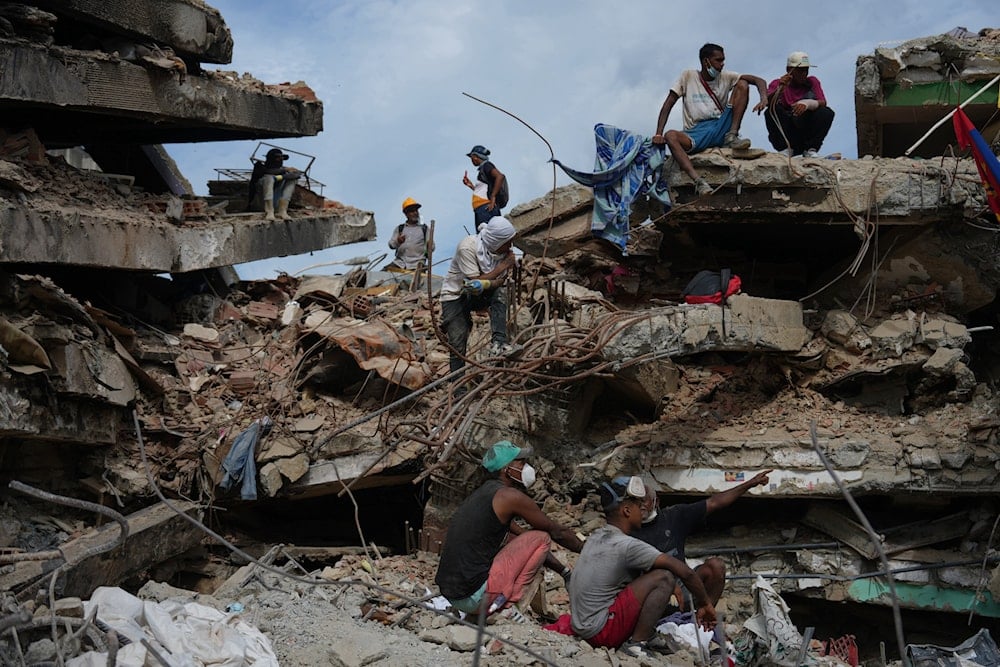
People stand on a collapsed building by the earthquakes in La Guaira, Venezuela, Thursday, July 23, 2026 (AP)
The United Kingdom continues to deny Venezuela access to approximately 31 tonnes of its own gold, worth around $4 billion, even as the South American nation struggles to recover from twin earthquakes that killed more than 5,000 people and caused tens of billions of dollars in damage.
According to an explainer published by CNN, the gold remains inaccessible because the British government continues to refuse to recognize the Venezuelan authorities requesting its release.
The bullion remains locked inside the Bank of England’s heavily guarded underground vaults, years after British authorities prevented Caracas from retrieving the reserves amid a politically driven dispute over which Venezuelan administration London was prepared to recognize.
The humanitarian catastrophe has failed to move British authorities toward releasing the Venezuelan property.
London places recognition policy above immediate survival, recovery needs
Instead, billions of dollars that could finance homes, hospitals, infrastructure, emergency assistance, and employment remain immobilized in London, while thousands of Venezuelans mourn their relatives or remain displaced by the June 24 disaster.
The Bank of England acknowledges that most of the more than 400,000 gold bars stored in its nine underground vaults do not belong to the bank. They are held on behalf of foreign governments, central banks, and financial institutions, with the owners retaining legal title to specific bars.
Yet Venezuela remains unable to access its reserves because of a British political and legal process that has placed London’s recognition policy above the immediate survival and recovery needs of the Venezuelan population.
Billions withheld as Venezuela counts the dead
The earthquakes, measuring magnitudes 7.2 and 7.5, struck northern Venezuela on June 24, devastating residential areas and infrastructure, including in and around Caracas.
An initial World Bank assessment estimated direct physical damage at $19.6 billion, with reconstruction and structural improvements potentially pushing the total recovery bill close to $50 billion.
Around 5,000 people were killed, approximately 17,000 injured and nearly 18,000 left homeless, according to government figures cited by the World Bank. Residential buildings accounted for 47% of the recorded damage, while infrastructure represented another 27%.
Against that scale of destruction, Britain is withholding Venezuelan gold worth several billion dollars—resources that belong to the affected country and could be mobilized without forcing Caracas to take on further external debt.
Venezuela appeals to the King
Acting President Delcy Rodríguez has appealed directly to Britain’s King Charles III, asking him to facilitate the release of the reserves for reconstruction.
“That gold belongs to our people and should be used to address the terrible, tragic consequences of this double earthquake,” Rodríguez said on state television this month. “Venezuela has the resources to recover, to get back on its feet,” she added.
Although the British monarch does not normally intervene in political or financial disputes, the appeal underscored the desperation of a government forced to plead for access to assets that already belong to the Venezuelan state.
Maduro removed, but British blockade remains
Britain’s original justification for blocking Caracas from accessing the bullion was tied to its refusal to recognize President Nicolás Maduro following Venezuela’s 2018 presidential election.
British courts were subsequently asked to decide which competing board of the Central Bank of Venezuela had authority over the reserves. The UK Supreme Court recorded that rival boards had issued conflicting instructions concerning Venezuelan assets held in Britain, including gold then valued at nearly $1 billion.
The political conditions surrounding that dispute have since changed dramatically.
Maduro was kidnapped by US forces in January and transferred to New York, where he remains in custody. Rodríguez, previously his deputy, assumed the role of acting president and began re-establishing relations with Washington, opening parts of Venezuela’s oil sector to US investment and aligning Caracas more closely with US regional initiatives.
Nevertheless, Britain has continued withholding recognition from the Venezuelan authorities and has made no public commitment to return the gold.
No recognition even after Maduro
Days after Maduro’s abduction, then-British Foreign Secretary Yvette Cooper told Parliament that London still did not recognize the legitimacy of the Venezuelan government.
“The Bank of England must make decisions independently, but our principles focus on maintaining and promoting stability and the transition to democracy,” Cooper said when questioned about the reserves.
The claim that the matter is solely an independent decision for the Bank of England obscures the central role of the British government. The long-running court dispute was shaped by London’s decision over which Venezuelan political representatives it recognized as having authority over the country’s central bank.
The result is a cruel contradiction: Britain claims to be promoting stability while depriving a disaster-stricken country of billions of dollars that could be used to stabilize communities, rebuild destroyed neighborhoods, and support survivors.
British lawmakers demand release
The continued seizure has also drawn opposition inside Britain.
A parliamentary motion tabled on June 29 called on the government to take urgent steps to facilitate the return of the Venezuelan reserves. The motion said the gold, valued at approximately £3 billion, remained inaccessible because of the dispute over which Venezuelan representatives Britain recognizes.
Lawmakers argued that, in the face of such an overwhelming catastrophe, all available resources should be directed toward humanitarian relief and reconstruction. The motion was signed by dozens of MPs, including Richard Burgon, Jeremy Corbyn, John McDonnell, Diane Abbott and Zarah Sultana.
The scale of the assets Britain continues to withhold also dwarfs its own humanitarian contribution. The British government provided a £2 million aid-match contribution to the Venezuela earthquake appeal, while approximately £3 billion in Venezuelan gold remained inaccessible in London.
IMF allows access, Britain just watches
Meanwhile, the International Monetary Fund recently allowed Venezuela to access $346 million from its own reserve resources to support urgent humanitarian and reconstruction needs.
IMF officials stressed that the money came from Venezuela’s paid-in reserve assets rather than a new loan. The release therefore demonstrated that international institutions can facilitate access to Venezuelan-owned resources when the political will exists.
Britain has so far chosen a different path.
As Venezuela attempts to bury its dead, house displaced families and reconstruct entire communities, the Bank of England’s vaults continue to hold billions of dollars in Venezuelan wealth beyond the country’s reach.
The gold remains protected beneath London, not from theft, but from the Venezuelan people who own it and urgently need it.
Read more: Venezuela earthquake death toll surpasses 4,000, government says


